A# 7-sharp-5 Guitar Chord
Chord Diagrams, Interactive Fretboard and Chord Theory
A# dominant 7th with sharp 5th guitar chord is also written as A#7(#5), A#7#5, A#7+5 or A#aug7.
Position 1
Barre
Movable
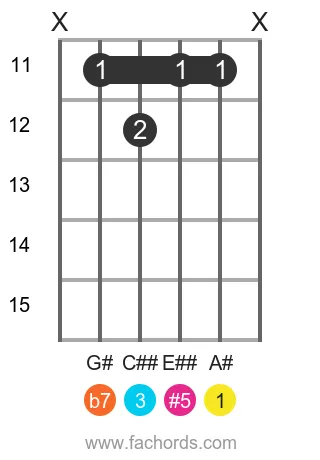
Position 2
Barre
Movable
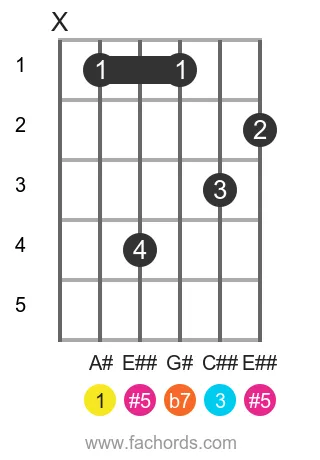
Position 3
Barre
Movable
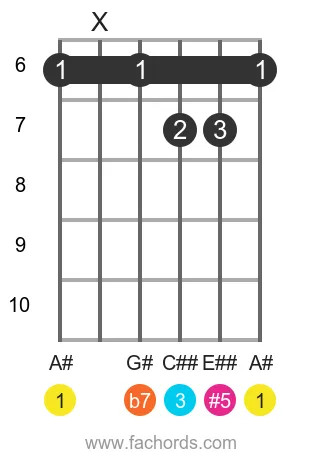
 Find more shapes in our all guitar chords online library. If you
prefer a printable pdf, download
the Free Guitar Chords Chart Pdf
Find more shapes in our all guitar chords online library. If you
prefer a printable pdf, download
the Free Guitar Chords Chart Pdf
You can also use this accessible A#7(#5) chord page, with written diagram instructions and screen-reader support for blind users.
Master the A# 7(#5) Guitar Chord with Interactive Practice
Want a structured chord roadmap instead of jumping between pages?
Go to the full guitar chords tutorial.
Constructed from the intervals Root (1), Major Third (3), Augmented Fifth (#5), and Minor Seventh (b7), the A# 7(#5) chord is a compelling member of the Augmented Chords family. Its unique sound arises from the notes A#, C##, E##, and G#, forming a potent dominant 7 chord with a raised fifth. To truly understand and internalize this distinct musical color, our interactive fretboard tool provides an unparalleled learning experience. Explore every possible fingering, hear the chord as a strum or arpeggio, and receive immediate verification of your accuracy through its real-time microphone detection feature.
The striking combination of a major third and minor seventh with an augmented fifth is what gives the A# 7(#5) its characteristic tension and distinctive, often unresolved, musical flavor. This 'altered dominant' is a staple for adding rich harmonic color in styles like jazz, blues, and neo-soul. To truly grasp its role and function, explore our guide on the Dominant Chord family, and deepen your theoretical knowledge with our Chord Construction tutorial. Many effective voicings for chords of this complexity utilize barre shapes, so refining your technique with our Guitar Bar Chords lesson is highly recommended. Once you're confident with the physical shapes, dedicate time to improving your chord changes for fluid musical expression.
Below this section, you'll find an extensive collection of over 20 detailed A# 7(#5) chord diagrams, progressing from fundamental open positions to versatile movable shapes. We'll also delve into the music theory specific to this chord, provide examples of popular songs featuring its unique sound, and outline the common keys in which it frequently appears. For truly disciplined practice, make it a habit to engage with the interactive tool above first. Utilize the drum and BPM tool to establish a solid rhythm, practice both strumming and arpeggiating the chord, and allow the instant acoustic analysis from the mic feedback to refine your technique before diving into rote memorization.
Notes of the A# 7(#5) chord:
Chord structure of the Dominant Seventh Sharp Fifth chord:
Play This Chord With Other Roots
C 7(#5) | D 7(#5) | E 7(#5) | F 7(#5) | G 7(#5) | A 7(#5) | B 7(#5) | C#7(#5) | D#7(#5) | F#7(#5) | G#7(#5) | A#7(#5) | Ab7(#5) | Bb7(#5) | Db7(#5) | Eb7(#5) | Gb7(#5)

Created by
Giancarlo is a musician (teaching guitar since 2000), software engineer, AI consultant and published researcher
FAQ
What is an A# 7(#5) chord?
The A# 7(#5) chord is a distinctive member of the Augmented Chords family. It's constructed from the notes A#, C##, E##, and G#, which correspond to the Root (1), Major Third (3), Augmented Fifth (#5), and Minor Seventh (b7) intervals, respectively. This chord is a dominant 7 chord with a raised fifth.
What are the specific notes that make up the A# 7(#5) chord?
The A# 7(#5) chord is composed of four specific notes: A# (the Root), C## (the Major Third), E## (the Augmented Fifth), and G# (the Minor Seventh). These notes together create its unique musical flavor.
Why is the A# 7(#5) chord classified as an 'Augmented Chord'?
The A# 7(#5) chord is classified as an 'Augmented Chord' primarily because of the presence of the Augmented Fifth (#5) interval. This specific raised fifth is a defining characteristic that gives augmented chords their distinct sound and places this chord within that family.
How do the intervals 1, 3, #5, and b7 define the A# 7(#5) chord?
These intervals are the building blocks that define the A# 7(#5) chord's structure from its root. '1' is the Root (A#), '3' is the Major Third (C##), '#5' is the Augmented Fifth (E##), and 'b7' denotes the Minor Seventh (G#). Understanding these specific interval relationships is key to mastering the chord.
What distinguishes an A# 7(#5) chord from a standard A#7 (dominant 7) chord?
The primary difference between an A# 7(#5) chord and a standard A#7 chord lies in the fifth interval. A standard A#7 chord would typically feature a perfect fifth, whereas the A# 7(#5) chord explicitly includes an *Augmented Fifth* (#5). This raised fifth gives the A# 7(#5) a more complex and distinct musical character.
Why are notes like C## and E## (double sharps) used in the A# 7(#5) chord's composition?
Double sharps like C## and E## are used to accurately maintain the theoretical interval names from the A# root. To correctly represent a Major Third above A# as '3' and an Augmented Fifth above A# as '#5', these specific enharmonic spellings are necessary. This ensures consistent chord construction logic based on intervals.
