Explore A# 13 Guitar Chord Shapes with Interactive Fretboard
Want a structured chord roadmap instead of jumping between pages?
Go to the full guitar chords tutorial.
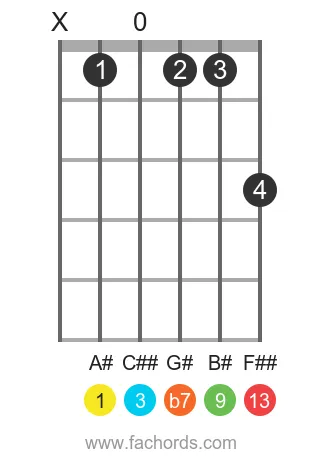
Discover the spatial logic of the A# 13 chord on the guitar fretboard. This rich and complex member of the Dominant Chords family is constructed from seven distinct notes – A#, C##, E#, G#, B#, D#, and F## – corresponding to the intervals Root (1), Major Third (3), Perfect Fifth (5), Minor Seventh (b7), Major Ninth (9), Perfect Eleventh (11), and Major Thirteenth (13). Visualize these unique voicings and their layout across the strings instantly using our interactive fretboard tool. It not only lets you see fingerings but also provides instant confirmation of your accuracy with its real-time microphone feature, verifying your played notes against the chord.
As an extended dominant chord, the A# 13 adds significant harmonic depth, frequently used in jazz, funk, and R&B to build tension and provide rich color. Understanding how this complex layering of intervals creates its unique sound is fundamental; delve into the theoretical framework of these chords with our comprehensive Chord Construction guide. To fully appreciate its 'dominant' function, explore our tutorial on the Dominant Chord family. Furthermore, if you're keen to trace the evolution from simpler 7th chords to more elaborate voicings like the 13th, our insights into Ninth Chords offer valuable context. Integrating these advanced shapes smoothly into your playing requires fluid transitions, and our tips to Improve Chords Change can be highly beneficial.
Below, you'll discover a curated selection of A# 13 chord diagrams, ranging from accessible open positions to more challenging barre shapes, alongside detailed music theory breakdowns, popular song examples, and the keys where this chord typically appears. Before you commit these shapes to memory, take advantage of the interactive tool above. Set your pace with the drum & BPM tool, try out different voicings, and let the mic feedback precisely guide your finger placement. This active, exploratory approach to understanding shapes is far more effective than rote memorization.
Notes of the A# 13 chord:
Tones in the Dominant Thirteen chord:
A#13 Guitar Chord Diagrams
Position 1
Open
Position 2
Barre
Movable
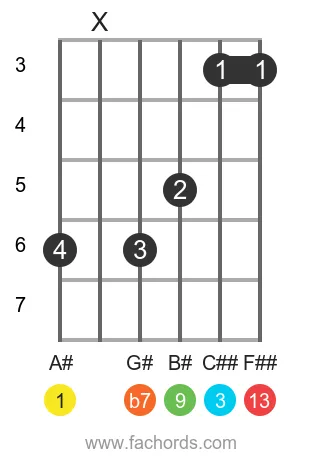
Position 3
Barre
Movable
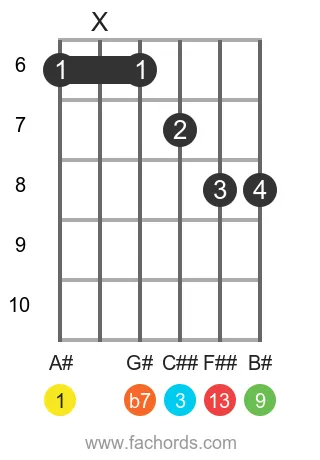
 Find more shapes in our all guitar chords online library. If you
prefer a printable pdf, download
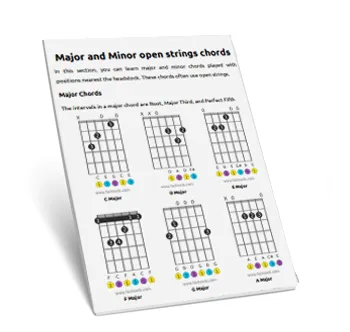
the Free Guitar Chords Chart Pdf
Find more shapes in our all guitar chords online library. If you
prefer a printable pdf, download
the Free Guitar Chords Chart Pdf
You can also use this accessible A#13 chord page, with written diagram instructions and screen-reader support for blind users.

Created by
Giancarlo is a musician (teaching guitar since 2000), software engineer, AI consultant and published researcher
FAQ
What defines the A# 13 chord as a member of the Dominant Chords family?
The A# 13 chord belongs to the Dominant Chords family because its fundamental structure includes a root, a major third, and a minor seventh (1, 3, b7). These specific intervals establish its dominant quality, upon which the higher extensions are built.
What are the specific notes that compose an A# 13 chord?
To form an A# 13 chord, you need to play or imply seven distinct notes. These are A# (root), C## (Major Third), E# (Perfect Fifth), G# (Minor Seventh), B# (Major Ninth), D# (Perfect Eleventh), and F## (Major Thirteenth).
How is the A# 13 chord constructed by stacking musical intervals?
The A# 13 chord is constructed by sequentially stacking specific intervals on top of its root, A#. This process involves adding a Major Third (3), a Perfect Fifth (5), a Minor Seventh (b7), a Major Ninth (9), a Perfect Eleventh (11), and finally a Major Thirteenth (13).
Why is the A# 13 chord considered a more advanced chord for guitarists?
This chord is considered advanced because it consists of seven distinct notes and incorporates several extended intervals (9, 11, and 13). Playing such a comprehensive and dense chord on the guitar often requires precise fingering and a good understanding of how to voice complex structures across the fretboard.
What does the number '13' signify in the name A# 13 chord?
In the context of chord naming, the number '13' signifies that the chord includes the Major Thirteenth interval. This implies that all preceding dominant chord intervals, the root (1), Major Third (3), Perfect Fifth (5), Minor Seventh (b7), Major Ninth (9), and Perfect Eleventh (11), are also present or implied in the chord's construction.