Ab9b5 Guitar Chord | Play, Hear and Practice Interactively
Want a structured chord roadmap instead of jumping between pages?
Go to the full guitar chords tutorial.
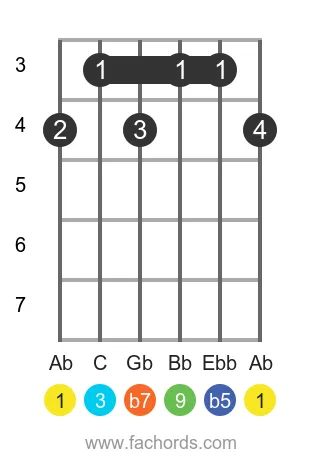
The Ab9b5 chord is a complex member of the Dominant Chords family, built from the notes Ab, C, Ebb, Gb, and Bb. These correspond to the intervals Root (1), Major Third (3), Diminished Fifth (b5), Minor Seventh (b7), and Major Ninth (9). Use the interactive fretboard tool at the top of this page to explore every fingering, listen to the chord played as a strum or arpeggio, and get instant feedback on your playing with the real-time microphone feature.
This advanced chord, with its distinctive flat fifth and major ninth, adds a unique tension and color to your playing. To fully grasp its construction and musical role, dive deeper into our tutorial about ninth (9) guitar chords and explore the broader family of Dominant Chord voicings. For a foundational understanding of how such complex chords are built, our guide on Chord Construction is invaluable. And remember, smooth transitions are key, so check out tips to Improve Chords Change.
Below, you'll discover a comprehensive collection of Ab9b5 chord diagrams, ranked from the simplest open positions to more advanced movable shapes, alongside detailed music theory, example songs where this chord shines, and the common keys it appears in. Before you scroll down, take a moment to engage with the interactive tool above. Use the built-in drum and BPM tool to practice your timing, listen closely to how the chord sounds, and let the mic feedback guide you to perfect your finger placement. This active learning approach is incredibly effective for mastering new chords.
Notes in the Ab 9b5 chord:
Tones in the Dominant Ninth Flat five chord:
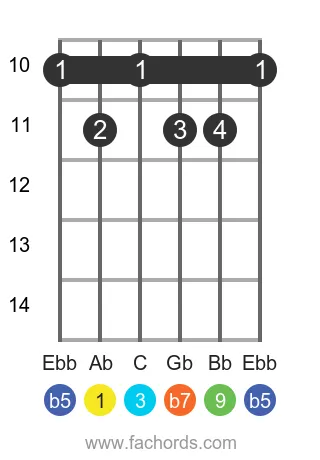
Guitar Patterns for the Ab Dominant Ninth Flat five chord
Position 1
Barre
Movable
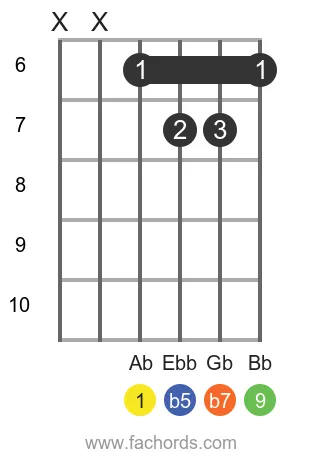
Position 2
Barre
Movable
Position 3
Barre
Movable
 Find more shapes in our all guitar chords online library. If you
prefer a printable pdf, download
the Free Guitar Chords Chart Pdf
Find more shapes in our all guitar chords online library. If you
prefer a printable pdf, download
the Free Guitar Chords Chart Pdf
You can also use this accessible Ab9b5 chord page, with written diagram instructions and screen-reader support for blind users.

Created by
Giancarlo is a musician (teaching guitar since 2000), software engineer, AI consultant and published researcher
FAQ
What notes make up the Ab 9b5 chord on guitar?
The Ab 9b5 chord is composed of the notes Ab, C, Ebb, Gb, and Bb. These notes correspond to the Root, Major Third, Diminished Fifth, Minor Seventh, and Major Ninth intervals respectively.
What are the intervals that define the Ab 9b5 chord?
The Ab 9b5 chord is constructed using the intervals 1 (Root), 3 (Major Third), b5 (Diminished Fifth), b7 (Minor Seventh), and 9 (Major Ninth). These specific intervals give the chord its unique sound and theoretical definition.
Is the Ab 9b5 chord considered a dominant chord?
Yes, the Ab 9b5 chord is a member of the Dominant Chords family. Dominant chords are characterized by the presence of a minor seventh interval (b7), which in this case is Gb relative to Ab.
Why is the Ab 9b5 chord described as a complex chord and not for beginners?
The Ab 9b5 chord is considered complex because it incorporates several altered intervals, specifically the diminished fifth (b5) and a major ninth (9), in addition to the root, major third, and minor seventh. Mastering it requires a solid understanding of chord building by stacking intervals and fretboard intervals, which goes beyond basic chord knowledge.
Why is Ebb listed as a note in the Ab 9b5 chord instead of D?
The note Ebb (E double flat) is used in the Ab 9b5 chord to maintain proper theoretical spelling. From the root Ab, an Ebb represents a diminished fifth. While D sounds enharmonically similar to Ebb, using Ebb correctly reflects the intervallic structure of the chord as a diminished fifth, ensuring each chord tone occupies its unique scale degree.
