How to Use Fretboard Tones Maps
Learn How to Build Chords and Chord Tones Soloing
Unlike other instruments, the guitar offers a strong visual approach: the fretboard is a grid on which you can draw patterns that bring different sounds to life.
In fact, guitarists often refer to shapes instead of chords or boxes instead of scales.
We can shift a pattern up or down the neck without even knowing the names of the notes we are playing, and it will still sound good.
This approach also works with bar chords.
This classic approach is certainly helpful and simplifies things, but it has some drawbacks.
If you rely only on scale boxes and fixed shapes, sooner or later you'll find yourself playing the same things repeatedly, trapped in those shapes, and eventually, you'll experience boredom.
In this tutorial, I want to introduce a tool that I've found very useful for breaking fixed patterns and gaining freedom on the instrument: fretboard tones maps.
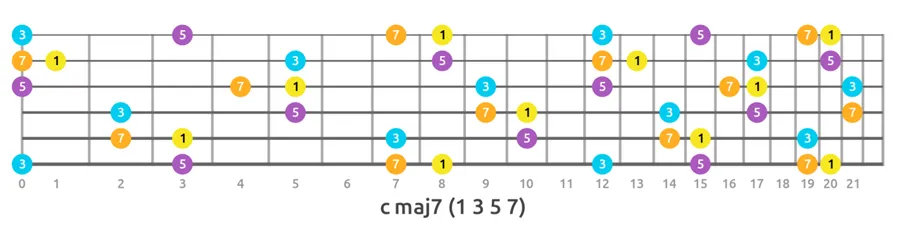
They are so helpful that I've included 44 of them (one for each chord type) in my complete ebook "Chords Domination".
What Are Fretboard Tones Maps?
The logic behind these fretboard maps is really simple.
We simply map all the tones of a chord across the entire fretboard.
Take, for example, the C major chord.
We know that a major chord is built by stacking the root (1), the third (3), and the fifth (5).
In the key of C, we have C, then we count 3 to reach E, and then we count 5 from C to get G: C, E, G.
Now, we map all the C, E, and G notes on the fretboard.
As mentioned earlier, on the guitar, we can shift patterns along the neck. So instead of showing specific note names, we show the interval names: 1, 3, and 5.
If we shift the diagrams to place the root (1) on the note C, we have a C major chord; if the root (1) is on D, we have a D major chord, and so forth:
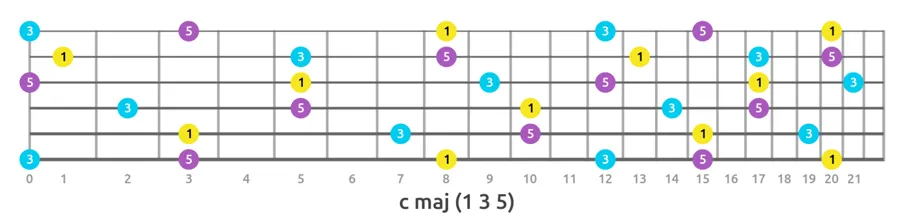
Yes, these are the CAGED shapes that many of you already know.
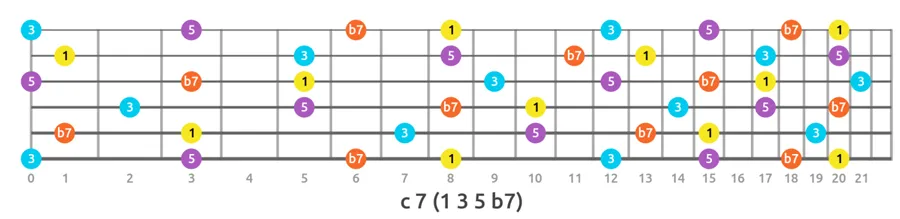
Now let's draw a fretboard map for a C dominant 7th chord.
A dominant chord is a major chord plus a minor seventh, which can be found by counting 7 from the root and then lowering it by one half-step.
In the key of C, if we count 7, we reach B, which becomes Bb when flattened by a half-step.
So, to create a C7 fretboard map, we map all the C, E, G, and Bb notes.
Again, we map the intervals, not the note names.
What if we wanted a C major 7th? Well, we count 7 from the root and reach our Major Seventh, B in the key of C:
Using Fretboard Tones Maps to Create Chords
With a fretboard map, we can clearly see where the tones of a chord are placed on the fretboard.
We can use these maps to create chords anywhere on the fretboard. All you need to know is the chord structure; for example, a major chord is 1, 3, 5, a minor chord is 1, b3, 5, and a dominant chord is 1, 3, 5, b7.
To create a chord, simply select the chord tones in the fretboard area where you want to play.
There are some guidelines to keep in mind:
- Usually, we place the root (1) at the bottom of the chord, so the root has the lowest pitch.
- However, you can place another tone as the lowest note; in this case, you're creating a chord inversion.
- Sometimes it's not possible to play all the tones in a chord (we have only 4 fingers and 6 strings), so we might have to leave out some tones.
Usually, the 5th is the first to go, as it doesn't add much harmonically.
You could even drop the root (1) if there's a bass player covering it.
The most important tones are 1, 3, and 7 because they contain the most harmonic content. Shell chords, often used in jazz, are based on these tones.
If you have a bass or keyboard player covering the root, you can omit it and focus on other tones.
Example: C Dominant 7th Chord Construction
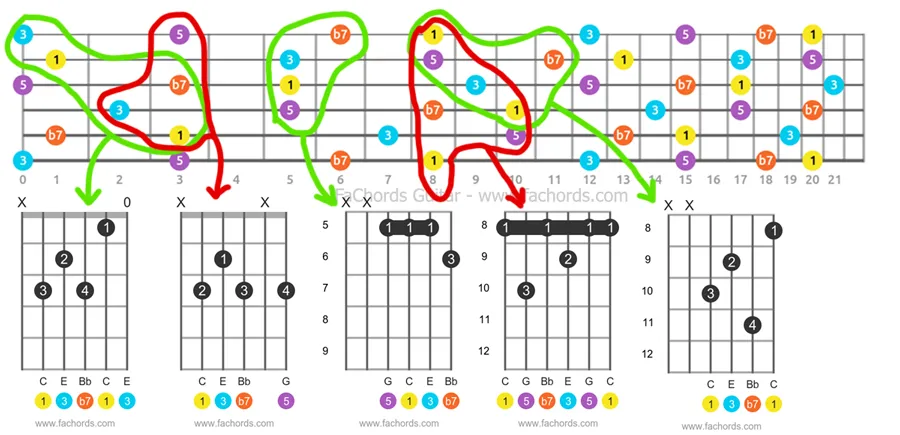
Below is a diagram showing how to create several C7 chord shapes across the entire fretboard.
The third chord fingering is a second inversion because it has the 5th as the lowest note.
The last chord shape omits the 5th but still sounds great, as explained earlier.
Fretboard Tones Maps as References for Guitar Solos
A well-known trick among great guitar soloists is the following: instead of mindlessly playing scales up and down, try to focus on the notes that belong to the chords in the backing track.
This technique is called chord tones soloing and is a hallmark of the best lead guitar players.
Fretboard tones maps are helpful for seeing where the good notes are!
Take a look at the video below and try to play a solo using only the chord tones shown in the video:
I-V-vi-IV Chord Progression (C G Am F in the key of C)
Where to Find Fretboard Maps
Complete Ebook: Chords Domination
I've created a comprehensive ebook that contains complete fretboard notes maps for the 44 most commonly used chord types.
You can get a free excerpt here.
Free Interactive Chord Progressions Generator
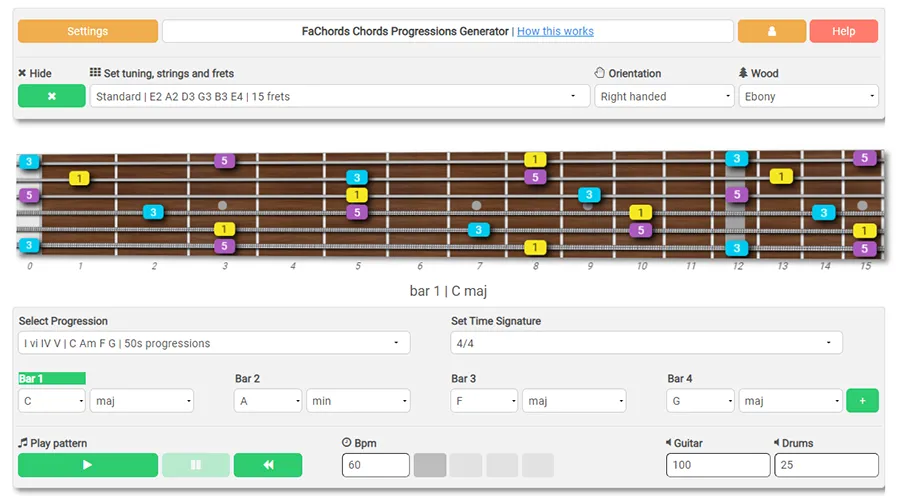
On this website, you'll also find a free web app that allows you to create chord progressions and see the tones of the chords on the fretboard, just like in the video above.
Give it a try with the FaChords Chord Progressions Generator now.
I hope the concept of fretboard tones maps has sparked your creativity and desire to experiment! To stay updated, subscribe here.
FAQ
What exactly are Fretboard Tones Maps and how do they differ from standard chord diagrams?
Fretboard Tones Maps are visual tools that display all possible occurrences of a chord's specific tones (represented as intervals like 1, 3, 5, b7) across the entire guitar fretboard. Unlike standard chord diagrams, which show just one specific shape or fingering, these maps reveal the complete harmonic landscape of a chord, helping you understand where each integral note is located everywhere on the neck.
Why do Fretboard Tones Maps use interval names (like 1, 3, 5) instead of specific note names (like C, E, G)?
Fretboard Tones Maps use interval names (e.g., Root (1), Third (3), Fifth (5)) because the guitar allows patterns to be shifted across the fretboard. By mapping intervals, one diagram can represent any chord of that type (e.g., a Major chord map can be used for C Major, D Major, G Major, etc., by simply placing the Root (1) on the desired note). This approach provides flexibility and promotes a deeper understanding of harmonic relationships, rather than memorizing fixed note positions.
How can I use Fretboard Tones Maps to create my own unique chord voicings?
To create unique chord voicings using Fretboard Tones Maps, first understand the chord's structure (e.g., a major chord is 1, 3, 5). Then, using the map, select the chord tones (1, 3, 5, etc.) in a specific area of the fretboard, arranging them to fit your fingers and achieve the desired sound. You can experiment with different inversions (placing a tone other than the root as the lowest note) and even omit certain tones to fit your playing context.
What is a chord inversion, and how do Fretboard Tones Maps help me understand them?
A chord inversion occurs when a note other than the root (1) is played as the lowest note in a chord voicing. For example, a C major chord with E (the third) as the lowest note is an inversion. Fretboard Tones Maps help you understand and create inversions by visually displaying all instances of each chord tone across the fretboard, making it easy to identify and select specific tones to place at the bottom of your chord shapes.
How can Fretboard Tones Maps help me improve my guitar soloing?
Fretboard Tones Maps can significantly improve your guitar soloing by guiding you to play notes that are harmonically relevant to the chords in a backing track. Instead of just playing scales mindlessly, these maps highlight all the 'good notes' (chord tones) for each chord. This approach, known as 'chord tones soloing,' helps you create more melodic, purposeful, and harmonically rich solos, characteristic of experienced lead guitarists.
