The E Major Scale
Understanding the E Major Guitar Scale: A Guide for Guitarists
The E Major scale is a fundamental component of guitar playing, offering a blend of melodic versatility and technical ease.
In this article, we'll explore the E Major scale in open position and other scale patterns.
We'll also learn about the chords within the key of E Major, its relative C# Minor Scale, and some popular guitar songs that utilize the E Major scale.
E Major Scale Patterns
The interactive tool below will help you see the E major scale shown on the fretboard:
E Major Scale in Open Position
The E Major scale in open position is particularly accessible for beginners.
It consists of the notes E, F#, G#, A, B, C#, and D#. To play this scale in open position, you begin with the open E string (the lowest string) and proceed through the scale, utilizing open strings and the first few frets.
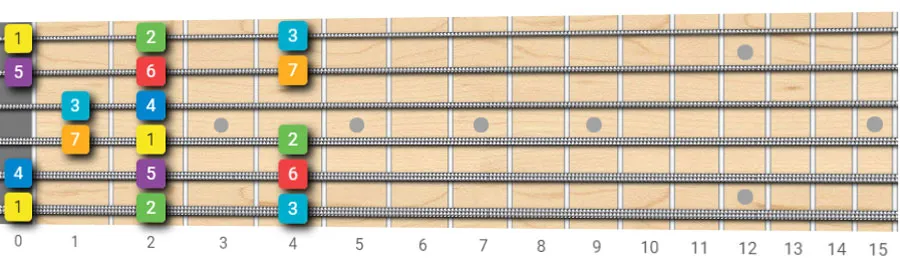
This scale is visually and physically intuitive, making it an excellent starting point for those new to the instrument.
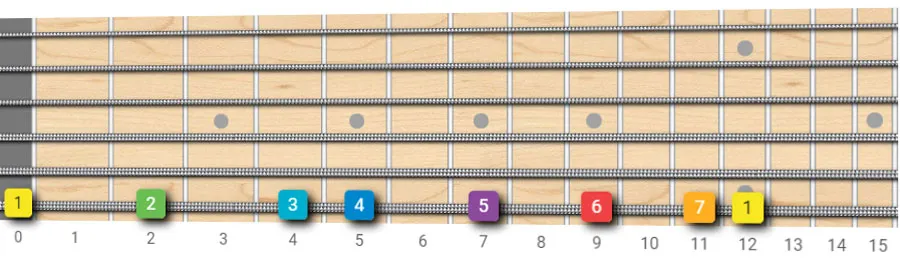
E Major Scale On One Single String
Playing a scale horizontally is really helpful in understanding its interval structure.
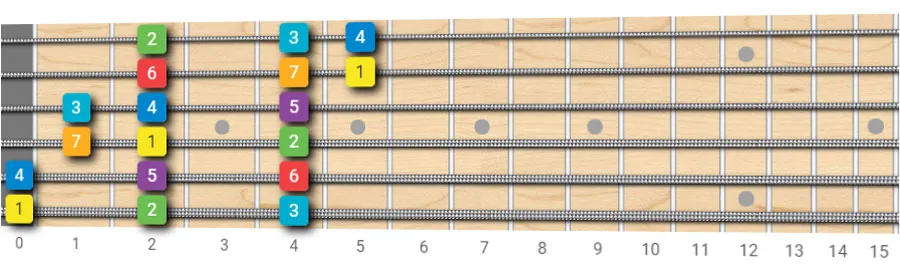
E Major Scale 3 Notes Per String
The 3-notes-per-string fingering is symmetrical (same number of notes on each string) and allows great speed and agility.
E Major Scale - Root On 5th String
It's good to be able to play a scale with root on a different string than the low E.
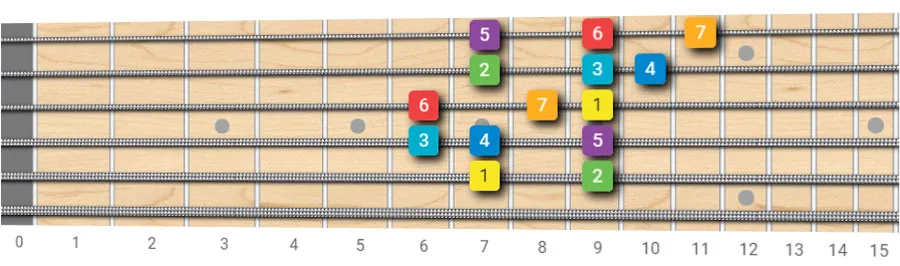
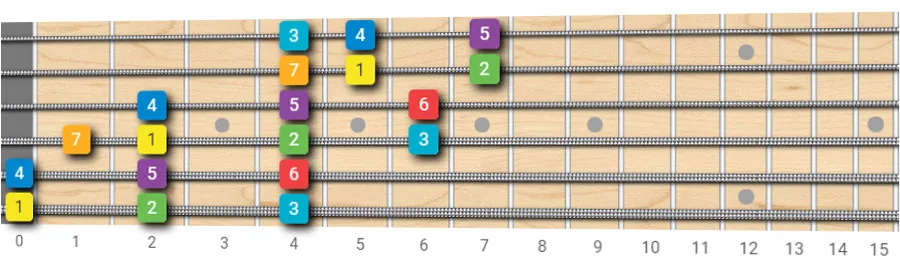
E Major Scale - Diagonal Pattern
This pattern uses the same shape applied on 2 different octaves.
Notes And Structure Of The E Major Scale
The E Major scale is composed of seven distinct notes, followed by the octave, which is a repetition of the first note at a higher pitch. Here are the notes in the E Major scale:
- E (Root)
- F# (Major second)
- G# (Major third)
- A (Perfect fourth)
- B (Perfect fifth)
- C# (Major sixth)
- D# (Major seventh)
- E (Octave)
Like any other major scale, its structure is W, W, H, W, W, W, H (W is a whole-step, or 2 frets and H is a half-step, or 1 frets).
Why E Major is Easy for Guitarists
One of the primary reasons the key of E Major is considered easy for guitar players is its ergonomic layout on the fretboard.
The open strings of a guitar naturally resonate with several notes in the E Major scale (E, A and B), allowing for a more resonant and fuller sound with less effort.
Additionally, the finger placement required for chords and scales in E Major is generally more comfortable and less strenuous, making it a preferred key for many guitarists.
Chords in the Key of E Major
The key of E Major consists of the following chords.
These chords are the building blocks for numerous songs and are crucial for understanding chord progressions and harmonies within the key of E Major.
3 Tones Chords
| E maj | F# min | G# min | A maj | B maj | C# min | D# dim |
|---|---|---|---|---|---|---|
| B (5) G# (3) E (1) |
C# (6) A (4) F# (2) |
D# (7) B (5) G# (3) |
E (1) C# (6) A (4) |
F# (2) D# (7) B (5) |
G# (3) E (1) C# (6) |
A (4) F# (2) D# (7) |
4 Tones Chords
| E maj7 | F# m7 | G# m7 | A maj7 | B 7 | C# m7 | D# m7/b5 |
|---|---|---|---|---|---|---|
| D# (7) B (5) G# (3) E (1) |
E (1) C# (6) A (4) F# (2) |
F# (2) D# (7) B (5) G# (3) |
G# (3) E (1) C# (6) A (4) |
A (4) F# (2) D# (7) B (5) |
B (5) G# (3) E (1) C# (6) |
C# (6) A (4) F# (2) D# (7) |
Relative C# Minor Scale
The relative minor scale to E Major is C# Minor.
This scale shares the same notes as E Major but starts from C#.
The C# Minor scale is comprised of C#, D#, E, F#, G#, A, and B.
Understanding the relationship between E Major and its relative minor, C# Minor, expands a guitarist's ability to improvise and compose in a more emotionally diverse musical landscape.
Guitar Songs Using the E Major Scale
Many iconic songs are written in the key of E Major, taking advantage of its rich, guitar-friendly sound.
Examples include:
- Green River by Creedence Clearwater Revival
- Under the Bridge by Red Hot Chili Peppers
- Don't Think Twice by Bob Dylan
These songs showcase the versatility and expressive potential of the E Major scale, from rock ballads to intricate fingerstyle compositions.
Conclusion
The E Major scale is a cornerstone of guitar music, offering a combination of ease, ergonomic comfort, and a wide range of expressive possibilities.
Whether you're a beginner learning your first scales or an experienced player composing your own music, the E Major scale provides a solid foundation for your musical exploration on the guitar.
To stay updated on new tutorials, subscribe here.
FAQ
What are the specific notes that form the E Major scale?
The E Major scale is composed of seven distinct notes before repeating the octave: E, F#, G#, A, B, C#, and D#. This sequence follows the major scale formula, which is a pattern of whole-steps (two frets) and half-steps (one fret): W-W-H-W-W-W-H.
Why is the E Major scale often considered easy and comfortable for guitarists, especially beginners?
The E Major scale is ergonomic and beginner-friendly because of how its notes naturally align with the guitar's fretboard. Several open strings (E, A, and B) are part of the scale, which allows for a fuller, more resonant sound with less effort. Additionally, the required finger placement for both scales and chords in E Major is generally less strenuous, making it an excellent starting point for new players.
How does the E Major scale in open position differ from other E Major scale patterns presented in the tutorial?
The E Major scale in open position primarily utilizes the guitar's open E, A, and B strings in conjunction with notes in the first few frets, making it highly accessible and intuitive for beginners. Other patterns, such as the '3 Notes Per String' or 'Root On 5th String' fingerings, are designed for different purposes, like developing speed and agility across the fretboard or practicing the scale from various root positions on different strings.
What is the relationship between the E Major scale and the C# Minor scale?
The C# Minor scale is the relative minor of E Major. This means both scales share the exact same set of notes (C#, D#, E, F#, G#, A, B). The only difference is that the C# Minor scale begins and ends on C# instead of E. Understanding this relationship expands a guitarist's ability to improvise and compose with a wider range of musical emotions.
What are the primary chords derived from the E Major scale?
The main chords found within the key of E Major are E Major, F# minor, G# minor, A Major, B Major, C# minor, and D# diminished. These chords are built directly from the notes of the E Major scale and serve as the fundamental building blocks for chord progressions and harmonies in this key. The key also includes their respective 7th chords like E maj7, F# m7, etc.
Why are there different E Major scale patterns, such as 'One Single String' or 'Diagonal,' and how are they useful?
Each E Major scale pattern serves a specific purpose to enhance a guitarist's technique and understanding. The 'One Single String' pattern helps in visualizing and understanding the scale's interval structure horizontally. '3 Notes Per String' patterns are great for developing speed and fluidity due to their symmetrical nature. Patterns with the 'Root On 5th String' help in navigating the fretboard and playing the scale from different starting points, while 'Diagonal Patterns' allow you to cover two octaves using a consistent shape.