How To Play Melodic Lines with Dyads
Two Notes Chords that Add Harmony To Your Solos
In this tutorial, I want to share some ideas about dyads, two notes played together.
Unless chords, that are composed of three or more notes, dyads are small fragments that you can include in your lead phrasing to enrich it harmonically.
Another name, actually more common, for dyads is double stop; in this tutorial we'll use the term dyad, but feel free to swap it with "double stop".
Please have a look at the demonstration video below, and keep reading for more details.
How To Play Dyads
Let's have a look at the scale I used in the video, the F Mixolydian scale:
F G A Bb C D Eb F
If we harmonize this scale, by stacking third intervals on the top of each note (here you find a complete tutorial on how create chords from scales) we get the following chords:
| F maj | G min | A dim | Bb maj | C min | D min | Eb maj |
|---|---|---|---|---|---|---|
| C (5) A (3) F (1) |
D (6) Bb (4) G (2) |
Eb (b7) C (5) A (3) |
F (1) D (6) Bb (4) |
G (2) Eb (b7) C (5) |
A (3) F (1) D (6) |
Bb (4) G (2) Eb (b7) |
If we keep only the root and the third of these chords, dropping the fifths, we obtain "two notes chords", or dyads, composed of major or minor intervals.
Remember that a minor interval is 3 half-steps, or semitones, while a major interval is 4 half-steps (more about intervals here).
| F maj | G min | A min | Bb maj | C min | D min | Eb maj |
|---|---|---|---|---|---|---|
| A (3) F (1) |
Bb (4) G (2) |
C (5) A (3) |
D (6) Bb (4) |
Eb (b7) C (5) |
F (1) D (6) |
G (2) Eb (b7) |
Please notice that the A diminished chord, which is composed of root, minor third and diminished fifth, has been transformed in a A minor chord, because the diminished fifth, which is the unique characteristic of this chord type, is gone.
Play With Dyads - The Basic Idea
The idea is, instead of playing single notes, is to play the correspondent dyad.
So, for example, on the root, F, we play F and A, which is a major third and thus creates a major sound.
On C, we play also Eb, which is a minor third, so we have a minor chord, and so forth.
Riff 1
In the video above, the section Riff 1 shows you how to move up and down a scale by playing diads.
You'll notice that I play the scale horizontally, on one single string. The only difficulty is to switch major and minor dyads as needed.
Regarding the fingering, I use the index finger for playing the roots (the notes in the scale), the middle finger for major thirds, and the ring finger for minor thirds.
The Main Types of Dyads on Adjacent Strings
So far we talked about minor and major dyads, but we can also use fourth intervals, fifths intervals (the power chord!), even diminished fifths:
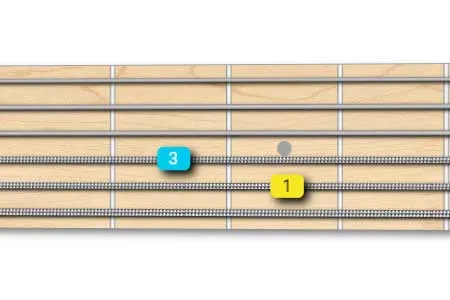
Major third dyad
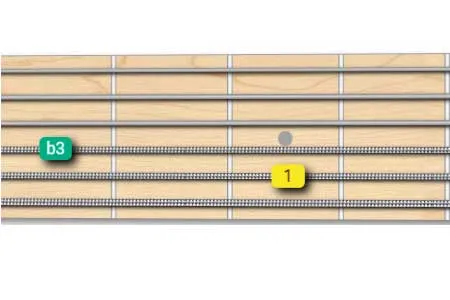
Minor third dyad
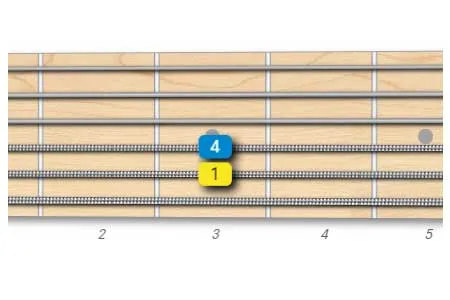
Perfect fourth dyad
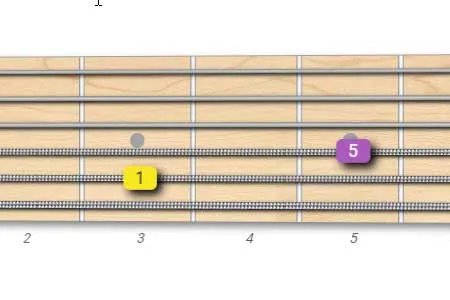
Perfect fifth dyad
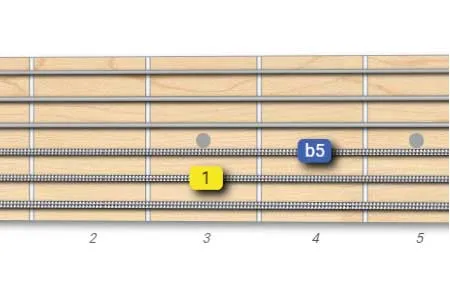
Diminished fifth dyad
Riff 2
"Riff 2" part of the demonstration video shows you how to use all these kinds of dyads to conceive something more interesting and dynamic. In particular, the use of the diminished fifth introduces tensions that resolve in a pleasant way on the major third.
Where To Go From Here
We have only scratched the surface of the options that dyads could introduce in your phrasing.
Here are some more suggestion for experimenting:
- If you have a bass player that plays the root, play dyads built with the third and the fifth
- Use shell chords as base structure for your dyads, and play root and seventh, or third and seventh
- Play dyads on non-adjacent strings: using wide intervals creates a very nice effects
That's all for today, if you want to stay updated on new learning material don't forget to subscribe here.
FAQ
What are dyads and how do they differ from chords in guitar solos?
Dyads are combinations of two notes played together, often referred to as double stops. Unlike chords, which consist of three or more notes, dyads are smaller harmonic fragments. They are used in lead phrasing to enrich it harmonically by adding a two-note texture, rather than a full chordal sound.
How do I create dyads from a scale, such as the F Mixolydian scale, for soloing?
To create dyads from a scale, you first harmonize the scale by stacking third intervals on top of each note to form chords. Then, for the purpose of creating dyads, you select only the root and the third of each of those chords, dropping the fifths. This process results in two-note combinations that represent either major or minor intervals.
Why does an A diminished chord become an A minor dyad when constructing dyads from the F Mixolydian scale?
An A diminished chord is typically composed of a root, a minor third, and a diminished fifth (A-C-Eb). When creating a dyad by keeping only the root and the third, the diminished fifth (Eb) is removed. This leaves only the root (A) and the minor third (C), which defines an A minor interval, effectively turning the diminished chord into an A minor dyad in this two-note context.
What is a practical fingering approach for playing dyads horizontally along a single string?
When playing dyads horizontally along one string, a common fingering approach involves using your index finger for the root notes of the scale. Then, use your middle finger to play the major third dyads and your ring finger for the minor third dyads. This technique helps in smoothly navigating between different dyad types as you move across the fretboard.
Besides major and minor thirds, what other types of dyads can I use in my guitar solos, and what effect do they create?
Beyond major and minor third dyads, you can effectively use perfect fourths, perfect fifths (which are commonly known as power chords), and diminished fifths. Diminished fifths are particularly valuable for introducing harmonic tension into your solos, which can then be resolved in a pleasing way, often to a major third, adding dynamism and interest to your phrasing.
Are there more advanced ways to construct and apply dyads beyond using just the root and third of a chord?
Yes, there are several advanced applications for dyads. If a bass player is covering the root, you can create dyads using the third and the fifth of a chord. You can also derive dyads from shell chord structures, playing combinations like the root and seventh, or the third and seventh. Furthermore, playing dyads on non-adjacent strings can create wider intervals, producing a very interesting and open harmonic effect.