C Guitar Chord Variations
Learn Useful Voicings For The C Chord
If you are on this page it's likely you already know how to play the standard C major chord. It's one of the first shapes that beginners learn (even if it's not the easiest one) as many songs contain the C major chord in the progression.
In this article, I want to show you some C chord variations, that will help you advance your chord theory knowledge.
Depending on the chord tones you'll add or remove, the quality of the chord could change, and in the following, we're going to deepen this important concept.
The C Major Chord - Standard Shape
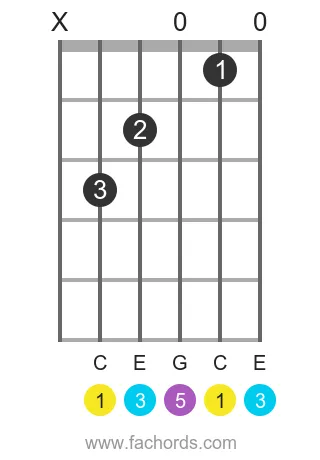 Let's start analyzing the most common form for the C major chord. A major chord is composed of the root, the 3rd and the 5th note of its corresponding major scale.
In the case of C, the scale is C, D, E, F, G, A, B and C. The 3rd is E, and the 5th is G. So the C major chord is C, E and G.
The most used chord shapes often use open strings, because they allow easier fingerings and better sounds.
The C major chord is no exception, so, as you can see in the picture, the G and the high E strings are left free to ring.
The lowest E string is muted because we want to have the root of the chord, C, as the lowest note.
C Major Chord Variations
Now we're going to press or release some frets, trying to keep the left hand in the same position. Let's analyze the resulting chords.
For this analysis, I used my reverse chord finder tool, be sure to experiment with it if you want to understand better chord construction.
C Major Chord - Standard Shape
Ok, this is the standard C major chord voicing that we all should know.
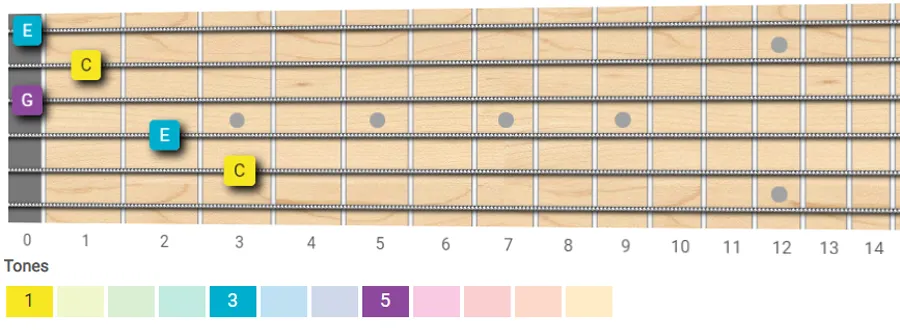
If you look at the diagram below, you'll notice that notes C and E are present twice on different frets. This happens frequently on guitar chords.
C Major Chord - Variation 1
The first variation we can introduce is by placing your pinkie on the 3rd fret of the E high string, which is a G.
We still have the same notes C, E and G, but the sound is a little different.
C Major Chord - Variation 2
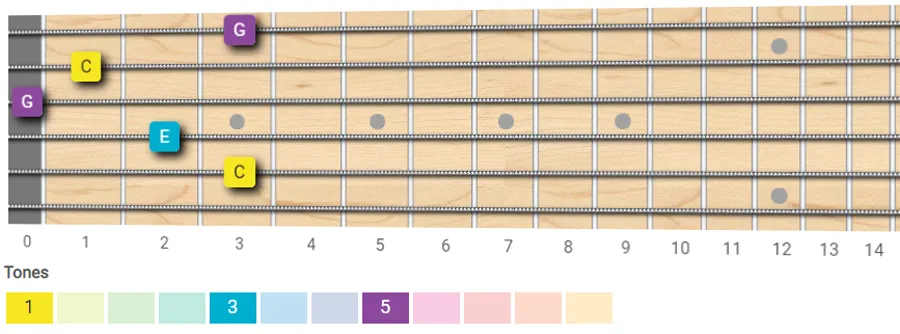
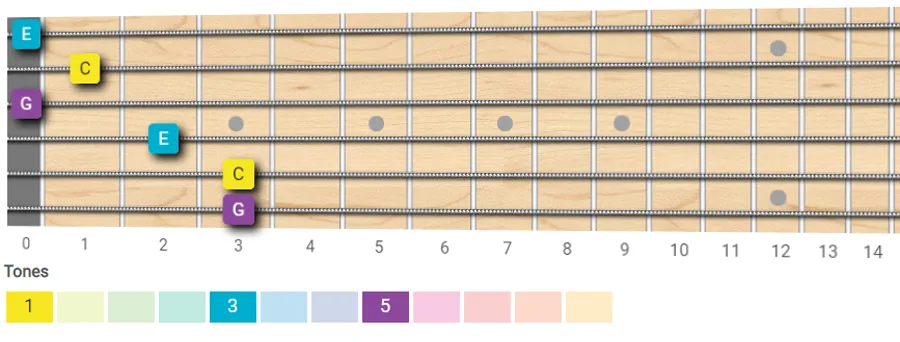
In this voicing, we play the G on the low E string (with the pinkie). Now we have a G as the lowest note of the chord, but the chord is still a C major, because the notes on the table are still C, E a and G.
The correct way to name this chord is C/G, which means a C major chord with a G on the bass.
C Major Add9 Chord
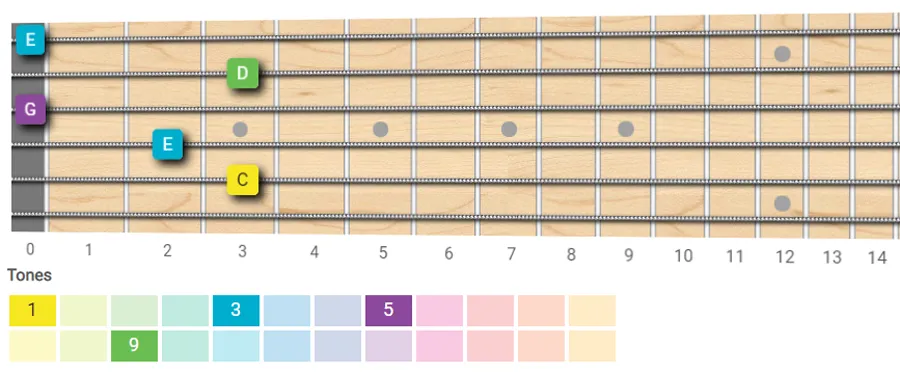
If we place the pinkie on fret 3rd of the B string, we'll get a D. D is the 2nd note of the C major scales, so the notes in this chord are: C, E, G and D. We name this chord C add9.
Why add9? Because D is the 2nd note in the scale, and if we go one octave higher, it's the 9th (count to verify). So it's a C major chord plus (add) a 9th.
C Major Dominant 7
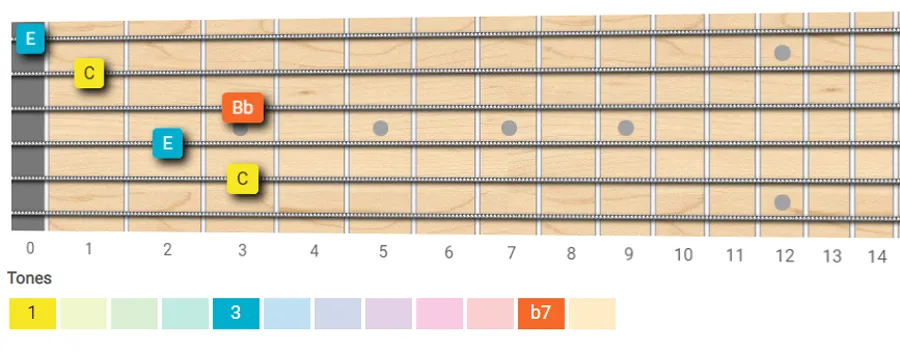
We move again our pinkie, this time we place it on the 3rd fret of the G string, which is a B flat. B is the 7th note of the C major scale,
Bb is then b7 (one half-step down). We have 1 (C), 3 (E), G (5) and Bb (b7) which is the formula of the C dominant seventh chord.
Notice that the G (5) is not present in this voicing. It's correct, the 5th is often dropped because it does not bring too much harmonic information and can be discarded in favor of an easier fingering.
C Major 7th Chord
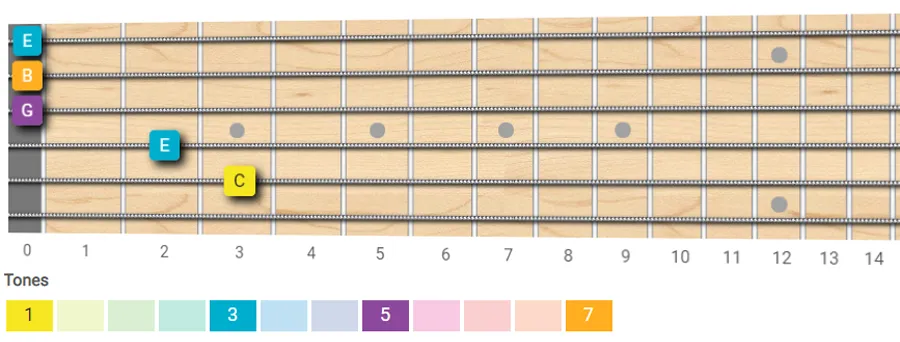
This is an easy voicing: let the 3 higher strings ring open!
We have a new note here, B, which, as stated before, is the 7th note of the major scale. The formula is 1 (C), 3 (E), 5 (G) and 7 (B), which turns out to be a C major seventh chord.
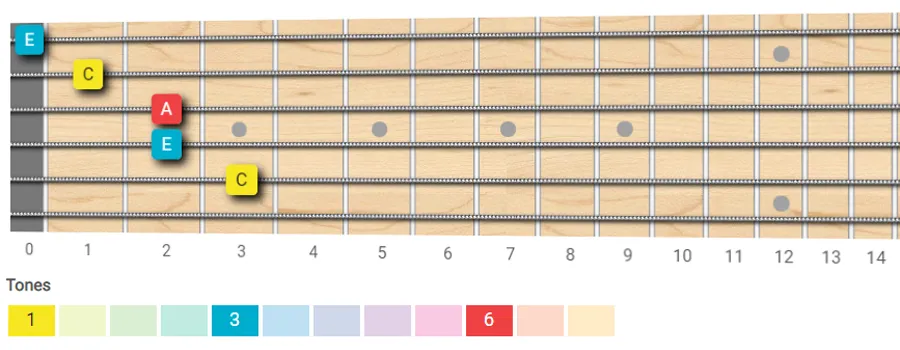
C Major 6th Chord
This fingering includes the note A. If we count from C to A, we get 6.
Indeed, this is a C major 6 chord: C (1), E (3), G (5), A (6).
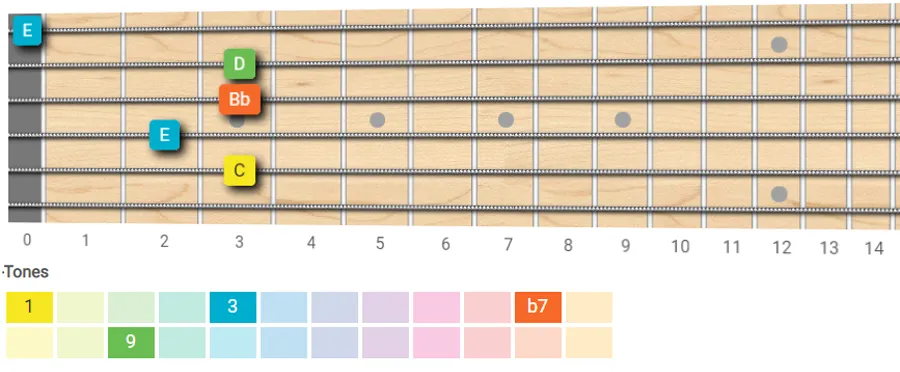
C9 Dominant Chord
If we add a 2nd (D) to the dominant seventh chord, we get a C dominant 9 chord.
C (1), E (3), G (5), Bb (7), D (9).
Notice that the 5th is dropped also in this voicing.
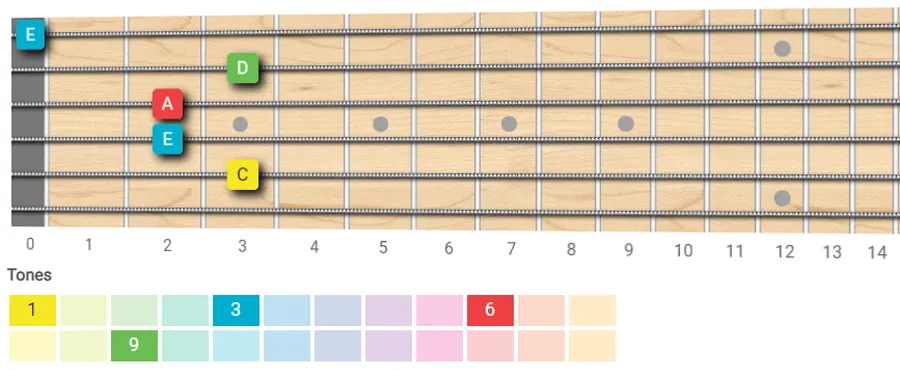
C 6/9 Chord
We now can combine the 6th and the 9th: C (1), E (3), G (5), A (6), D (9), to get a C 6/9 chord, used often in Gipsy Jazz.
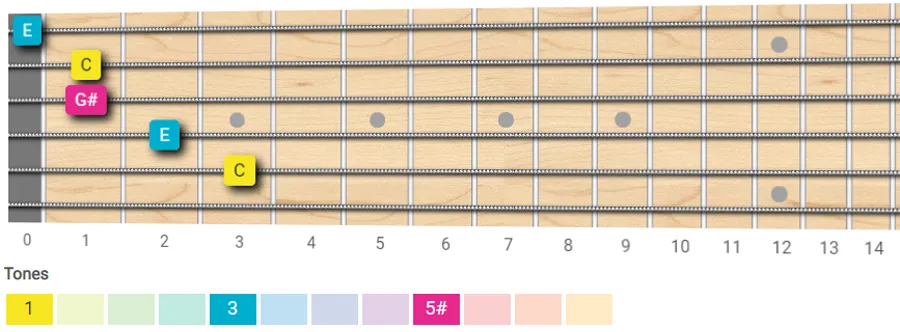
C Augmented Chord
The 5th can be dropped, as seen before, or can be raised or lowered. If we raise the 5th (G) by one half-step (G#), we get the formula for a C augmented chord: 1 (C), 3 (E), 5# (#G).
C Sus2 Chord
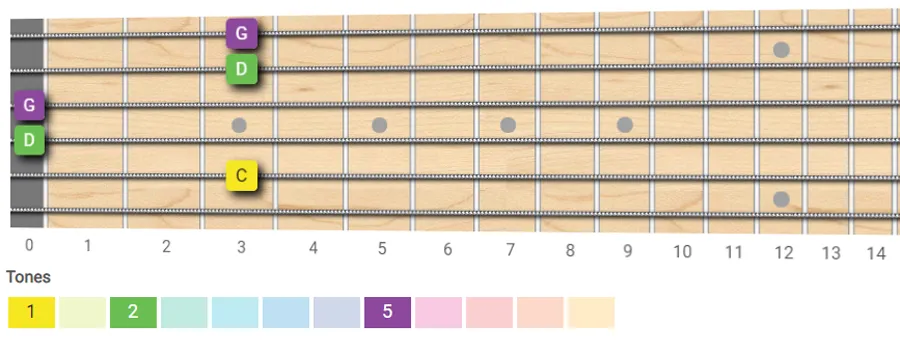
Ok, now we can drop the 3rd note in the chord, to get a chord quality that is not major neither minor. Here's the C suspended 2 chord1 (C), 2 (D), and 5 (G).
C Sus4 Chord
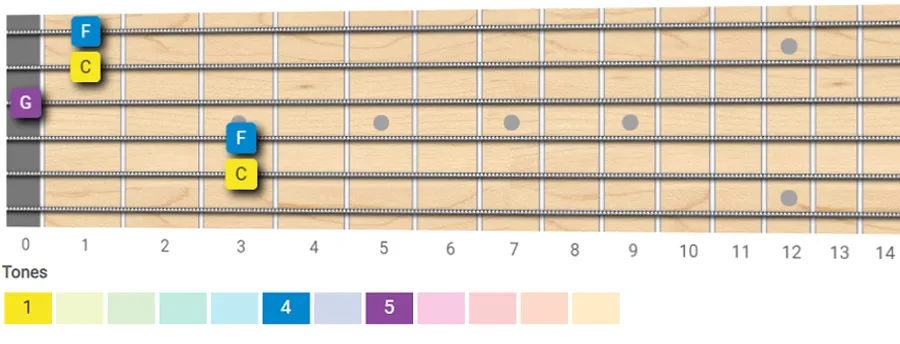
Same as before, but this time we use the 4th instead of the 2nd: 1 (C), 4 (F), and 5 (G) are the notes that create a C sus4 chord.
Recap Exercise Guitar Tab
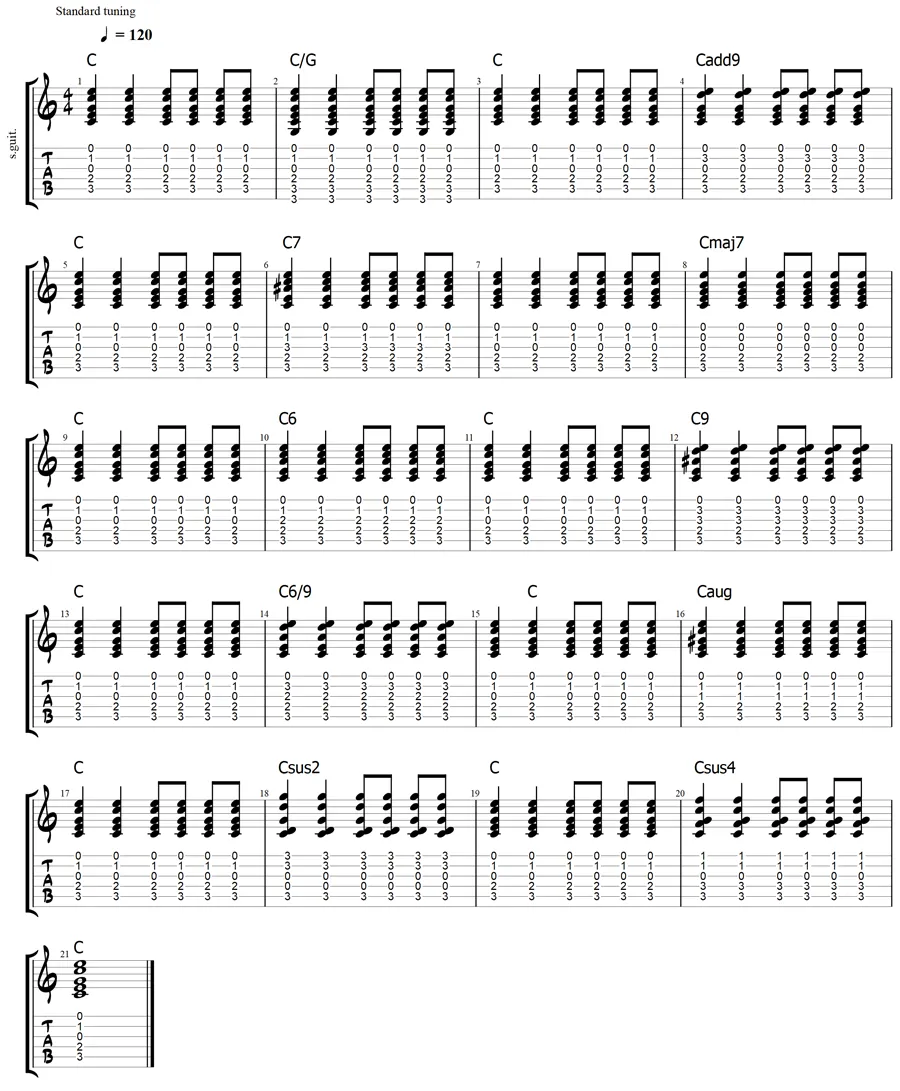
Here's a tab with all the chords shown so far:
Chord Variations - Conclusions And Additional Resources
Ok, this was just a taste of the wonderful world of chord theory. I'll leave you with some further resources that could help you advance your knowledge:
- My complete ebook, Chords Domination | Play Any Chord You Want Across All The Fretboard will show you tons of chord voicings across the entire fretboard, as well as how to create your own fingerings.
- This complete tutorial on chord construction will help you understand better the concepts shown on this page.
- Be also sure to download my chord formulas table with more than 44 chord qualities.
That's all for today, to stay updated on new stuff, please subscribe here.
FAQ
What is the main purpose of learning C chord variations beyond the standard C major shape?
Learning C chord variations helps advance your chord theory knowledge by understanding how adding or removing specific notes can change the overall quality and sound of the chord, offering different harmonic textures for musical expression.
Why are the 5th notes sometimes omitted in certain C chord variations, such as C7 or C9?
The 5th note is frequently dropped in some chord voicings because it does not contribute as much essential harmonic information as other notes. Omitting it can simplify the fingering on the guitar, making the chord easier to play without significantly altering its core identity or function.
What is the key difference between a C dominant 7th (C7) and a C major 7th (CMaj7) chord?
The main difference lies in the seventh note used. A C dominant 7th chord includes a flattened seventh (Bb), which creates a specific type of harmonic tension. In contrast, a C major 7th chord uses a natural seventh (B), providing a richer and often more resolved sound.
What does the notation 'C/G' signify when referring to a C chord variation?
The notation 'C/G' means a C major chord with the note G specifically played as the lowest (bass) note. Even though the chord's quality remains C major, having a different note in the bass fundamentally changes the harmonic foundation and feel of the voicing.
In chords like Cadd9, why is the '2nd' note often referred to as a '9th'?
The terms '2nd' and '9th' refer to the same musical note (D in the key of C). When this note is added to a chord an octave above its natural scale position, it is called a 9th. This distinguishes it as an extension beyond the basic triad (root, 3rd, 5th).
How do suspended chords, such as Csus2 and Csus4, achieve their unique sound compared to major chords?
Suspended chords get their distinctive quality by replacing the 3rd note of the major chord with either the 2nd (for sus2) or the 4th (for sus4). This removal of the defining 3rd note eliminates the major or minor quality, creating a harmonically open and unresolved sound.