Explore Bm Guitar Chord Shapes & Master Its Fretboard Geometry
Want a structured chord roadmap instead of jumping between pages?
Go to the full guitar chords tutorial.
Discovering new chord shapes on the guitar fretboard is key to expanding your playing. For the B minor (Bm) chord, visualizing its arrangement across the strings becomes effortless with our interactive virtual fretboard. This allows you to see the notes B, D, and F# and their corresponding intervals (1, b3, 5) for this essential member of the Minor Chords family. Play along, and use the real-time mic feedback to instantly verify if you're hitting the correct notes and perfecting your sound.
The B minor chord, like all minor chords, brings a rich emotional color and often a sense of introspection or melancholy to your music. Understanding how these notes (B, D, F#) and their intervals (1, b3, 5) are arranged is crucial for mastering not just this chord, but also for grasping the fundamental principles of chord construction. Exploring the different shapes of this chord will not only enhance your fretboard knowledge but also improve your chord change skills, allowing for smoother musical transitions.
Below, you'll find comprehensive diagrams showcasing the Bm chord in various positions, from the easiest to the more challenging ones. Each diagram highlights the theory behind the chord, allowing you to understand its construction across different keys and apply it to a multitude of songs. We encourage you to first explore the shapes presented on our interactive fretboard rather than simply memorizing static images. This active approach will deeply embed the B minor chord into your muscle memory and musical understanding.
Notes that compose the B m chord:
Chord Structure:
The B Minor Chord | Full Tutorial
The B minor chord, commonly abbreviated as "Bm" in tablature and sheet music, is a fundamental chord in the guitar world.
Its significance lies in its versatility and frequent appearance in various music genres.
Understanding and mastering the Bm chord is crucial for guitarists, particularly because it is a staple in many chord progressions, especially in the keys of G, A and D - three of the most commonly used keys in guitar music.
Playing The B Minor Chord
Easy Version
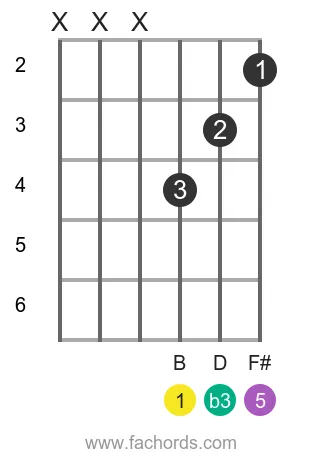
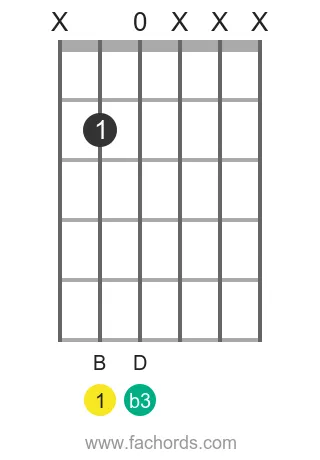
For newcomers, a three-finger version of Bm is recommended:
- Ring finger on the 4th fret of the G (3rd) string
- Middle finger on the 3rd fret of the B (2nd) string
- Index finger on the 2nd fret of the E (1st) string
- Strum from the G string down, focusing on the top three strings.
Common Version (Barre Chord)
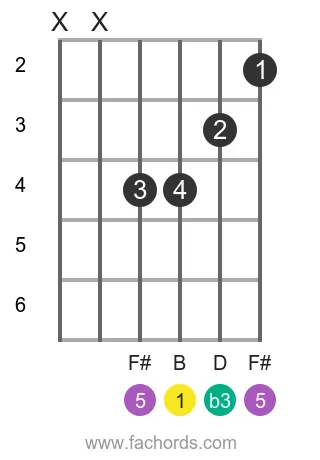
The more prevalent version of Bm is a barre chord.
Transitioning from simpler versions to the full barre chord is a journey.
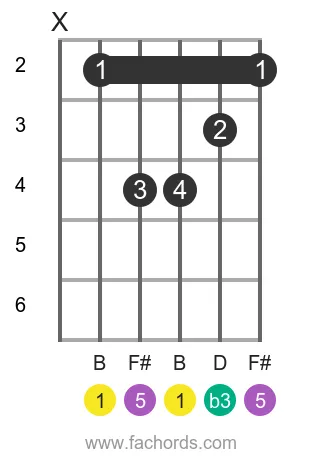
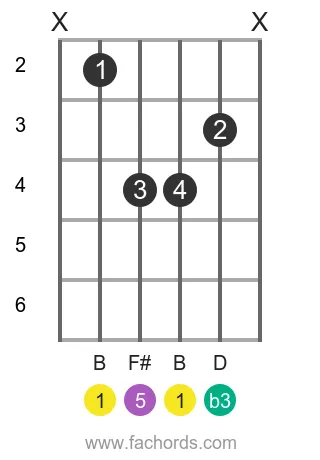
Start by mastering the positioning and pressure required for barring, then integrate the other fingers.- Index finger across the 2nd fret (excluding the low E string)
- Middle finger on the 3rd fret of the B (2nd) string
- Ring finger on the 4th fret of the D (4th) string
- Pinky finger on the 4th fret of the G (3rd) string
- Strum from the A string down, ensuring to mute the low E string.
Barre Version in 7th Position
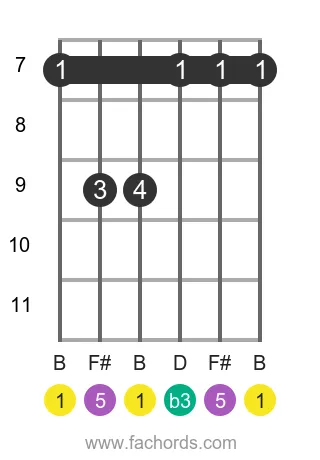
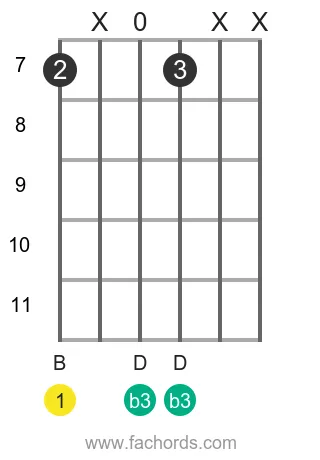
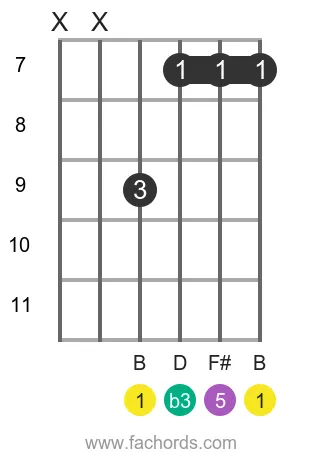
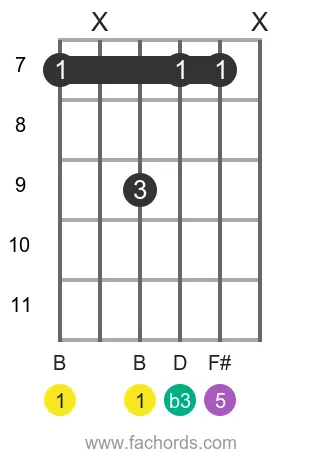
Another barred version, easier due to closer frets, is played in the 7th position:
- Index finger barring the 7th fret (from the low E to the high E string)
- Ring finger on the 9th fret of the A (5th) string
- Pinky finger on the 9th fret of the D (4th) string
Songs With The B Minor Chord
In rock music, the Bm chord has made its mark. Classic examples include Warrant's "Heaven" and Tesla's "Love Song."
These tracks showcase the chord's versatility and its role in defining the sound of rock ballads.
Hotel California begins with a B minor chord and probably is the most popular song in this key.
Also Money by Pink Floyd and Fade to Black by Metallica are in this key.
Country music also embraces Bm. Hits like "All My Ex's Live in Texas" by George Strait and "Always on My Mind" by Willie Nelson heavily feature the Bm, demonstrating its emotional depth in country storytelling.
B Minor Key | Chord Chart
Here below are the chords of the keys of B minor, in which our Bm chord is the root of the key.
Common Keys With The B Minor Chord
Here below you find the most used keys that contain the B minor chord.
G Major Key
In the key of G major, the B minor chord is the 3rd degree, so it has the function of Mediant.
A Major Key
In the key of A major, the B minor chord is the Supertonic (2nd degree)
D Major Key
In the key of D major, you find the B minor chord on the 6th degree, also called Submediant, or relative minor. In fact, the relative minor key of D major is B minor.
That''s all, to learn more about guitar chords, check my complete ebook Chords Domination | Play Any Chord You Want Across All The Fretboard.
B Minor Guitar Chord Shapes
Position 1
Open
Position 2
Open
Position 3
Movable
Position 4
Movable
Position 5
Movable
Position 6
Movable
Position 7
Movable
Position 8
Barre
Movable
Position 9
Barre
Movable
Position 10
Barre
Movable
Position 11
Barre
Movable
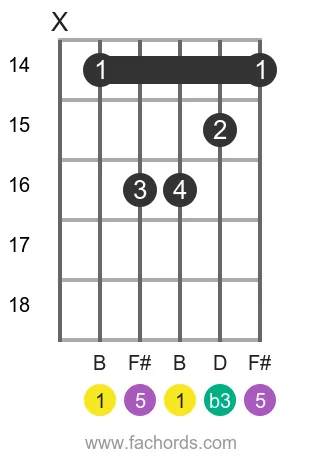
Position 12
Barre
Movable
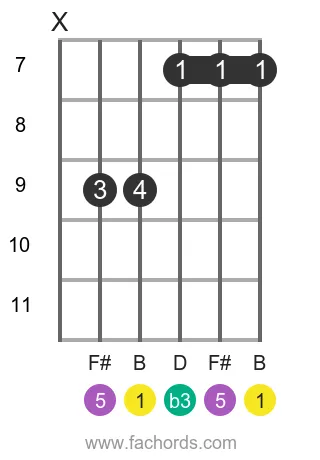
Position 13
Barre
Movable
 Find more shapes in our all guitar chords online library. If you
prefer a printable pdf, download
the Free Guitar Chords Chart Pdf
Find more shapes in our all guitar chords online library. If you
prefer a printable pdf, download
the Free Guitar Chords Chart Pdf
You can also use this accessible Bm chord page, with written diagram instructions and screen-reader support for blind users.

Created by
Giancarlo is a musician (teaching guitar since 2000), software engineer, AI consultant and published researcher
FAQ
What are the fundamental notes and intervals that make up a B minor chord?
The B minor (Bm) chord is composed of three notes: B, D, and F#. These notes correspond to the intervals of the 1 (Root), b3 (Minor Third), and 5 (Perfect Fifth) respectively, which define the minor chord quality.
Why are there different ways to play the B minor chord on guitar, such as easy and barre versions?
Different versions of the B minor chord, like the easy three-finger version and the various barre chord shapes, offer flexibility. They cater to different skill levels (e.g., easy for beginners) and allow the chord to be played in various positions on the fretboard, providing different voicings or making transitions easier within a song.
In which common major keys does the B minor chord typically appear, and what is its function?
The B minor chord is very versatile and appears in several common major keys: In G Major, it functions as the 3rd degree (iii, or Mediant). In A Major, it is the 2nd degree (ii, or Supertonic). In D Major, it is the 6th degree (vi, or Submediant), and in this case, B minor is also the relative minor key of D major.
What is the difference between the common B minor barre chord at the 2nd fret and the barre version at the 7th fret?
Both are barre chord voicings for B minor, but they are played in different positions on the fretboard. The common barre chord uses an index finger to barre the 2nd fret (from the A string down). The barre version in the 7th position uses the index finger to barre the entire 7th fret, often making it feel easier to fret due to the closer fret spacing higher up the neck.