Guitar Chords: Free Interactive Finder, Diagrams and Chord Theory
A complete guide to playing, reading and building chords on the guitar
This page is your all-in-one guide to guitar chords. You'll find an interactive chord identifier tool, a complete chord library organized by root note, step-by-step diagrams for every essential beginner chord, and lessons on intermediate and advanced chord types, from bar chords and dominant 7ths to diminished, suspended, and beyond. Whether you're picking up the guitar for the first time or looking to deepen your fretboard knowledge, everything you need is right here.
Guitar Chord Analyzer And Finder - Interactive Tool
How To Use The Interactive Chord Tool
The Chord Identifier lets you click directly on an interactive fretboard to select notes (one per string) and instantly identify the chord, or use the Chord Lookup dropdowns to browse voicings by key, type, and position.
Here's what you can do with it:
- Set a root context to hint at the harmonic key (like a bassist holding a note)
- Place a capo on any fret to transpose all chords up the neck, the tool automatically adjusts note names and chord identification to reflect the capo position
- Play and pause the selected chord in a loop with a 4-beat countdown, and adjust the BPM
- Toggle an accompanying drum pattern
- Switch the display between note names and chord tones
- Flip the fretboard for left-handed players
- Choose from multiple guitar tunings (standard, drop D, open tunings, and more)
- Use the built-in microphone for pitch detection to identify notes from a real guitar
- Click any key on the piano keyboard to hear it
- Download the fretboard as an image or grab an embed/share code
Matched chords appear in a results table with their interval structure and an explanation of the chord quality.
What Is A Guitar Chord?
Quick answer: A guitar chord is three or more notes played at the same time, formed by pressing specific frets on different strings and strumming them together. The simplest chord, a major triad, is built from a root note, a major third and a perfect fifth (for example, C major = C, E, G). Use the interactive chord finder below to identify any shape on the fretboard, hear it played back, and try it in left-handed or alternate tunings.
A chord is three or more notes played at the same time. On the guitar, that means pressing specific frets on different strings and strumming them together to produce a harmonious sound.
The simplest chords are triads, built from three notes: the root (the note that gives the chord its name), the third (which determines whether the chord sounds major or minor), and the fifth. For example, a C major chord is made of the notes C, E, and G.
By adding or altering notes, such as a seventh, a suspended fourth, or a flatted fifth, you can create dozens of different chord qualities: major, minor, dominant, diminished, augmented, suspended, and many more.
On a guitar, the same chord can often be played in multiple positions on the fretboard. Each position produces a slightly different voicing (the same notes arranged in a different order or octave), which is what gives the guitar its rich harmonic variety.
Guitar Chord Types
Below is a table that covers all guitar chords: minor, major, dominant, augmented, suspended, diminished, extended, altered, and more.
It shows the correct finger placements for each chord, the notes that make up the chord, and the intervals within the chord.
Click on any chord name to see all possible variations and fingerings:
How To Read Chord Diagrams
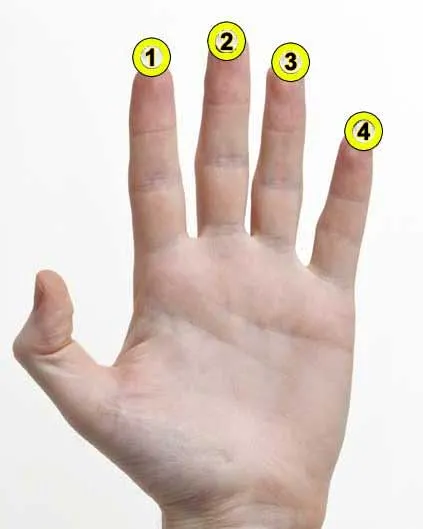
In chord diagrams, your left-hand fingers are numbered as follows:
- The index finger is labeled 1
- The middle finger is labeled 2
- The ring finger is labeled 3
- The pinky finger is labeled 4
These numbers tell you which fingers to use when pressing the frets.
Example: A Major Chord
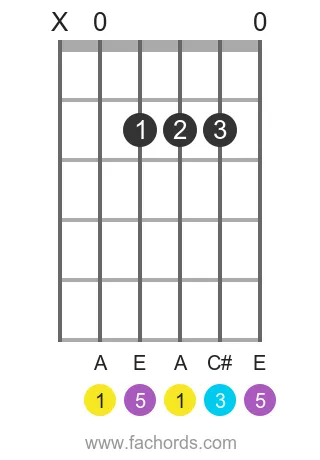
The diagram shows the guitar fretboard, with the thickest string (low E) on the left and the high E string on the right.
The numbers on the frets indicate where to press the strings. At the top of the diagram, an X means you should mute that string (don't play it), and a 0 means you should play that string open, without pressing any fret.
To play the A major chord as shown:
- Mute the low E string (6th string), see the X above it
- Let the A string (5th string) ring open, see the 0 above it
- Press the 2nd fret of the D string (4th) with your index finger (1)
- Press the 2nd fret of the G string (3rd) with your middle finger (2)
- Press the 2nd fret of the B string (2nd) with your ring finger (3)
- Let the high E string (1st string) ring open
At the bottom of each diagram, you'll see the note names for each string, along with colored circles showing the intervals in the chord (root, major third, fifth, etc.). The root is always shown in yellow.
Drill Down: Check out the complete tutorial on how to read chord diagrams with instructions on intervals and chord structures.
Beginner Guitar Chords
Here are the chord diagrams with step-by-step instructions for the most essential chords that every beginner should learn first.
Take your time with these shapes, it may take some practice to play them cleanly, and that's perfectly normal.
C Major Chord
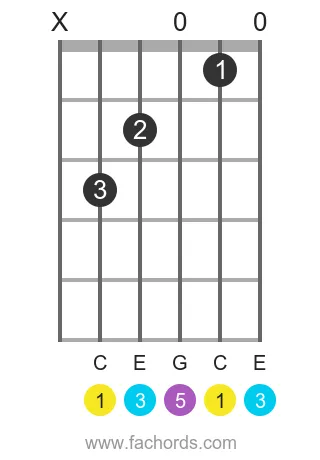
This is the most common way to play the C major chord on the guitar.
- Mute the low E string (don't play it)
- Let the A string ring open
- Place your ring finger (3) on the 3rd fret of the A string
- Place your middle finger (2) on the 2nd fret of the D string
- Let the G string ring open
- Place your index finger (1) on the 1st fret of the B string
- Let the high E string ring open
C Major Chord (Easy Version)
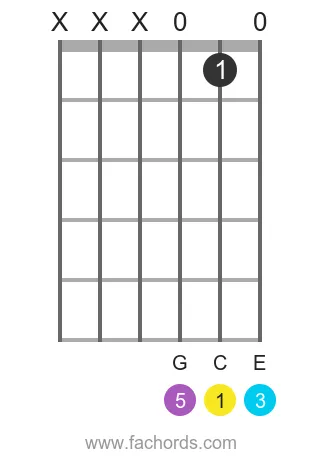
If the full C major feels too tricky at first, try this simplified version that uses only three strings and one finger.
- Mute the low E, A, and D strings
- Let the G string ring open
- Place your index finger (1) on the 1st fret of the B string
- Let the high E string ring open
A Major Chord
The A major chord uses three fingers lined up on the 2nd fret.
- Mute the low E string
- Let the A string ring open
- Place your index finger (1) on the 2nd fret of the D string
- Place your middle finger (2) on the 2nd fret of the G string
- Place your ring finger (3) on the 2nd fret of the B string
- Let the high E string ring open
G Major Chord
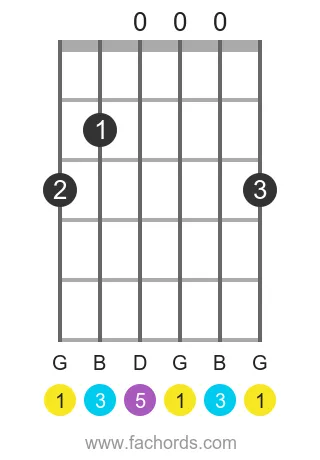
This is the most common fingering for the G major chord. You'll strum all six strings.
- Place your middle finger (2) on the 3rd fret of the low E string
- Place your index finger (1) on the 2nd fret of the A string
- Let the D string ring open
- Let the G string ring open
- Let the B string ring open
- Place your ring finger (3) on the 3rd fret of the high E string
G Major Chord (Easy Version)
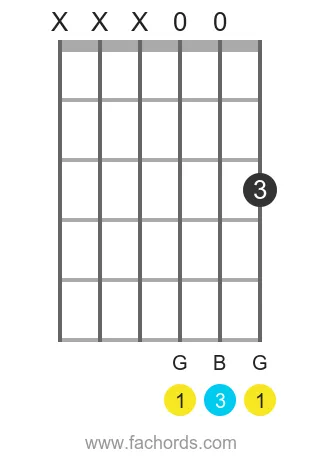
This simplified G major only needs one finger, great for quick chord changes.
- Mute the low E, A, and D strings
- Let the G string ring open
- Let the B string ring open
- Place your ring finger (3) on the 3rd fret of the high E string
E Major Chord
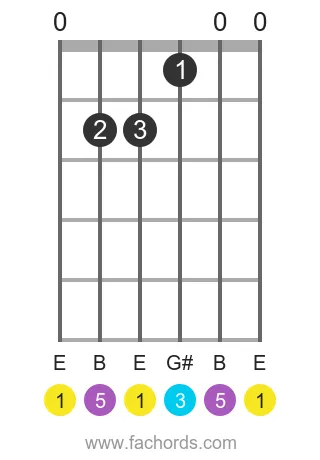
The E major chord is one of the most satisfying beginner chords, you get to strum all six strings.
- Let the low E string ring open
- Place your middle finger (2) on the 2nd fret of the A string
- Place your ring finger (3) on the 2nd fret of the D string
- Place your index finger (1) on the 1st fret of the G string
- Let the B string ring open
- Let the high E string ring open
E Major Chord (Easy Version)
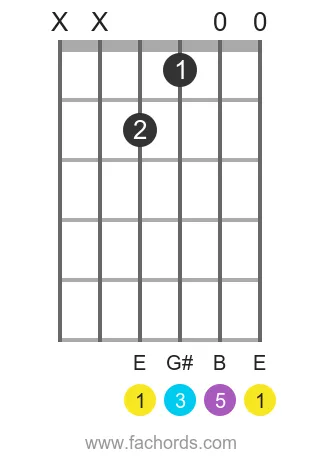
This two-finger version of E major is perfect if you're still building finger strength.
- Mute the low E and A strings
- Place your middle finger (2) on the 2nd fret of the D string
- Place your index finger (1) on the 1st fret of the G string
- Let the B string ring open
- Let the high E string ring open
D Major Chord
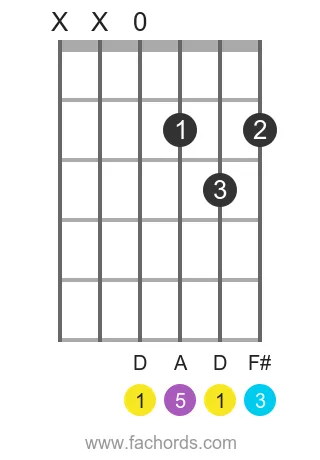
The D major chord is played on just the top four strings.
- Mute the low E and A strings
- Let the D string ring open
- Place your index finger (1) on the 2nd fret of the G string
- Place your ring finger (3) on the 3rd fret of the B string
- Place your middle finger (2) on the 2nd fret of the high E string
A Minor Chord
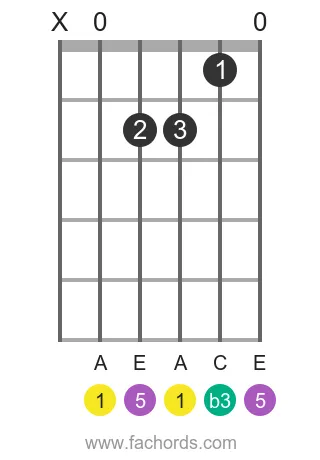
The A minor chord is a staple of ballads and melancholic songs. It's very similar to the E major shape, just moved over one string.
- Mute the low E string
- Let the A string ring open
- Place your middle finger (2) on the 2nd fret of the D string
- Place your ring finger (3) on the 2nd fret of the G string
- Place your index finger (1) on the 1st fret of the B string
- Let the high E string ring open
A Minor Chord (Easy Version)
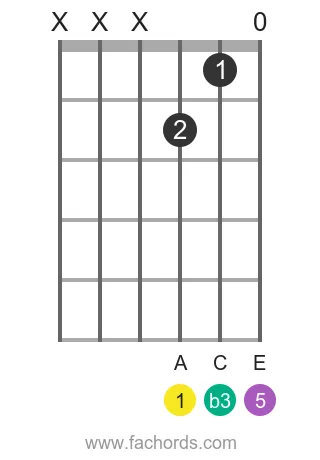
A two-finger version of A minor that's easier to grab quickly.
- Mute the low E, A, and D strings
- Place your middle finger (2) on the 2nd fret of the G string
- Place your index finger (1) on the 1st fret of the B string
- Let the high E string ring open
E Minor Chord
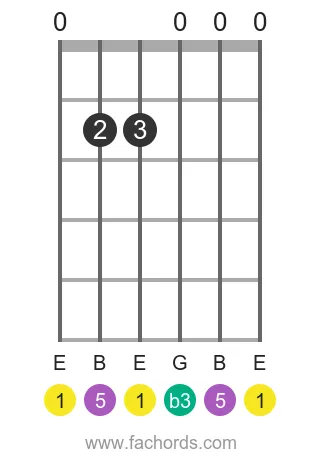
The E minor chord is one of the easiest chords on the guitar, just two fingers and all six strings ring out.
- Let the low E string ring open
- Place your middle finger (2) on the 2nd fret of the A string
- Place your ring finger (3) on the 2nd fret of the D string
- Let the G string ring open
- Let the B string ring open
- Let the high E string ring open
E Minor Chord (Easy Version)
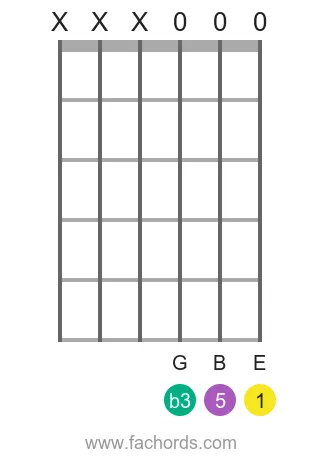
This E minor shape doesn't require pressing any frets at all, just let the top three strings ring open. If you've ever played the opening of "Nothing Else Matters" by Metallica, you've already used this voicing.
- Mute the low E, A, and D strings
- Let the G, B, and high E strings ring open
D Minor Chord
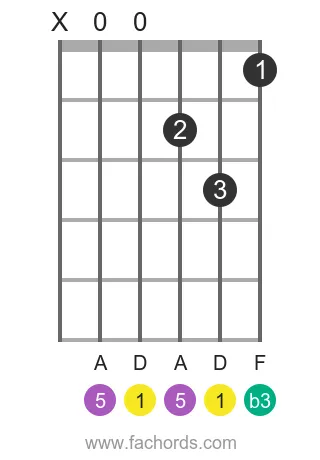
The D minor chord rounds out the essential beginner chords. Like D major, it's played on just the top four strings.
- Mute the low E and A strings
- Let the D string ring open
- Place your middle finger (2) on the 2nd fret of the G string
- Place your ring finger (3) on the 3rd fret of the B string
- Place your index finger (1) on the 1st fret of the high E string

Tips for Beginners: How To Practice Your First Chords
- Use your fingertips, press the strings with the very tips of your fingers. It might hurt at first, but calluses will develop over time.
- Stay close to the frets, place your fingers just behind the metal frets (not on top of them) for a cleaner sound with less effort.
- Keep your fingers upright, your fingertips should be perpendicular to the fretboard so you don't accidentally mute neighboring strings.
- Check each string, play every string in the chord one at a time to make sure each note rings clearly.
- Use just enough pressure, press the strings firmly enough for a clear tone, but no harder than necessary.
- Practice switching chords, start by alternating between two chords, then gradually work up to three and four.
Open Chords
Open
chords use open strings as much as possible, which makes them easier to
play since you have fewer frets to press. All the beginner chords above are open chords.
A basic major chord is built from the root, 3rd, and 5th of a scale. For example, a G major chord uses the notes G, B, and D. A minor chord uses the root, minor 3rd, and 5th, so G minor is G, Bb, and D.
Drill Down: Check out the first open guitar chords that a beginner should learn.
Power Chords
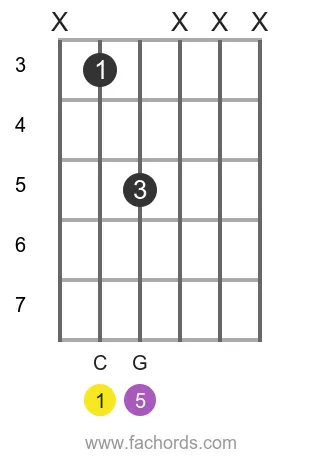 Power chords
are a staple of rock and blues and an excellent starting point for beginners.
Technically, they're dyads (two notes), not full chords, but they sound huge through a distorted amp.
Power chords
are a staple of rock and blues and an excellent starting point for beginners.
Technically, they're dyads (two notes), not full chords, but they sound huge through a distorted amp.
A power chord is made up of just the root and the fifth. For instance, a G power chord consists of the notes G and D. They're typically played on the three lowest strings (low E, A, and D).
Drill Down: Jump to the complete power chords tutorial to learn more.
Intermediate Guitar Chords
Once you're comfortable with the basics, check out our list of 15 intermediate guitar chords to expand your vocabulary.
Bar Chords
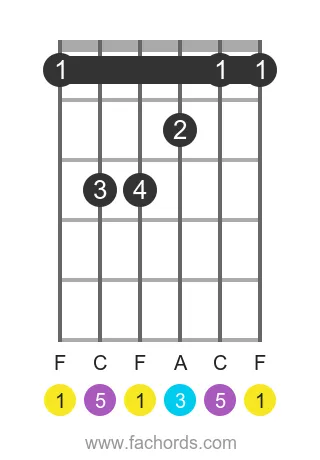 Bar chords
require pressing multiple strings with a single finger, usually your index finger laid
flat across the fretboard.
Bar chords
require pressing multiple strings with a single finger, usually your index finger laid
flat across the fretboard.
They can be challenging at first, especially if you haven't built up finger strength yet. But the payoff is huge: bar chords are movable shapes, meaning you can slide the same shape up or down the neck to play any chord.
You can play full bar chords like the F major chord (barring all six strings), or partial bar chords that cover just a few strings.
Drill Down: 7 Tips To Make Bar Chords Easier, practical advice for getting past the toughest beginner hurdle.
Dominant Chords
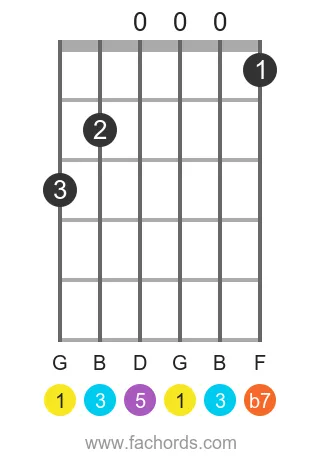 Dominant
chords (also called 7th chords) are major chords with
a minor seventh added, making them a four-note chord.
Dominant
chords (also called 7th chords) are major chords with
a minor seventh added, making them a four-note chord.
For example, G7 takes the G major chord (G, B, D) and adds F, the flatted seventh. This creates a feeling of tension that wants to resolve back to the home chord, which is why dominant chords are so important in chord progressions.
Drill Down: Learn more about 7th dominant chords and their extended forms, such as the Ninth chord.
Diminished Chords
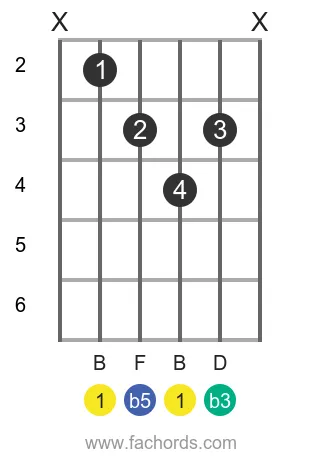 Diminished
chords create dissonance and tension, often resolving to more stable chords. They come
in three varieties:
Diminished
chords create dissonance and tension, often resolving to more stable chords. They come
in three varieties:
- Diminished triad (1, b3, b5)
- Half diminished (1, b3, b5, b7)
- Diminished 7th (1, b3, b5, bb7)
Drill Down: Learn all about diminished chords.
Suspended Chords
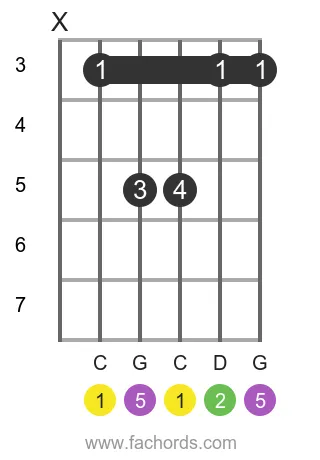 Suspended
chords are unique because they are neither major nor minor, the third is replaced by
either the 2nd or 4th, creating an open, unresolved quality that's a powerful tool in songwriting.
Suspended
chords are unique because they are neither major nor minor, the third is replaced by
either the 2nd or 4th, creating an open, unresolved quality that's a powerful tool in songwriting.
They come in two varieties: sus2 (1, 2, 5) and sus4 (1, 4, 5).
Drill Down: Learn more about suspended chords for guitar.
Sixth Chords
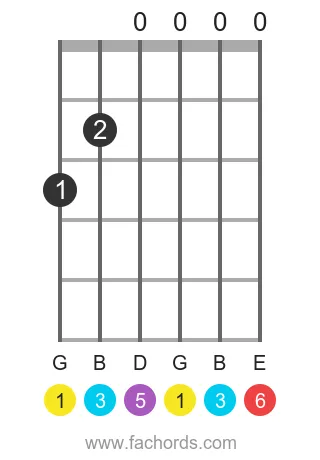 For a
laid-back, jazzy feel, try the 6th chord. It's a major chord with a major sixth added:
1, 3, 5, and 6 (so G6 = G, B, D, E).
For a
laid-back, jazzy feel, try the 6th chord. It's a major chord with a major sixth added:
1, 3, 5, and 6 (so G6 = G, B, D, E).
Drill Down: Learn more about 6th chord construction and applications.
Advanced Guitar Chords
Once you're comfortable with the standard shapes, it's time to see the fretboard as a whole. Instead of memorizing isolated chord shapes, you can assemble intervals on the fly to create chords of all qualities anywhere on the neck.
This C variations tutorial is a great example, it shows how different interval combinations produce different chord types, all from the same root note.
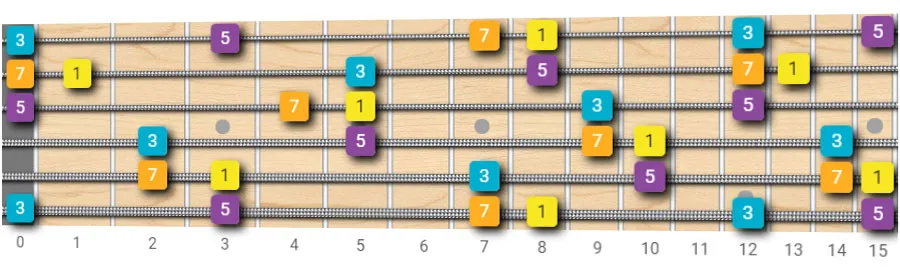
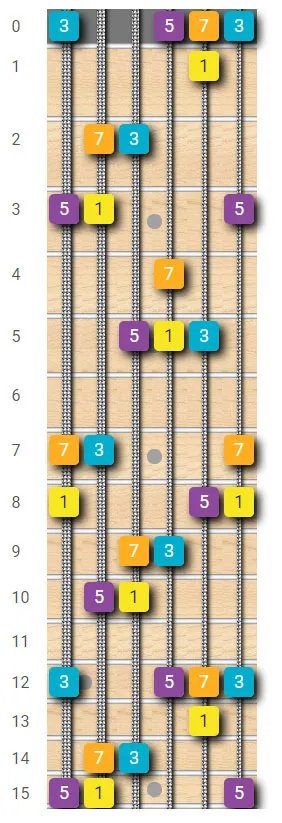
A great exercise: try forming as many C maj7 chords as possible using the fretboard map below. C maj7 consists of the root, 3rd, 5th, and 7th. You can often drop the 5th since it doesn't add much harmonic color, this is the idea behind shell chord shapes. Be sure to include all inversions.
Key takeaways
- A guitar chord is three or more notes played together: a basic triad has a root, a third and a fifth.
- Start with 7 open chords: E minor, E major, A minor, A major, D minor, D major and G major. Most popular songs use 4 of them.
- Bar chords are movable shapes that let one fingering cover every key; power chords work in any style and are neither major nor minor.
- The interactive chord finder on this page identifies any shape you click, plays it back, and supports Drop D, alternate tunings, capo and left-handed mode.
- You only need around 30 chords to cover most songs you'll ever play.
Guitar Chords: More Tips And Tricks
Finger Positions Are Just Suggestions
 You'll sometimes find chord diagrams that don't specify which fingers to use. That's because different
players finger the same chord differently, depending on hand size, playing style, and what
comes before or after in a song.
You'll sometimes find chord diagrams that don't specify which fingers to use. That's because different
players finger the same chord differently, depending on hand size, playing style, and what
comes before or after in a song.
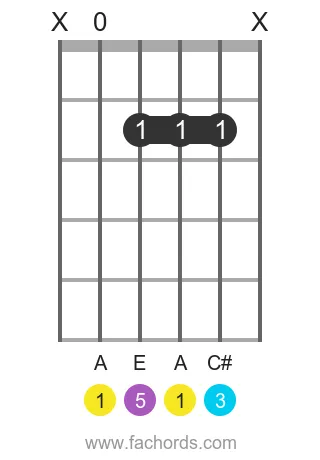
For example, if your fingers feel too cramped playing the standard A major shape, try a mini-barre instead: lay your index finger across the D and G strings at the 2nd fret, then place your middle finger on the B string at the same fret (as shown in the image). This frees up your ring and pinky fingers for melodies or bass notes.
Some shapes work better for flat-picking, others for fingerstyle, experiment and play whatever feels most comfortable.
How Guitar Chords Are Built
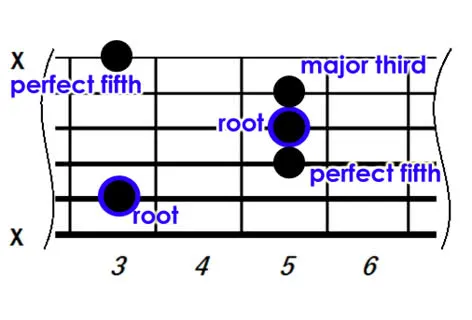
A chord is three or more notes played at the same time, built from specific intervals of a major scale.
A basic major chord uses the 1st note (the root), the 3rd, and the 5th. By changing these intervals, flatting the 3rd for minor, adding a 7th for seventh chords, you get every chord quality there is.
Guitars (and pianos) are popular partly because they're polyphonic instruments: they can play multiple notes simultaneously. A trumpet or flute can only play one note at a time, it takes at least three wind players to form a chord together.
Drill Down: To learn how to build your own chord shapes from scratch, check out our guitar music theory tutorial.
How Many Chords Should I Learn?
Theoretically, there are unlimited possible chords. You can start with open chords and move them up the fretboard to discover hundreds of different shapes.
In practice, around 30 chords will cover most of what you need, or even fewer, depending on the style of music you play. There are bluegrass guitarists who have built entire careers on just a dozen or so chords.
Many guitarists also transpose songs to more familiar keys, often with the help of a guitar capo.
If you're interested in going deeper into music theory and learning how to construct chords by combining intervals all along the fretboard, check out my complete ebook Chords Domination | Play Any Chord You Want Across All The Fretboard.
You now have a solid foundation for mastering guitar chords. Take your time, practice regularly, and the shapes will become second nature.
To stay updated on new tutorials, subscribe to the free newsletter (you'll also get access to the download area with lots of free printable resources).
Guitar Chords FAQ
The most common questions beginner and intermediate guitarists ask about chords.
What is a guitar chord?
A guitar chord is three or more notes played at the same time. On guitar, you press specific frets on different strings and strum them together to produce one harmonious sound. The simplest chords are triads, built from a root note, a third, and a fifth.
What are the easiest guitar chords for beginners?
The easiest open chords are E minor, A minor, E major, A major, D major, C major and G major. E minor uses only two fingers, and simplified two-finger versions of C, G, A minor and E exist for absolute beginners.
How many guitar chords should I learn?
Around 30 chords cover most popular songs, but you can start playing real music with just 4 open chords (G, C, D and E minor). Many guitarists also transpose songs to more familiar keys using a capo to stay within shapes they already know.
What is the difference between open chords, bar chords and power chords?
Open chords use unfretted strings and are the easiest to play. Bar chords use one finger laid flat across multiple strings and are movable shapes that work anywhere on the neck. Power chords are two-note shapes (root plus fifth) used in rock and blues, neither major nor minor.
How do I read a guitar chord diagram?
A chord diagram represents the fretboard with the thickest string (low E) on the left and the high E string on the right. Numbers on the frets show which finger to use (1 = index, 2 = middle, 3 = ring, 4 = pinky). An X above a string means mute it, a 0 means play it open.
Why does the F chord feel so hard?
F major is a bar chord, which requires laying one finger flat across all six strings while the other fingers form a shape behind it. It demands finger strength and precision that take a few weeks to build. A partial F shape on the top four strings is a common stepping stone.
Can I play guitar chords left-handed on a right-handed guitar?
Yes, but you need to restring the guitar so the thickest string is on top for your left hand. The interactive chord finder on this page has a left-handed toggle that mirrors every diagram without restringing your guitar.
Do guitar chord shapes change in alternate tunings like Drop D?
Yes. When you retune the low E string down to D, the same fingering produces different chord notes on the 6th string. Power chords become one-finger shapes, and many open chord shapes need to be adjusted. The interactive tool lets you switch tuning to see the new fingerings.
Below you'll find all the chord-related content available on this site:

Created by
Giancarlo is a musician (teaching guitar since 2000), software engineer, AI consultant and published researcher
