6th Chords on Guitar
How to Play Sixth Chords: construction and fretboard charts
When you first start playing the guitar you usually focus on basic scales and chords .
As you seek out new songs to learn the chords suddenly have numbers beside them.
These numbers simply tell you what extra notes are built onto simple major and minor chords (this resource will give you a complete understanding of this concept)
Today we will look at chords that use the 6th (sixth) note of the scale.
You will learn how to read them, create them, and most of all the sound they produce .
How a Sixth Chord is Made
Remember your major scale:
| C | D | E | F | G | A | B |
| 1 | 2 | 3 | 4 | 5 | 6 | 7 |
Our basic triad of 1, 3, and 5 or C E G is the formula for the C major chord .
And if we want to make it a C minor we flatten the 3rd and get C Eb G.
It's ok to write these chord formulas out on a cheat sheet to keep handy while playing.
Don't worry about memorization at first, it is more important you understand why these changes are affecting the sound.
When that E (the 3rd) is regular we have a strong and powerful sound .
When it is flat (Eb) we get a sad or contemplative vibe .
C Major Sixth Chord
C Minor Sixth Chord
To make a major 6th chord we simply use the formula 1, 3, 5, and 6 .
Thus a C6 is C, E, G, A .
And if you want to make a minor 6th chord you flatten that third and you have C, Eb, G, A .
We can also create an augmented sixth, but that is enharmonically equivalent to a minor 7th .
And our goal here isn't to make music theory confusing, so all you have to focus on is the major and minor sixth. (As usual with theory you can jump down some vast and puzzling rabbit holes if you like!)
6th Guitar Chords Chart
C 6
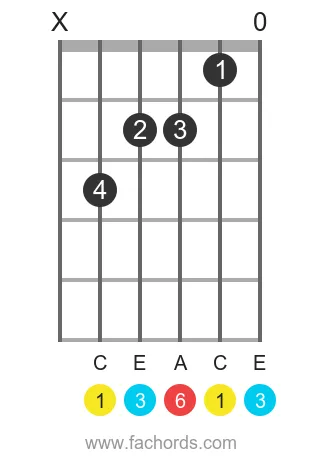
D 6
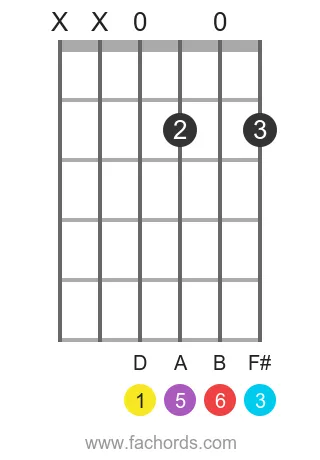
E 6
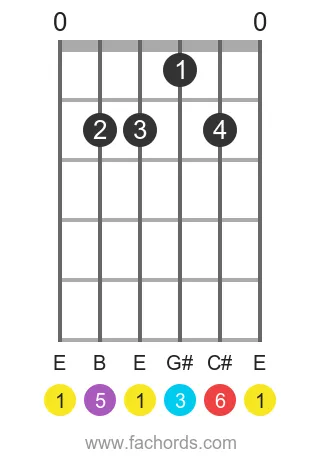
F 6
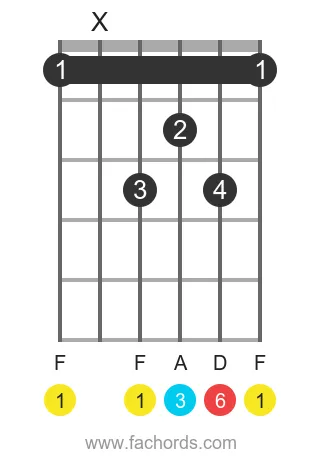
G 6
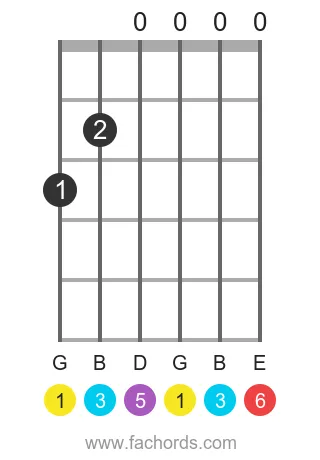
A 6
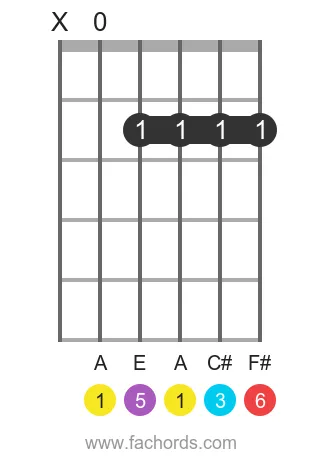
B 6
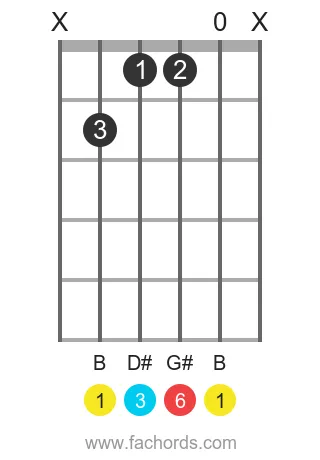
How the Sixth Chord is Used
These chords have a variety of uses depending on the genre they appear in.
We flatten and sharp our chord notes to change the feeling of the music and to create tension.
Some changes create a lot of dissonance and stress , they beg to be resolved back to the root note or chord.
But as for the 6th chord the tension it creates is very subtle.
One of the most popular uses of 6th chords is by Hawaiian style music .
The ukulele and many lap steels are tuned to C6. And that is a prime example of what that chord does.
It doesn't create any strong musical urges and has a very laid back vibe.
If you want a song you are writing to be casual and chill the 6th is your best friend.
It has so little tension that some songs END on it, like swing era tunes and some of The Beatles .
And that is about all we can say about 6th chords, because they really don't do anything specifically except add some color to the song.
Like an early rock or blues song needs flattened blue notes and dominant 7th chords or it will not sound right.
It doesn't need 6th chords, but when added right it is awesome.
Don't let that ambiguity hinder you, when it comes to 6th chords just relax and go with the flow!
Popular Examples of Sixth Chords
Of course major 6th chords are very present in early jazz and pop standards, along with other complex chords.
And a prime example of early rock use is boogie woogie which is rife with 6th and 9th chords.
Of course as a guitarist you will not be playing the piano bassline of that genre, but the sixth will show up in those and rockabilly licks.
" Fool on the Hill " by The Beatles starts on a D6 chord.
And a G6 is the ending chord for the song " She Loves You ".
They often loved to harmonize a sixth at the end of their early tunes.
Another great example of a major sixth is the start of " Jingle Bell Rock " that initial guitar phrase goes D, Dmaj7, D6 .
And you will even find the major sixth is in a very popular chord progression:
C C+ C6 C7
That movement of major, augmented, major 6th, and dominant 7th is common in songs like:
- " You've Got to Accentuate the Positive "
- " The Greatest Love of All "
- " For Once in My Life "
- " Baby Hold on to Me "
It is a very common progression and a good one to know.
Minor 6th Chords
The minor 6th is not as common and one mostly seen in jazz music.
Of course it is used in popular music but not nearly as much as the major.
In The Beach Boys song " God Only Knows " the first line moves from a major chord to a minor 6th , and it gives it a melodic mixed vibe of happy depression.
The Beatles do the same thing in "" Eleanor Rigby " when they sing 'all the lonely people' it moves from a minor 7th to a minor 6th.
The major 6th will be the chords you deal with the most, but when the right musical moment comes along you won't want to forget that minor 6th.
And yes you can totally get by on just playing major, minor, and seventh chords in most popular tunes and genres, but notice that the best composers and songwriters keep that 6th chord handy.
It is like a mild seasoning for when a song needs just a little something to make it go from good to great.
This ends our sixth chord tutorial. Be sure to download the free chords ebook that will show you plenty of different chord diagrams all over the fretboard, and for a more advanced resource, get our Chords Domination ebook.

Created by
Giancarlo is a musician (teaching guitar since 2000), software engineer, AI consultant and published researcher
FAQ
What is a 6th chord on the guitar and how is it constructed?
A 6th chord is an extended chord built by adding the sixth note of the major scale to a basic major or minor triad (root, third, and fifth). For a major 6th chord, the formula is 1-3-5-6, and for a minor 6th chord, it's 1-b3-5-6.
What is the key difference between a major 6th chord and a minor 6th chord?
The primary difference lies in the third note of the chord. A major 6th chord includes a major third, while a minor 6th chord includes a minor (flattened) third. Both types incorporate the natural sixth from the major scale.
What kind of musical feeling or sound do 6th chords typically create?
Sixth chords generally produce a 'casual,' 'chill,' or 'laid-back' sound. They add a subtle color to music without creating strong tension, often used to convey a relaxed vibe. They can even serve as ending chords in certain musical styles like swing.
Why does this tutorial focus mainly on major and minor 6th chords?
The tutorial focuses on major and minor 6th chords because while other theoretical variations like an 'augmented sixth' exist, they are often enharmonically equivalent to other common chords (like a minor 7th). The goal is to avoid making music theory unnecessarily confusing and to concentrate on the most distinct and practical applications of the 6th chord.
Are minor 6th chords used as frequently as major 6th chords in popular music?
No, minor 6th chords are generally less common in popular music compared to major 6th chords. Major 6ths frequently appear in early jazz, pop standards, and genres like boogie woogie, while minor 6ths are more often found in jazz or used selectively in popular songs to add a unique, often melancholic or 'mixed' emotional nuance.
