Explore the Gm9 Chord: Sound, Shapes, and Musical Use
Want a structured chord roadmap instead of jumping between pages?
Go to the full guitar chords tutorial.
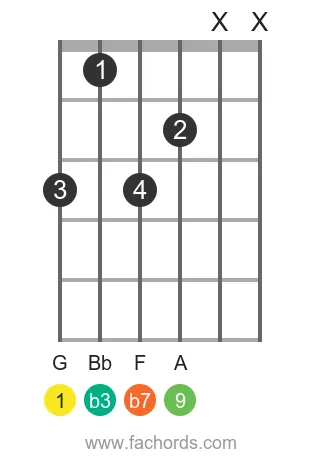
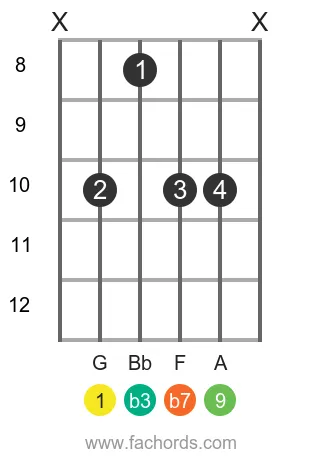
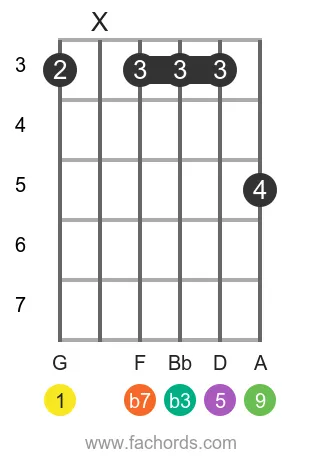
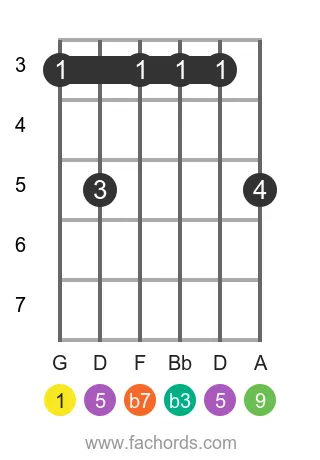
Dive into the rich, expressive world of the Gm9 chord, a captivating sound often found in jazz, R&B, and soulful music. This versatile member of the Minor Chords family is constructed from the notes G, Bb, D, F, and A, with its unique character defined by the intervals 1, b3, 5, b7, and 9. Use our interactive virtual fretboard to experiment with its voicings, hear its beautiful chord and arpeggio playback, and immediately verify your accuracy in real-time using the built-in mic feedback feature.
The Gm9 chord introduces the major ninth (A) over a Gm7, adding a sophisticated, ethereal quality to the standard minor seventh. Its full interval structure consists of the Root, Minor Third, Perfect Fifth, Minor Seventh, and Major Ninth, creating an extended harmony that enriches many musical contexts. To fully grasp how these color tones shape chords, explore our guide on Chord Construction. For a deeper dive into these rich voicings, our Ninth Chords tutorial offers further insights.
Before delving into the theory, we encourage you to spend time interacting with the Gm9 chord using our virtual fretboard. Experiment with different fingerings and listen to its unique timbre. Below, you will find chord diagrams organized from easiest to more challenging voicings, along with detailed theoretical explanations, practical applications in various songs, and useful key contexts to help you integrate this beautiful chord into your playing. Start playing, then analyze!
Notes that compose the G m9 chord:
Tones in the Minor Ninth chord:
Guitar Patterns for the G Minor Ninth chord
Position 1
Movable
Position 2
Movable
Position 3
Barre
Movable
Position 4
Barre
Movable
 Find more shapes in our all guitar chords online library. If you
prefer a printable pdf, download
the Free Guitar Chords Chart Pdf
Find more shapes in our all guitar chords online library. If you
prefer a printable pdf, download
the Free Guitar Chords Chart Pdf
You can also use this accessible Gm9 chord page, with written diagram instructions and screen-reader support for blind users.

Created by
Giancarlo is a musician (teaching guitar since 2000), software engineer, AI consultant and published researcher
FAQ
What notes make up the Gm9 chord?
The Gm9 chord is composed of five distinct notes: G, Bb, D, F, and A. These are the specific pitches that create the chord's unique sound on the guitar.
What do the intervals 1, b3, 5, b7, and 9 mean for the Gm9 chord?
These numbers represent the musical intervals from the root note, G. '1' is the Root (G), 'b3' is the Minor Third (Bb), '5' is the Perfect Fifth (D), 'b7' is the Minor Seventh (F), and '9' is the Major Ninth (A). This combination of intervals defines the structure and sound of the Gm9 chord.
Why is the Gm9 chord considered a minor chord?
The Gm9 chord is considered a minor chord because it contains a minor third interval (Bb) relative to its root note (G). This minor third is a fundamental component that establishes the 'minor' quality of the chord, even with the added ninth.
How does the Gm9 chord get its 'unique sound'?
The Gm9 chord gets its unique sound from the specific combination of its five intervals: the Root, Minor Third, Perfect Fifth, Minor Seventh, and particularly the Major Ninth. The addition of the Major Ninth interval adds a sophisticated and richer harmonic texture that distinguishes it from a simple G minor chord.
What makes the Gm9 chord a 'ninth' chord?
A chord becomes a 'ninth' chord when it includes the ninth interval (A, in the case of Gm9) in addition to the root, third, fifth, and seventh. This added ninth interval expands the harmonic possibilities and gives the chord its characteristic '9' designation.