G Minor Chord On Guitar: Diagrams and Theory
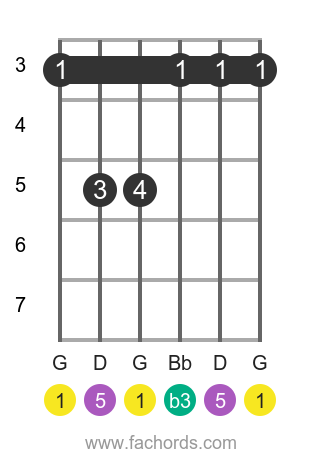
Welcome to our tutorial on the G minor (G m) chord. This chord, a member of the Minor Chords family, is constructed with the notes G, Bb, and D. The intervals that build this chord are the 1 (Root), b3 (Minor Third), and 5 (Perfect Fifth).
Understanding the notation of these intervals is crucial to mastering the G m chord. It's a part of the larger world of guitar chords, and you can learn more about this in our full tutorial on guitar chords.
As you delve into the G m chord, you'll discover that it's about more than just the notes and intervals. It's about how these elements come together to create a distinct sound. To learn more about how chords are built by stacking intervals, check out our guitar music theory tutorial.
The G m chord is a stepping stone to more advanced chords. Once you've mastered it, you might want to explore more advanced chords. And, if you'd like to understand how to invert intervals in a chord to get new shapes, our chord inversion tutorial is a great next step.
Finally, if you're unsure about any chord shapes shown on the fretboard, remember to use our interactive tool to analyze chord shapes. It's a handy tool for any guitarist, beginner or advanced. Happy playing!
Notes of the G m chord:
Chord Formula:
G Minor Chord | Common Shapes And Keys
In the following, we're going to see some G minor chord fingering options.
Before beginning, one warning:
Often, the stripped-down version of a chord does not sound as good as the original.
It is theoretically correct, and easier to play, but lacks sound richness.
Feel free to use it while learning, but your final target should be the standard shape, unless your musical taste suggests otherwise!
The G minor scale
We're not going to give a full lesson on harmony here, you only should know that a minor chord is constructed starting from its relative minor scale, taking the first (root), the 3rd and the 5th notes.
If you want to learn more about this, have a look at our chords formula tutorial.
Here's the G minor scales and its degrees:
G (1) A (2) Bb (3) C (4) D (5) Eb (6) F (7) G (8)If we take the root, the 3rd and the 5th degrees of this scales, we have the tones that compose a Gm chord
G (1) Bb (3) D (5)How we can apply what we learned so far to the guitar?
Well, if we have a look at the fretboard and where the three notes above are placed, we can start reasoning about our fingerings.
The G minor tones on the guitar fretboard
In the fretboard diagram below are shown the notes composing the G minor chord. Don't you know the notes of the fretboard?
Then you might find useful our guitar fretboard notes tutorial.
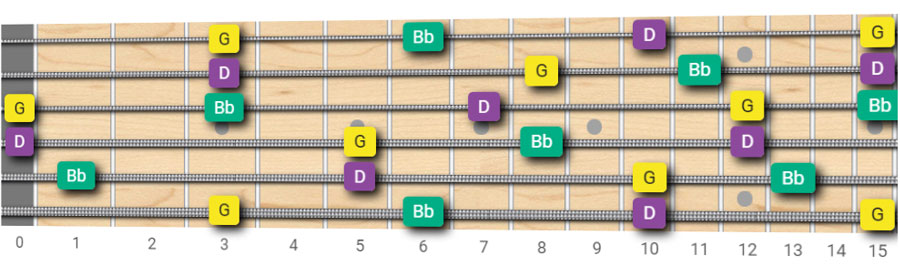
Did you spot already a easy Gm fingering? No?
Don't worry, now we're going to see how to pick some of the notes shown above for creating our cool chord shapes.
On the guitar, once we know what notes compose a chord, we can take any of these notes on any string for creating our chord shapes.
There are some rules, that are not strict but just guidelines:
- We can include a note in the chord one on more time, on any string and fret
- The root of the chord, G should be always included. We can
include it twice (on different strings) to give
it more power.
(Note: If you play with a band, this rule often does not apply, because for example is the bass player that plays the root).
- The 3rd of the chord, Bb should be always present (because it's the tone that makes that gives a major or minor feel to the chord)
- The fifth, D is the less important degree, but in this case, we'd like to include it as well.
- Some fingerings sound very good, others not so good, it's a matter of personal taste, experience and feeling.
Super easy G minor chord with just 2 fingers
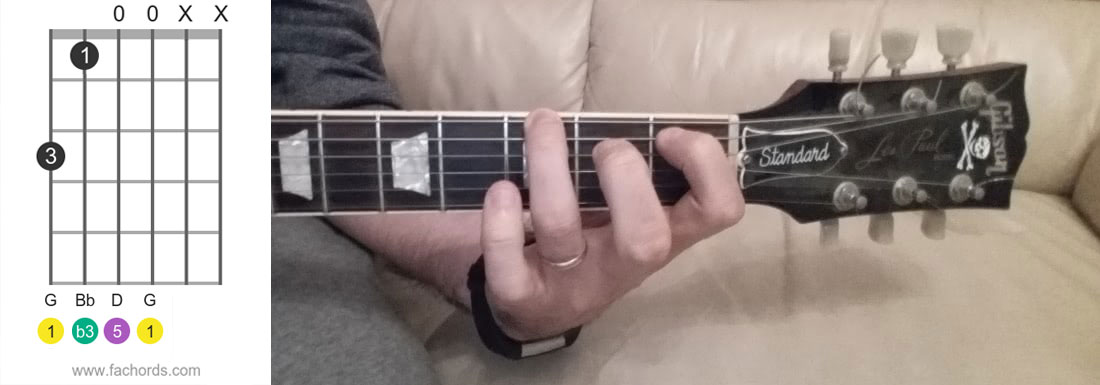
The easiest fingering for the G minor chord is shown in the following picture:
- Place your ring finger on the 3rd fret of the E low string
- Place your index finger on the 1st fret of the A string
- Play the D string open (without pressing any fret)
- Play the G string open (without pressing any fret)
- Do not play the B open string
- Do not play the E high string
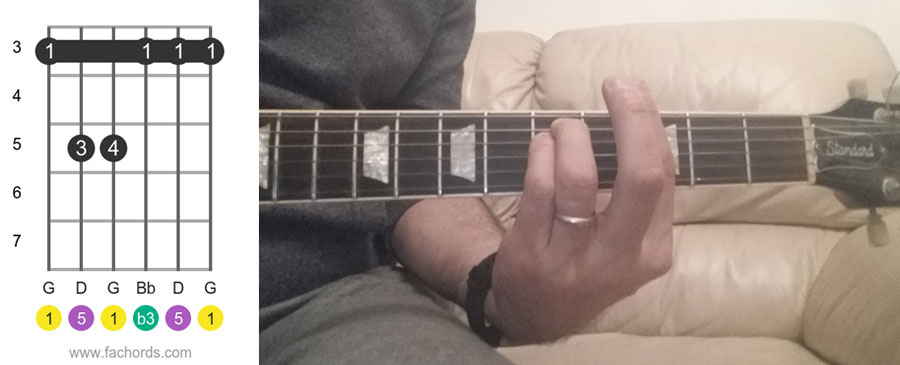
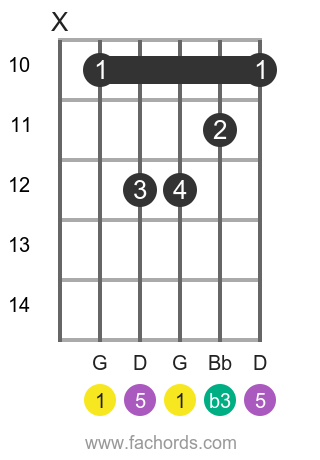
Classic G minor chord with root on the 6th string
The following fingering is the most used for the Gm chord.
It's a bit challenging because it requires a full barrè all over the six strings, but it's a great shape to practice for gaining strength.
G minor chord with root on the 5th string
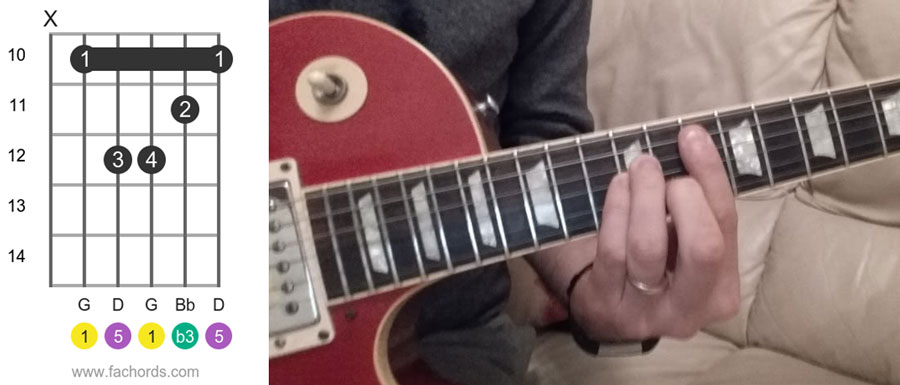
This fingering has a five strings barrè, and its taken in the higher fretboard position.
Be careful to mute the E lowest string, as E does not belong to the Gm chord.
This position is used a lot in funk and reggae music.
Keys with the G minor chord
Here below you find the most common keys (major and minor) that have a G minor chord on one of their degrees.
Major keys containing a Gm chord
F major key
| Key | I | ii | iii | IV | V | vi | vii |
|---|---|---|---|---|---|---|---|
| F | F | Gm | Am | Bb | C | Dm | Em/b5 |
Eb major key
| Key | I | ii | iii | IV | V | vi | vii |
|---|---|---|---|---|---|---|---|
| Eb | Eb | Fm | Gm | Ab | Bb | Cm | Dm/b5 |
Bb major key
| Key | I | ii | iii | IV | V | vi | vii |
|---|---|---|---|---|---|---|---|
| Bb | Bb | Cm | Dm | Eb | F | Gm | Am/b5 |
Minor keys containing a Gm chord
G minor key
| Key | i | ii | III | iv | v | VI | VII |
|---|---|---|---|---|---|---|---|
| G | Gm | Am/b5 | Bb | Cm | Dm | Eb | F |
D minor key
| Key | i | ii | III | iv | v | VI | VII |
|---|---|---|---|---|---|---|---|
| D | Dm | Em/b5 | F | Gm | Am | Bb | C |
C minor key
| Key | i | ii | III | iv | v | VI | VII |
|---|---|---|---|---|---|---|---|
| C | Cm | Dm/b5 | Eb | Fm | Gm | Ab | Bb |
G Minor Guitar Chord Shapes
Position 1
Movable
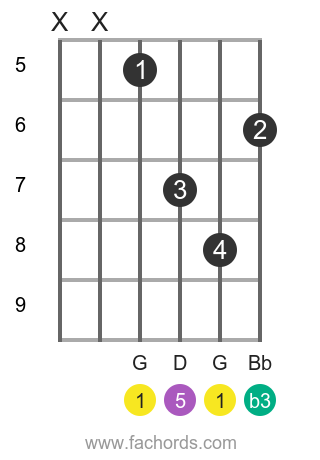
Position 2
Barre
Movable
Position 3
Barre
Movable
 Find more shapes in our all guitar chords online library. If you
prefer a printable pdf, download
the Free Guitar Chords Chart Pdf
Find more shapes in our all guitar chords online library. If you
prefer a printable pdf, download
the Free Guitar Chords Chart Pdf
You can also use this accessible Gm chord page, with written diagram instructions and screen-reader support for blind users.
FAQ
What are the fundamental notes and intervals that make up a G minor chord?
A G minor (Gm) chord is constructed from three specific notes: G, Bb (B-flat), and D. These notes correspond to the 1st (root), b3rd (minor third), and 5th (perfect fifth) intervals of the G minor scale, respectively, which give the chord its distinct minor sound.
Why is the Bb note (minor third) considered crucial when playing a G minor chord?
The Bb note is the minor third interval of the G minor chord, and it is crucial because it's the specific tone that defines the chord's minor quality. Without the minor third, the chord would lose its characteristic minor sound and wouldn't be a G minor chord. While the root (G) establishes the chord's name, the minor third dictates its fundamental character.
How are the notes of the G minor chord derived from the G minor scale?
The G minor chord is constructed by taking the 1st (root), 3rd, and 5th notes from the G natural minor scale. The G minor scale contains the notes G (1st), A (2nd), Bb (3rd), C (4th), D (5th), Eb (6th), and F (7th). Therefore, the G minor chord consists of G, Bb, and D.
What is the difference between a 'stripped-down' G minor chord and a 'standard' one, and when should I use each?
A 'stripped-down' G minor chord uses fewer notes or simpler fingerings, often making it easier for beginners to play. While theoretically correct, it may lack the full, rich sound of a 'standard' or full-barre chord shape. Stripped-down versions are great for learning, but your goal should typically be to master the standard shapes (like the full barre chords) for a fuller, more robust sound in most musical contexts.
When should I use a G minor barre chord with the root on the 6th string versus the 5th string?
The G minor barre chord with the root on the 6th string is a widely used and versatile shape, providing a full sound. The G minor barre chord with the root on the 5th string is often played in higher fretboard positions and is particularly favored in genres like funk and reggae due to its distinct voicing and feel. You typically mute the low E string with the 5th-string root shape. Your choice depends on the desired musical texture, style, and fretboard position.
In which major and minor keys can I commonly find the G minor chord?
The G minor chord appears as a diatonic chord in several keys. It functions as the ii (two minor) chord in F major, the iii (three minor) chord in Eb major, and the vi (six minor) chord in Bb major. In minor keys, it is the i (one minor) chord in G minor, the iv (four minor) chord in D minor, and the v (five minor) chord in C minor.