Explore the G 7(#11) Chord on Guitar & Play It Right
Want a structured chord roadmap instead of jumping between pages?
Go to the full guitar chords tutorial.
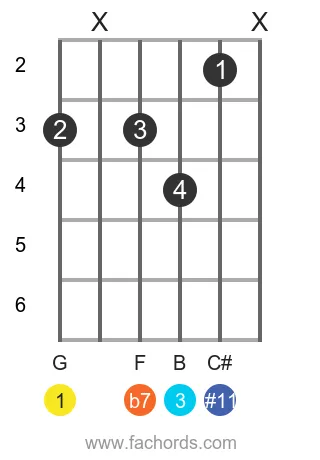
The G 7(#11) chord adds a vibrant, sophisticated color often heard in jazz and fusion, creating a sound that is both tense and intriguing. Built from the notes G, B, D, F, and C#, it derives its unique character from the intervals 1, 3, 5, b7, and the distinctive #11 (sharp eleventh). To truly grasp this dominant chord's sonic possibilities, use our interactive fretboard as your personal exploration lab, receiving instant mic feedback on your accuracy as you play, or listening to the chord playback to internalize its sound.
As an extended member of the Dominant Chords family, the G 7(#11) carries inherent tension, driving harmonic movement often towards resolution, a characteristic vital in styles from jazz to funk. Understanding how such chords are constructed, with their complex blend of intervals, is key to unlocking their power across the fretboard. For a deeper dive into the foundational principles of how chords are built, explore our comprehensive guide on Chord Construction. If you want to understand the core functionality of dominant chords, our Dominant Chord tutorial provides essential insights into their role in music.
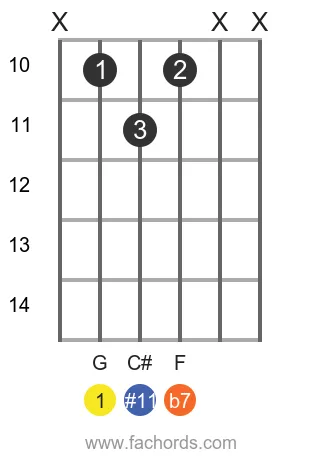
Before you delve into the theory, start by playing through the various G 7(#11) diagrams we provide, ranging from the easiest fingerings to more advanced voicings, to hear how this chord sounds across the neck. Our virtual fretboard, complete with BPM control and a drum machine, lets you experiment with different tempos and rhythms. After practicing, you can then explore the underlying theory, dissecting its role in songs and various musical keys.
Notes of the G 7(#11) chord:
Tones in the Dominant Seventh Sharp Eleventh Added chord:
G Dominant Seventh Sharp Eleventh Added Guitar Chord Diagrams
Position 1
Movable
Position 2
Movable
 Find more shapes in our all guitar chords online library. If you
prefer a printable pdf, download
the Free Guitar Chords Chart Pdf
Find more shapes in our all guitar chords online library. If you
prefer a printable pdf, download
the Free Guitar Chords Chart Pdf
You can also use this accessible G7(#11) chord page, with written diagram instructions and screen-reader support for blind users.

Created by
Giancarlo is a musician (teaching guitar since 2000), software engineer, AI consultant and published researcher
FAQ
What notes make up the G 7(#11) chord?
The G 7(#11) chord is composed of five specific notes: G (the root), B (the major third), D (the perfect fifth), F (the flat seventh), and C# (the augmented eleventh).
What does the '#11' interval in G 7(#11) mean, and why is it sharp?
The '#11' signifies an augmented (raised) eleventh interval from the root note (G). In this chord, it's a C#. It's sharp because the natural 11th (C) would create an undesirable dissonance with the major third (B) of the chord. Raising it to C# creates a more sophisticated and less clashing harmonic tension.
What musical quality or color does the #11 interval add to the G 7(#11) chord?
The #11 interval contributes a distinctive, often 'jazzy' or 'exotic' tension to the chord. It adds depth and a sophisticated, shimmering quality, making the G 7(#11) sound rich and complex, distinct from a standard dominant 7th chord.
Why is the G 7(#11) considered a 'dominant' chord?
The G 7(#11) is classified as a dominant chord primarily because it contains the flat seventh (b7) interval (F in this case). This interval, along with the root and major third, forms the core of a dominant chord, which typically creates tension that resolves to a tonic.
In what types of music is the G 7(#11) chord commonly used?
The G 7(#11) chord is frequently found in jazz and blues music. Its complex harmonic character makes it a staple for adding sophisticated voicings and color in these genres.
How does the G 7(#11) chord compare to a basic G7 chord?
The G 7(#11) chord is an extension of a basic G7 chord. While both contain the root (G), major third (B), perfect fifth (D), and flat seventh (F), the G 7(#11) adds the augmented eleventh (C#), which significantly alters its harmonic color and complexity.
Is the G 7(#11) chord difficult for guitarists to learn?
The G 7(#11) is considered a more advanced chord than fundamental beginner chords due to its extended nature and potentially intricate fingerings required to play all five notes. However, with dedicated practice and patience, guitarists can certainly master it.