G#7(#11) Guitar Chord Diagrams | G# Dominant Seventh Sharp Eleventh Added
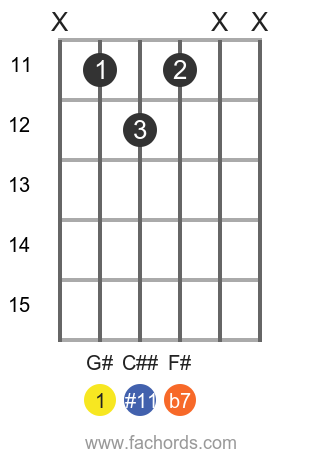
Welcome to our tutorial on the G# 7(#11) chord. This chord is a member of the Dominant Chords family, a group of chords known for their tense and unresolved sound. The G# 7(#11) chord is composed of the notes G#, B#, D#, F#, and C##, and is built from the intervals 1, 3, 5, b7, and #11.
Understanding the intervals that make up this chord is crucial. The intervals are: Root (1), Major Third (3), Perfect Fifth (5), Minor Seventh (b7), and Augmented Fourth (#11). If you need a refresher on intervals, check out our tutorial on fretboard intervals.
Learning to play the G# 7(#11) chord requires understanding chord diagrams and fretboard patterns. These visual aids show the tones that compose the chord and how they're arranged on the fretboard. For a comprehensive guide on this, dive into our full tutorial about guitar chords of all types.
The G# 7(#11) chord is more advanced than beginner chords, so if you're ready to level up your playing, this is a great place to start. You can find more advanced chords in our intermediate guitar chord tutorial.
This chord is often found in jazz chord progressions, which frequently use maj7, m7, and 7 chord types. To learn more about these progressions, visit our tutorial about jazz chord progression.
Finally, if you're experimenting with chord shapes on the fretboard and need help identifying them, our interactive tool for analyzing chord shapes can be a great help.
Mastering the G# 7(#11) chord will expand your musical vocabulary and open up new possibilities for your guitar playing. So grab your guitar and let's get started!
Notes of the G# 7(#11) chord:
Chord structure of the Dominant Seventh Sharp Eleventh Added chord:
Guitar Patterns for the G#7(#11) chord
Chord boxes are sorted from the easiest to the hardest. Learn how to read chord diagrams.
If you have difficulties with bar chord shapes, check the Bar Chords Tips tutorial.
You can also use this accessible chords page with written diagrams instruction.
Position 1
Movable
 You can find more shapes in our all guitar chords online library. If you
prefer a printable pdf, download
the Free Guitar Chords Chart Pdf
You can find more shapes in our all guitar chords online library. If you
prefer a printable pdf, download
the Free Guitar Chords Chart Pdf
FAQ
What are the specific notes that compose the G#7#11 chord?
The G#7#11 chord is made up of the notes G#, B#, D#, F#, and C##. These notes correspond to the chord's theoretical intervals.
Why is the G#7#11 considered a 'Dominant Chord'?
The G#7#11 is part of the Dominant Chords family because it possesses a 'tense and unresolved sound'. This characteristic quality is inherent to dominant chords and their function in harmony.
What do the intervals 1, 3, 5, b7, and #11 signify in the G#7#11 chord?
These numbers represent the specific intervals from the root note (G#) that form the chord: 1 is the Root, 3 is the Major Third, 5 is the Perfect Fifth, b7 is the Minor Seventh, and #11 is the Augmented Fourth. These intervals give the chord its unique sound.
Is the G#7#11 chord suitable for beginner guitarists?
No, the G#7#11 chord is explicitly described as 'more advanced than beginner chords'. It's presented as a way to enhance your playing once you're ready to tackle more complex harmonies and techniques.
When would a guitarist typically use the G#7#11 chord in music?
The G#7#11 chord is frequently found in jazz chord progressions. It adds a specific color and tension often utilized in jazz contexts, especially alongside maj7, m7, and 7 chord types.
What does the '#11' in the G#7#11 chord name indicate?
The '#11' indicates the inclusion of an Augmented Fourth interval in the chord structure. This interval is added to the standard dominant 7th chord (Root, Major Third, Perfect Fifth, Minor Seventh), contributing to its distinct sound.