Master the Emaj7 Guitar Chord: Theory and Application
Want a structured chord roadmap instead of jumping between pages?
Go to the full guitar chords tutorial.
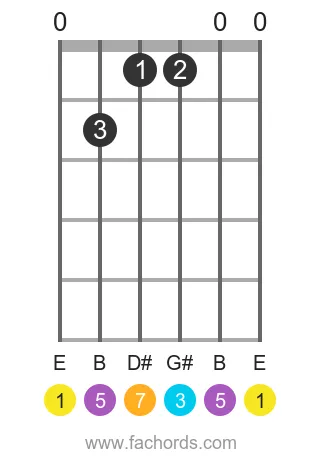
The Emaj7 chord, a sophisticated member of the Major Chords family, is built upon the intervals 1, 3, 5, and 7. These translate to the Root, Major Third, Perfect Fifth, and Major Seventh, respectively. For Emaj7, these notes are E, G#, B, and D#. You can explore these theoretical foundations using our interactive virtual fretboard, which visually displays each tone. Practice with real-time feedback from your microphone to confirm your accuracy, and utilize chord/arpeggio playback to hear the rich sound of this jazz-infused chord.
The Emaj7 chord's characteristic Major Seventh interval gives it its smooth jazz color and sophisticated sound, making it a favorite in genres seeking rich harmonic textures. Beyond its direct application, delving into the theory behind chord construction helps unlock its full potential, allowing you to build and understand similar harmonies. Mastering this chord also lays the groundwork for more advanced techniques, such as understanding chord inversions to create diverse voicings, and will naturally improve your chord changes by deepening your theoretical grasp.
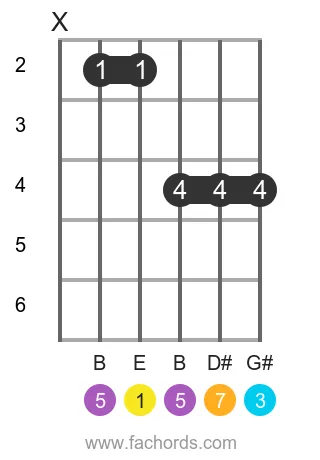
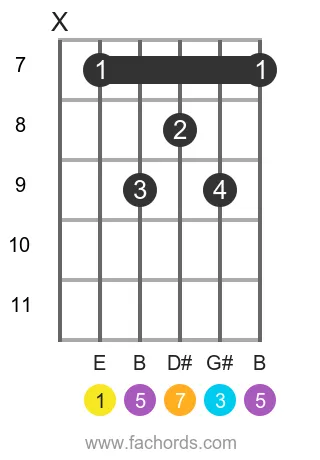
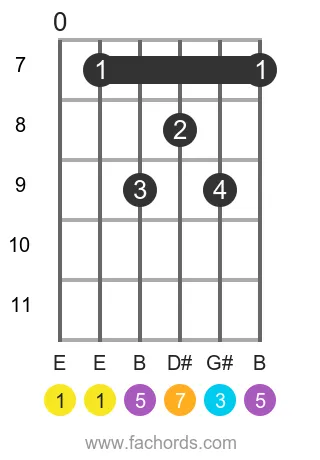
Below, you'll find comprehensive diagrams for the Emaj7 chord, ordered from the simplest to more challenging shapes, ready for disciplined practice. While these diagrams provide visual guidance, we encourage you to first utilize the interactive virtual fretboard to internalize the theory and feel of the chord across various keys. Consistent practice with this tool will not only solidify your understanding of Emaj7 but also empower you to confidently apply it in diverse songs and musical contexts.
Notes of the E maj7 chord:
Formula of the Major Seventh chord:
How To Play The E Major Seventh chord on guitar
Position 1
Open
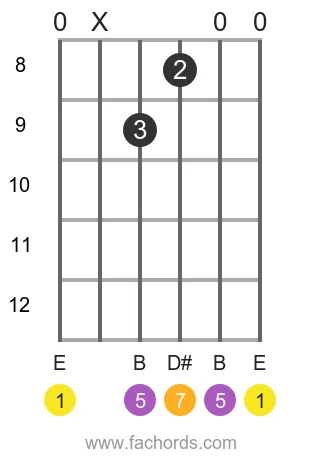
Position 2
Movable
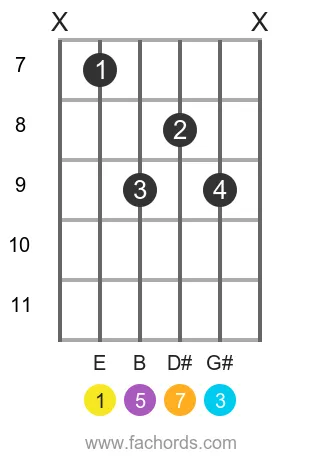
Position 3
Open
Position 4
Open
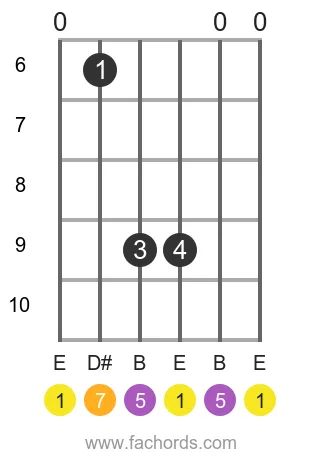
Position 5
Barre
Movable
Position 6
Barre
Movable
Position 7
Barre
Open

Position 8
Barre
Open
 Find more shapes in our all guitar chords online library. If you
prefer a printable pdf, download
the Free Guitar Chords Chart Pdf
Find more shapes in our all guitar chords online library. If you
prefer a printable pdf, download
the Free Guitar Chords Chart Pdf
You can also use this accessible Emaj7 chord page, with written diagram instructions and screen-reader support for blind users.
FAQ
What notes make up an Emaj7 chord?
The Emaj7 chord is composed of four specific notes: E, G#, B, and D#. These notes give the chord its unique sound and character.
What do the numbers 1, 3, 5, and 7 represent in the context of an Emaj7 chord?
These numbers represent the intervals that build the Emaj7 chord from its root note, E. Specifically, 1 is the Root (E), 3 is the Major Third (G#), 5 is the Perfect Fifth (B), and 7 is the Major Seventh (D#).
Why is the Emaj7 chord described as 'rich and complex' or 'sophisticated'?
The Emaj7 chord is considered rich and sophisticated because of the addition of the Major Seventh interval (D#). This interval creates a more ethereal and resolved sound compared to a simple major chord, making it a favorite in genres like jazz and popular music for adding harmonic depth.
Is the Emaj7 chord difficult for beginners to learn?
While the Emaj7 chord is generally more advanced than basic beginner chords due to its finger positioning and theoretical understanding, it's not insurmountable. With dedicated practice, guitarists who have a basic understanding of chords can successfully add it to their repertoire.
What is the benefit of 'inverting intervals' when playing the Emaj7 chord?
Inverting intervals within the Emaj7 chord allows you to discover new fretboard shapes and voicings while still playing the same chord. This practice can lead to different sonic textures and makes the chord more versatile for various musical contexts and arrangements.
