E Dominant Seventh Sharp Eleventh Added Guitar Chord Charts & Variations
Welcome to our tutorial on the E 7(#11) chord, a fascinating member of the Dominant Chords family. This chord is composed of the notes E, G#, B, D, and A#, creating a rich and complex sound that can add depth to your guitar playing.
The E 7(#11) chord is built by stacking the intervals 1, 3, 5, b7, and #11. These intervals refer to the Root, Major Third, Perfect Fifth, Minor Seventh, and Augmented Fourth respectively. If you're new to the concept of intervals and how they build chords, you may find our tutorial on building chords by stacking intervals helpful.
Understanding the E 7(#11) chord requires a solid understanding of fretboard intervals and how to denote chords based on the intervals that compose them. This chord is more advanced than beginner chords, so you might want to check out our tutorial on intermediate guitar chords if you're just getting started.
Once you've mastered the E 7(#11) chord, you can incorporate it into various chord progressions to create more complex music. It's often used in jazz chord progressions, for example, alongside maj7 and m7 chord types. To understand how to put chords together to create songs, take a look at our tutorial on the most common chord progressions.
So, are you ready to dive into the world of the E 7(#11) chord? Let's get started!
Notes of the E 7(#11) chord:
Chord structure of the Dominant Seventh Sharp Eleventh Added chord:
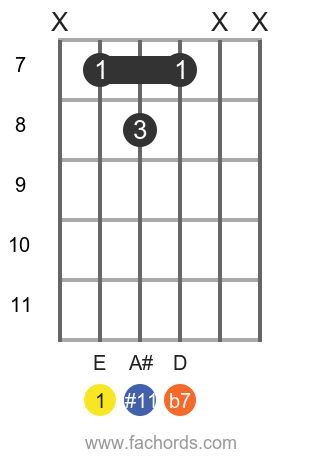
E7(#11) Guitar Chord Fingers Positions
Chord boxes are sorted from the easiest to the hardest. Learn how to read chord diagrams.
If you have difficulties with bar chord shapes, check the Bar Chords Tips tutorial.
You can also use this accessible chords page with written diagrams instruction.
Position 1
Movable
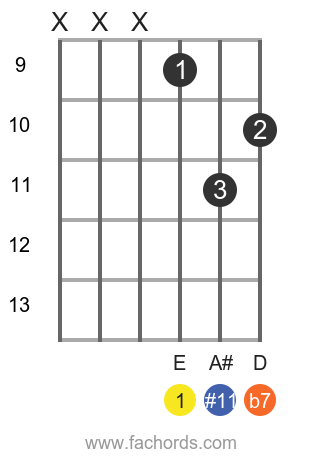
Position 2
Barre
Movable
 You can find more shapes in our all guitar chords online library. If you
prefer a printable pdf, download
the Free Guitar Chords Chart Pdf
You can find more shapes in our all guitar chords online library. If you
prefer a printable pdf, download
the Free Guitar Chords Chart Pdf
FAQ
What are the specific notes that form the E7#11 chord?
The E7#11 chord is comprised of five distinct notes: E, G#, B, D, and A#. These notes are what give the chord its unique, rich, and complex sound.
Why is the E7#11 chord classified as a "dominant chord"?
The E7#11 chord belongs to the Dominant Chords family because its foundational structure includes the root (1), major third (3), and minor seventh (b7) intervals, which are characteristic of dominant seventh chords. The #11 is an extension added to this dominant base.
What does the "#11" signify in the E7#11 chord name?
The "#11" in E7#11 indicates the inclusion of an augmented eleventh interval. This specific interval, which is equivalent to an Augmented Fourth from the root, is added to the dominant seventh chord to create its distinctive extended sound.
How are the intervals used to build the E7#11 chord?
The E7#11 chord is built by stacking specific intervals from the root note. These intervals are the 1 (Root), 3 (Major Third), 5 (Perfect Fifth), b7 (Minor Seventh), and #11 (Augmented Fourth).
In what musical contexts is the E7#11 chord commonly used?
Due to its rich and complex sound, the E7#11 chord is often incorporated into jazz chord progressions. It can be used alongside other chord types like maj7 and m7 to create more intricate musical textures and harmonies.
Is the E7#11 a suitable chord for guitarists who are just starting out?
No, the E7#11 is considered a more advanced chord. The tutorial explicitly states it's 'more advanced than beginner chords,' implying that a solid understanding of fundamental chord theory and intervals is beneficial before tackling it.