Understand and Play the E 6/9 Guitar Chord
Want a structured chord roadmap instead of jumping between pages?
Go to the full guitar chords tutorial.
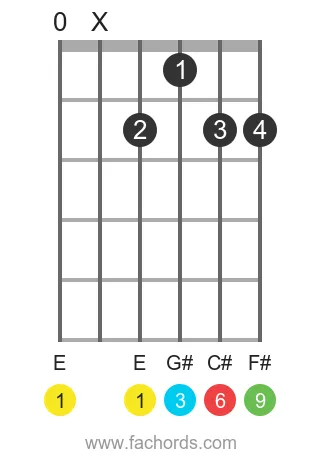
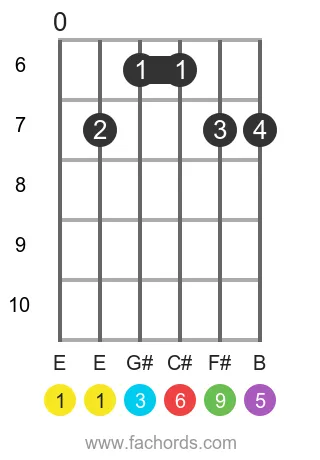
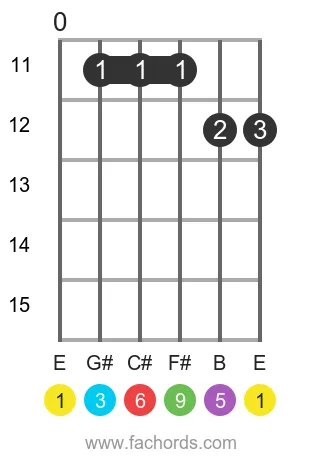
The E 6/9 chord, a rich harmony within the Major Chords family, is constructed from specific musical intervals that give it its unique character. It comprises the notes E, G#, B, C#, and F#, corresponding to the 1 (Root), 3 (Major Third), 5 (Perfect Fifth), 6 (Major Sixth), and 9 (Major Ninth) degrees of the E major scale. To truly grasp its sound and feel, our interactive virtual fretboard allows you to visualize and play this chord. Utilize the instant chord playback to hear its distinct quality, and fine-tune your accuracy with real-time mic feedback that verifies your playing technique.
Understanding the underlying theory of these intervals is paramount to mastering the E 6/9 chord, a staple for its vintage and jazz-infused sweetness. This chord exemplifies the elegance of extended harmonies, adding color beyond basic triads. For a comprehensive overview of how chords are built by stacking intervals, consult our tutorial on chord construction. As an example of a sixth chord, it incorporates an added sixth interval, expanding on the basic triad. Furthermore, the inclusion of a ninth interval places it within the realm of ninth chords, offering further harmonic possibilities.
In the sections that follow, you will find detailed chord diagrams, progressing from easiest to hardest, alongside further theoretical explanations and examples of how the E 6/9 chord is used in popular songs and across different keys. Before delving into static charts, we encourage you to spend time with our interactive tool. Use it to internalize the sound and feel of the E 6/9 chord through disciplined practice, setting a solid foundation for your learning.
E 6/9 chord Notes:
Chord structure of the Major Sixth Nine Added chord:
Guitar Patterns for the E6/9 chord
Position 1
Open
Position 2
Barre
Open
Position 3
Barre
Open
 Find more shapes in our all guitar chords online library. If you
prefer a printable pdf, download
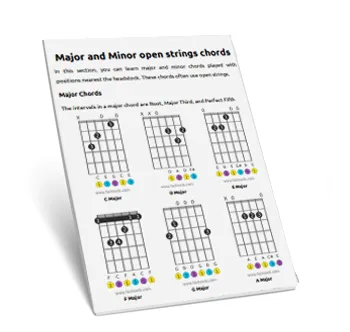
the Free Guitar Chords Chart Pdf
Find more shapes in our all guitar chords online library. If you
prefer a printable pdf, download
the Free Guitar Chords Chart Pdf
You can also use this accessible E6/9 chord page, with written diagram instructions and screen-reader support for blind users.

Created by
Giancarlo is a musician (teaching guitar since 2000), software engineer, AI consultant and published researcher
FAQ
What are the specific notes and intervals that constitute an E 6/9 chord?
The E 6/9 chord is composed of the notes E, G#, B, C#, and F#. These notes represent the 1 (Root), 3 (Major Third), 5 (Perfect Fifth), 6 (Major Sixth), and 9 (Major Ninth) intervals, respectively, from the root note E.
Why is this chord specifically named 'E 6/9'?
The 'E' in 'E 6/9' indicates that E is the root of the chord. The '6' refers to the inclusion of a Major Sixth interval (C#) in addition to the basic triad, and the '9' signifies the presence of a Major Ninth interval (F#).
How does the E 6/9 chord relate to other chord types like major, sixth, and ninth chords?
The E 6/9 chord is a member of the Major Chords family because it contains a major third and perfect fifth above its root. It is also an example of a sixth chord due to the added Major Sixth interval, and it belongs to the ninth chords family because it includes a Major Ninth interval.
What elements contribute to the E 6/9 chord's description as a 'rich and complex harmony'?
The E 6/9 chord achieves its rich and complex harmony through the combination of its specific intervals. The addition of both the Major Sixth and Major Ninth to the basic major triad creates a fuller, more nuanced sound compared to simpler major chords, adding depth and distinct character to the harmony.