D#+(#11) Guitar Chords Explained | D# Augmented Fifth Sharp Eleventh added
Welcome to our tutorial on the D# +(#11) chord, a member of the Augmented Chords family. This particular chord is composed of the notes D#, F##, A##, and G##. It's built using a series of intervals - namely the 1, 3, #5, and #11. If you're new to these terms, they refer to the different types of musical intervals that exist, with each number representing a specific distance between two notes. For a deeper understanding of these intervals, feel free to check out our tutorial about fretboard intervals.
Understanding the D# +(#11) chord is a step towards mastering more complex guitar chords. This chord, with its unique sound, can add a refreshing twist to your music. If you're interested in learning how to build chords by stacking intervals, we have a comprehensive tutorial that teaches how to build chords by stacking intervals.
Playing the D# +(#11) chord involves certain fretboard patterns that highlight the tones composing the chord. Our tutorial will guide you through these patterns with easy-to-follow chord diagrams. For those who want to delve deeper into chord notation based on the intervals that compose it, we recommend our tutorial on how to denote chords depending on the intervals that compose it.
Remember, practice is key when it comes to mastering any guitar chord, including the D# +(#11) chord. So grab your guitar and let's get started!
Notes in the D# +(#11) chord:
Tones in the Augmented Fifth Sharp Eleventh added chord:
 Download
the Free Guitar Chords Chart Pdf
Download
the Free Guitar Chords Chart Pdf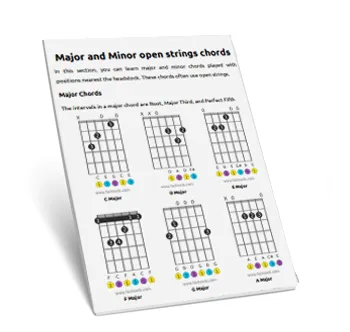
FAQ
What notes make up the D# +(#11) chord?
The D# +(#11) chord is composed of four specific notes: D#, F##, A##, and G##. These notes form the unique sound of this augmented chord.
What kind of chord is the D# +(#11)?
The D# +(#11) chord is classified as a member of the Augmented Chords family, indicating its characteristic sound and construction.
What do the interval numbers (1, 3, #5, #11) mean for the D# +(#11) chord?
These numbers represent the specific musical intervals used to build the D# +(#11) chord. Each number indicates a particular distance between notes, starting from the root (1), and including the 3rd, #5th, and #11th.
Why should I learn the D# +(#11) chord on guitar?
Learning the D# +(#11) chord enhances your guitar skills by introducing a more complex chord. Its unique sound can add a refreshing twist and distinctive character to your music.
How are the notes of the D# +(#11) chord determined?
The notes of the D# +(#11) chord are determined by stacking a specific series of intervals from its root note. These intervals are the 1st (root), 3rd, #5th, and #11th.
How do I approach learning to play the D# +(#11) chord on the guitar?
Playing the D# +(#11) chord involves learning specific fretboard patterns that highlight its unique tones. Consistent practice of these patterns is key to mastering the chord on your guitar.