D# aug Guitar Chord
Chord Diagrams, Interactive Fretboard and Chord Theory
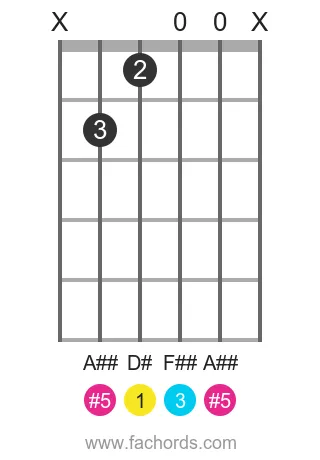
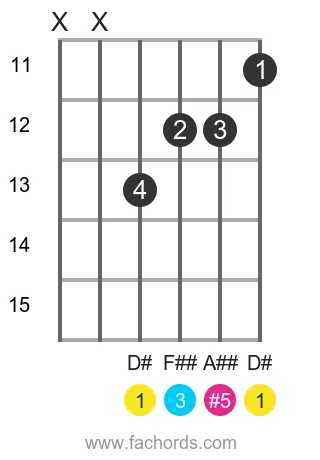
D# augmented guitar chord is also written as D#aug, D#+, D#(#5) or D#maj(#5).
Position 1
Open
Position 2
Open
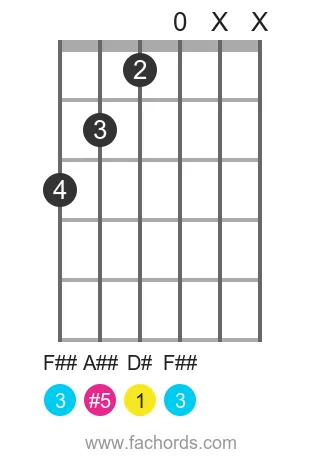
Position 3
Movable
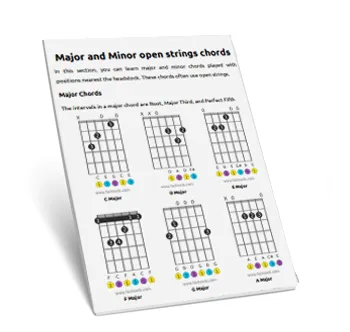
 Find more shapes in our all guitar chords online library. If you
prefer a printable pdf, download
the Free Guitar Chords Chart Pdf
Find more shapes in our all guitar chords online library. If you
prefer a printable pdf, download
the Free Guitar Chords Chart Pdf
You can also use this accessible D#aug chord page, with written diagram instructions and screen-reader support for blind users.
Explore D#aug Guitar Chord: Interactive Fretboard Shapes
Want a structured chord roadmap instead of jumping between pages?
Go to the full guitar chords tutorial.
Discover the unique fretboard geometries for the D#aug chord, visualizing its layout across the strings with our interactive virtual fretboard. This chord belongs to the Augmented Chords family, built from the notes D#, F##, and A##. Its characteristic sound comes from the intervals 1, 3, and #5 (Root, Major Third, and Augmented Fifth). Use the real-time microphone feedback to verify your finger placement for each shape, and play the chord as a strum or arpeggio to hear its distinct quality.
The augmented fifth is the defining interval for the D#aug chord, creating its characteristic tension and adding rich, complex color to your progressions. Understanding how these intervals stack is crucial; you can explore the fundamentals in our guide on Chord Construction. As you get comfortable with visualizing and playing these shapes, focus on fluid transitions between chords. Our dedicated tips for Improve Chords Change will guide you in integrating the D#aug chord smoothly into your musical vocabulary, emphasizing how its unique interval structure interacts with other chords.
Below, you'll find a complete collection of D#aug chord diagrams, presented from the simplest open positions to more advanced movable shapes. We’ll also delve into the underlying music theory, showcase popular songs featuring this chord, and list the keys where it frequently appears. Before you begin memorizing these diagrams, take advantage of the interactive tool above. Explore the various shapes, listen to their sound, and use the real-time mic feedback to confirm your fingerings are accurate. This focused exploration of the fretboard will help you internalize the D#aug chord before you commit shapes to memory.
Notes in the D# aug chord:
Chord Formula:
Play This Chord With Other Roots
C aug | D aug | E aug | F aug | G aug | A aug | B aug | C#aug | D#aug | F#aug | G#aug | A#aug | Abaug | Bbaug | Dbaug | Ebaug | Gbaug

Created by
Giancarlo is a musician (teaching guitar since 2000), software engineer, AI consultant and published researcher
FAQ
What are the specific notes that form a D# augmented chord?
The D# augmented chord is built from three distinct notes: D# (the root), F## (a major third above the root), and A## (an augmented fifth above the root).
What does the term 'augmented' signify in the context of a D# augmented chord?
In music theory, 'augmented' refers to the quality of the fifth interval in the chord. For the D# augmented chord, this means the fifth is raised a half-step from a perfect fifth, creating an 'augmented fifth' (A##) and giving the chord its characteristic, often dissonant or unresolved sound.
Why does the D# augmented chord use double sharps (F## and A##) for some of its notes?
The notes F## and A## are used to maintain the correct theoretical interval structure of an augmented chord, which is a root, a major third, and an augmented fifth. F## accurately represents the major third above D#, and A## represents the augmented fifth above D#. Using enharmonic equivalents would incorrectly imply different interval relationships based on standard music theory conventions.
What are the fundamental intervals that define a D# augmented chord?
The D# augmented chord is fundamentally defined by three intervals: the 1 (root), the 3 (major third), and the #5 (augmented fifth). These intervals always determine the specific sound and structure of any augmented chord, with D# as the root in this case.
How does the D# augmented chord typically sound or function in music compared to other chords?
The D# augmented chord has a unique, often tension-filled or 'floating' quality due to its augmented fifth interval. Unlike stable major or minor chords, it typically sounds less resolved and can be used to add harmonic color, create a sense of suspense, or lead to other chords in a progression.
Is the D# augmented chord considered part of a specific chord family?
Yes, the D# augmented chord belongs to the 'Augmented Chords family.' All chords within this family share the characteristic interval structure of a root, a major third, and an augmented fifth, giving them their distinct sound.