Db6 Guitar Chord | Play, Hear and Practice Interactively
Want a structured chord roadmap instead of jumping between pages?
Go to the full guitar chords tutorial.
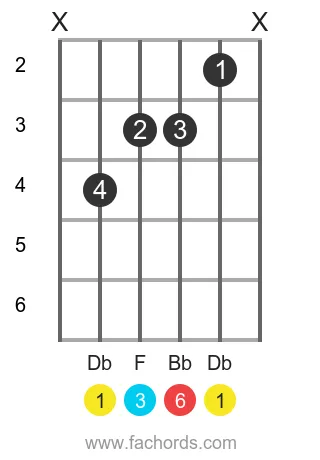
The Db6 chord belongs to the Major Sixth family and is built from four notes: Db, F, Ab, and Bb - corresponding to the intervals Root (1), Major Third (3), Perfect Fifth (5), and Major Sixth (6). Use the interactive fretboard tool at the top of this page to visualize every fingering, listen to the chord played as a strum or arpeggio, and check your own playing with real-time microphone feedback - the tool will tell you if you're hitting the notes perfectly.
The Db6 chord is a vibrant addition to your playing, offering a rich harmonic depth that's essential in many jazz and contemporary styles. Understanding its construction is key to mastering it; explore our guide to 6th Chords to see how they fit into the broader chord families. For a deeper dive into how chords are built from intervals, check out our Chord Construction tutorial. Once you're comfortable with the theory and shapes, focus on improving your chord changes for smooth transitions.
Below, you'll find a comprehensive collection of chord diagrams for the Db6, ranging from the easiest open positions to more challenging movable shapes. We'll also cover additional music theory insights, popular songs that feature this chord, and the various keys where it shines. Before you scroll down, take a moment to engage with the interactive tool above - set a comfortable tempo with the drum & BPM tool, strum the chord, and let the mic feedback confirm your finger placement. This immediate feedback loop is incredibly powerful for solidifying new chords in your muscle memory.
Notes of the Db 6 chord:
Chord structure of the Major Sixth chord:
Db6 Guitar Chord Fingers Positions
Position 1
Movable
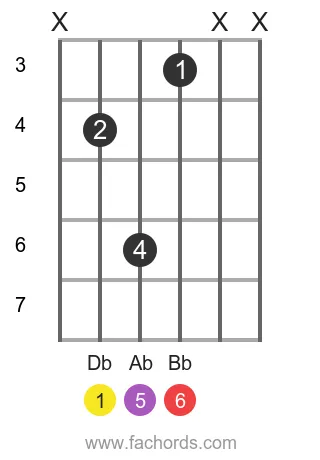
Position 2
Movable
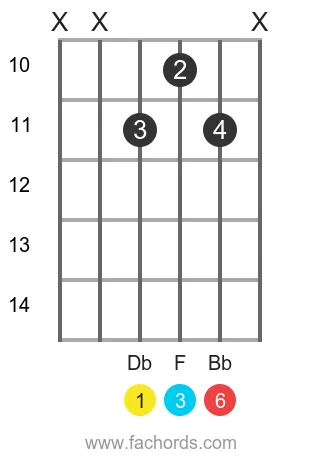
Position 3
Movable
Position 4
Movable
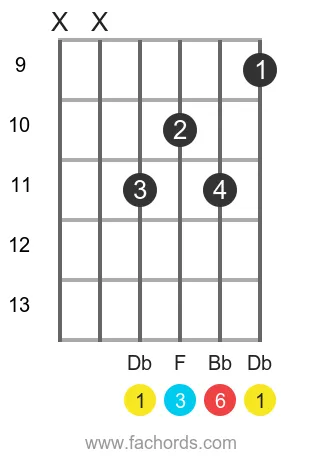
Position 5
Barre
Movable
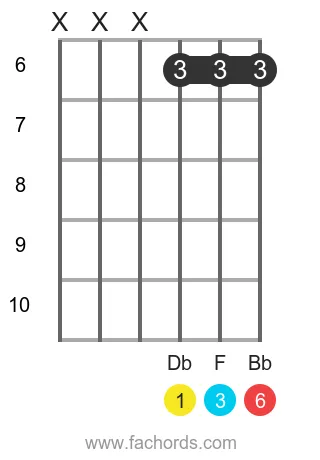
Position 6
Barre
Movable
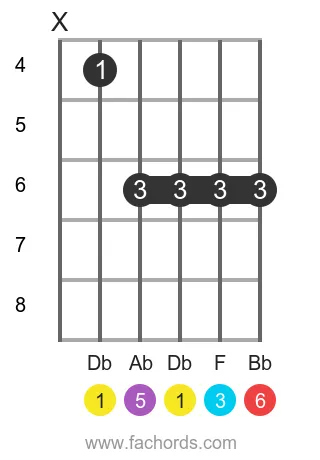
Position 7
Barre
Movable
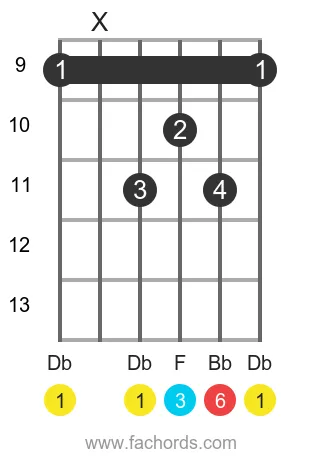
 Find more shapes in our all guitar chords online library. If you
prefer a printable pdf, download
the Free Guitar Chords Chart Pdf
Find more shapes in our all guitar chords online library. If you
prefer a printable pdf, download
the Free Guitar Chords Chart Pdf
You can also use this accessible Db6 chord page, with written diagram instructions and screen-reader support for blind users.


Created by
Giancarlo is a musician (teaching guitar since 2000), software engineer, AI consultant and published researcher
FAQ
What specific notes are included in a Db 6 chord?
The Db 6 chord is composed of the notes Db, F, Ab, and Bb. These correspond to the root, major third, perfect fifth, and major sixth intervals, respectively, when counted from the root note Db.
How does the '6' in Db 6 differentiate it from a standard Db major chord?
The '6' indicates that a major sixth interval (Bb in this case) has been added to a fundamental Db major triad (Db, F, Ab). This added note creates a richer, more complex harmonic sound distinct from a simple major chord.
In what musical situations is the Db 6 chord typically used?
The Db 6 chord is known for its sophisticated and vibrant sound, making it a common choice in genres like jazz. It adds harmonic depth and interest to chord progressions, helping to create more complex and engaging musical textures.
What does it mean to build the Db 6 chord by 'stacking intervals'?
Building the Db 6 chord by stacking intervals means constructing it step-by-step from its root. You start with the root note (Db), then add a major third (F) above it, then a perfect fifth (Ab) above the root, and finally a major sixth (Bb) above the root, layering these intervals to form the complete chord.
Why is the Db 6 chord classified under the 'Major Chords family'?
The Db 6 chord maintains its classification within the Major Chords family because its foundational structure is a major triad (Db, F, Ab). The addition of the major sixth interval enhances and colors this major quality without altering its inherent major tonality to a minor, dominant, or diminished sound.
