Db11 Guitar Chord | Play, Hear and Practice Interactively
Want a structured chord roadmap instead of jumping between pages?
Go to the full guitar chords tutorial.
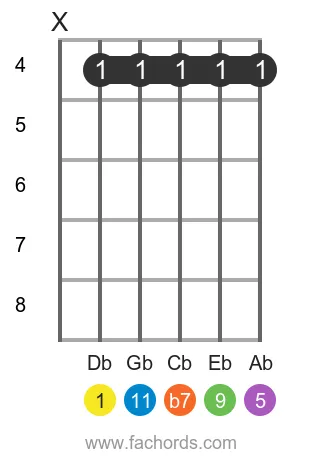
Welcome to the fascinating world of the Db11 chord, a rich and complex member of the Dominant Chords family. This expressive chord is built from six notes: Db, F, Ab, Cb, Eb, and Gb. These correspond to the intervals Root (1), Major Third (3), Perfect Fifth (5), Minor Seventh (b7), Major Ninth (9), and Perfect Eleventh (11). To truly master its sound, utilize the interactive fretboard tool at the top of this page; it lets you visualize every fingering, listen to the chord played as a strum or arpeggio, and instantly check your accuracy with real-time microphone feedback.
The Db11, with its extended harmony, adds a sophisticated, jazz-infused color to your music, building on the tension-release dynamic common to dominant chords. To grasp the foundation of these complex voicings, explore our guide on Dominant Chords. You can also delve deeper into how these extended chords are built by stacking intervals in our Chord Construction tutorial. While the Db11 is often played with advanced fingerings, many shapes involve barres; if you're working on them, our Guitar Bar Chords resource can help. Once you're comfortable, don't forget to practice improving your chord changes to integrate the Db11 smoothly into your playing.
Below, you'll discover over 20 detailed Db11 chord diagrams, ranging from the most accessible shapes to more advanced voicings, along with foundational music theory, inspiring songs featuring the Db11, and the common keys where it beautifully fits. But before you dive into static diagrams, take a moment to engage with the interactive tool above. Set a comfortable tempo with the drum and BPM tool, strum the Db11, and let the mic feedback guide you. This hands-on, immediate practice loop is by far the most effective way to truly learn and internalize a new chord like the Db11.
Notes that compose the Db 11 chord:
Chord Structure:
Db11 Guitar Chord Diagrams
Position 1
Barre
Movable
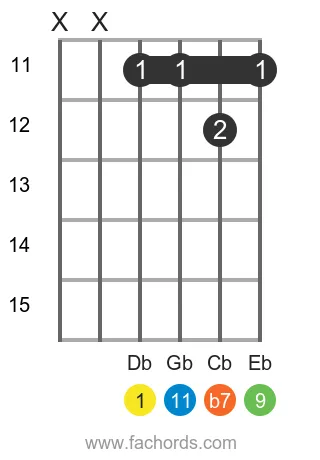
Position 2
Barre
Movable
Position 3
Barre
Movable

 Find more shapes in our all guitar chords online library. If you
prefer a printable pdf, download
the Free Guitar Chords Chart Pdf
Find more shapes in our all guitar chords online library. If you
prefer a printable pdf, download
the Free Guitar Chords Chart Pdf
You can also use this accessible Db11 chord page, with written diagram instructions and screen-reader support for blind users.

Created by
Giancarlo is a musician (teaching guitar since 2000), software engineer, AI consultant and published researcher
FAQ
What specific notes make up the Db 11 chord?
The Db 11 chord is composed of six distinct notes: Db (the root), F (major third), Ab (perfect fifth), Cb (minor seventh), Eb (major ninth), and Gb (perfect eleventh).
What do the intervals 1, 3, 5, b7, 9, and 11 represent in the Db 11 chord?
These numbers represent the specific musical intervals stacked above the root note, Db. '1' is the root, '3' is the major third, '5' is the perfect fifth, 'b7' is the minor seventh, '9' is the major ninth, and '11' is the perfect eleventh.
Why is the Db 11 chord classified as a 'Dominant Chord'?
The Db 11 chord is considered a dominant chord primarily because it contains a minor seventh (b7) interval, Cb, above its root, Db. Dominant chords are known for their inherent tension, which typically drives musical progression towards resolution.
How do the 9th and 11th intervals contribute to the 'complex and vibrant' sound of the Db 11 chord?
The inclusion of the 9th (Eb) and 11th (Gb) intervals, which extend beyond a basic dominant seventh chord, adds layers of harmony and dissonance. These extended intervals provide a richer, more sophisticated texture, creating the chord's characteristic complex and vibrant quality.
What is the musical role of a Db 11 chord?
As a member of the Dominant Chords family, the Db 11 chord's primary musical role is to create a strong sense of tension. This tension typically propels the music forward, building anticipation for a resolution to another chord, often a tonic.