Explore and Play: The C Minor Guitar Chord on the Fretboard
Want a structured chord roadmap instead of jumping between pages?
Go to the full guitar chords tutorial.
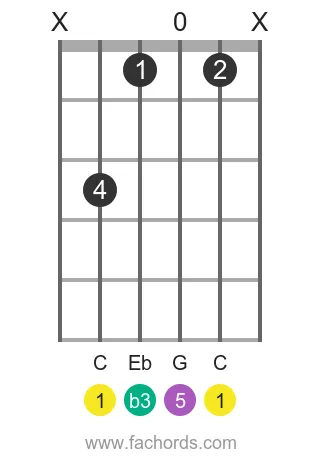
To truly master the C minor (C m) chord, visualize its shape directly on the fretboard. Our interactive virtual fretboard allows you to see and play this essential minor chord, composed of the notes C, Eb, and G, built from the intervals 1, b3, and 5. Use the real-time mic feedback to instantly verify your finger placement and ensure every note rings clear, or use the playback feature to hear the perfect sound. This approach helps you understand its spatial layout across the strings.
As a fundamental part of the Minor Chords family, the C m chord brings a distinct emotional color to your playing, derived from its Root (1), Minor Third (b3), and Perfect Fifth (5) intervals. Understanding this harmonic structure is crucial for any aspiring guitarist. You can gain a deeper understanding of how these intervals work together to create the distinctive sound of the C m chord by checking out our tutorial on Chord Construction. If you are looking to incorporate chords like C minor into your songs, learning about Improve Chords Change can help you create smoother progressions. Also, exploring different Understanding Chord Inversions can unlock new ways to voice this chord.
Below, you'll find various diagrams of the C m chord, arranged from easiest to hardest, alongside theoretical insights and suggestions for incorporating it into songs and different musical keys. Before diving into memorization, take advantage of our interactive tool to visually explore different shapes and positions, experimenting with the virtual fretboard and its playback feature. This hands-on exploration will build a strong foundation for your playing.
Notes that compose the C m chord:
How the Minor chord is built:
C Minor Guitar Chord | Complete Tutorial
Before we find different chord positions for Cm let’s get an idea of how the chord is built and used.
The notes for the C major scale are C D E F G A B and a major chord is made up of the root, major third, and perfect fifth.
Which means a C major chord is made up of the notes C-E-G. If we instead use the root, minor third, and perfect fifth we get C Eb G or C minor
C minor scale: C D Eb F G Ab Bb
Songs with the C minor chord
Minor chords are often associated with sadder and often slower music.
Major chords are perfect for upbeat rock and blues, while the minors are there to change the mood.
You will find plenty of minor chords in classical music along with genres like pop, rock, and funk.
- One famous song written in a minor key was "Stairway to Heaven"
- One particular tune using Cm was "Blackbird" by The Beatles.
- The song "Creep" by Radiohead uses C major and then C minor to end each verse. (And the song "Creep" is supposedly a copy of the song "Air That I Breathe" by The Hollies and that also uses the Cm chord)
That is why that chord progression (C major and the C minor) has been used so many times (even "Get Free" by Lana Del Ray) it sounds so nice changing from the major to the minor.
C minor chord guitar shapes

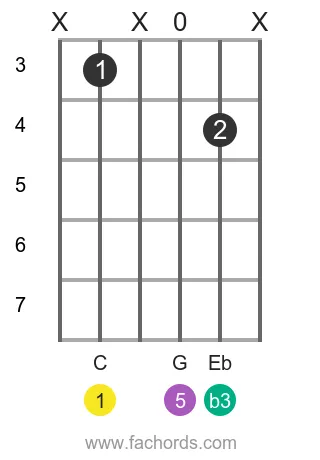
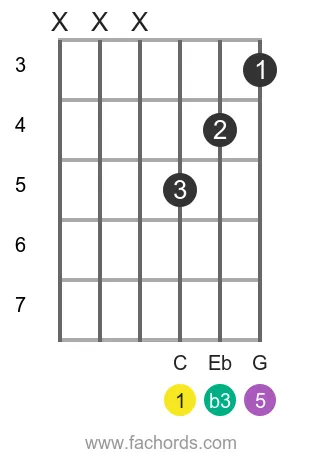
Using the tones above we can come up with some of the more popular versions of how to play the Cm chord.
Usually when we play a chord we want the root note (here C) to be the lowest played bass note.
Sometimes we will find a chord shape where that isn’t the case, which means the chord is an inversion. If the lowest note is E or G instead of the C than that is an inversion.
It will depend on previous and latter chords in the progression as to whether the inversions sound good when played.
Sometimes the inversions will sound better than the regular chord with the normal root note!
Common C minor shape (barre required)
One common way to play Cm is by using barre chord minor shapes.
For example the Am shape moves up three frets to become Cm X35543. Or we move the Em shape up eight frets at 8-10-10-8-8-8.
C Minor Chord Shape | Barre at 3rd Fret

C Minor Chord Shape | Barre at 7th Fret

Cm fingering variations
Or we can try voicing it as 8655XX or perhaps the first inversion which is easily played X6554X
C Minor Chord Voicing

Other Uncommon Shapes For C Minor Chord
We can also try some complicated positions with muted strings.
Like X3X04X which is used in the song Blackbird like we mentioned above.
Also this "open" Cm X3101X. Remember muting the outer E strings will be a lot easier than internal strings, they require a lot more practice.
C Minor Chord Voicing

C Minor Chord Voicing

Keys with C minor chord
You will often see Cm in the Keys of Eb, Bb, and Ab.
Of course it may be used in regular keys like G and F if you want a mood change from major to minor.
Three common scales that are fitting when playing the Cm chord are the natural minor scale, the harmonic minor, and the melodic minor scale.
Eb major key
| Key | I | ii | iii | IV | V | vi | vii |
|---|---|---|---|---|---|---|---|
| Eb | Eb | Fm | Gm | Ab | Bb | Cm | Dm/b5 |
Bb major key
| Key | I | ii | iii | IV | V | vi | vii |
|---|---|---|---|---|---|---|---|
| Bb | Bb | Cm | Dm | Eb | F | Gm | Am/b5 |
Ab major key
| Key | I | ii | iii | IV | V | vi | vii |
|---|---|---|---|---|---|---|---|
| Ab | Ab | Bbm | Cm | Db | Eb | Fm | Gm/b5 |
G minor key
| Key | i | ii | III | iv | v | VI | VII |
|---|---|---|---|---|---|---|---|
| G | Gm | Am/b5 | Bb | Cm | Dm | Eb | F |
F minor key
| Key | i | ii | III | iv | v | VI | VII |
|---|---|---|---|---|---|---|---|
| F | Fm | Gm/b5 | Ab | Bbm | Cm | Db | Eb |
C Minor Guitar Chord Voicings
Position 1
Open
Position 2
Movable
Position 3
Movable
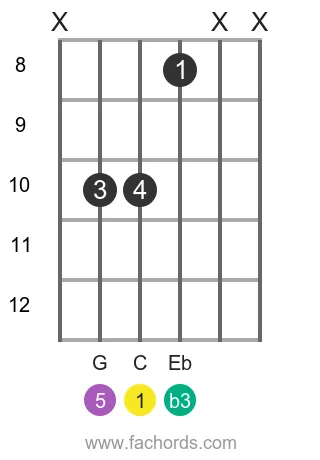
Position 4
Movable
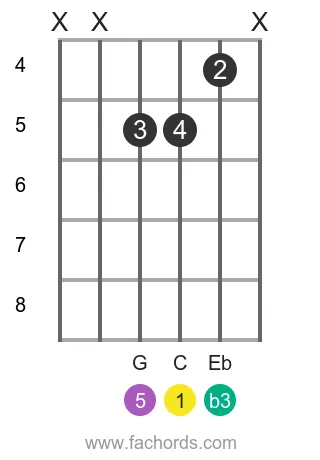
Position 5
Movable
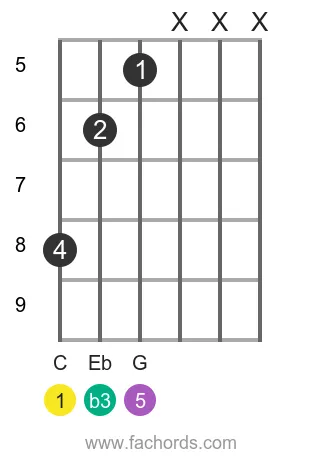
Position 6
Open
Position 7
Movable
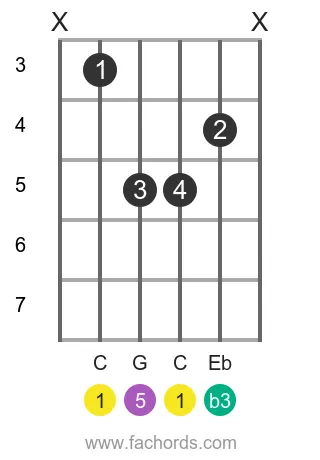
Position 8
Movable
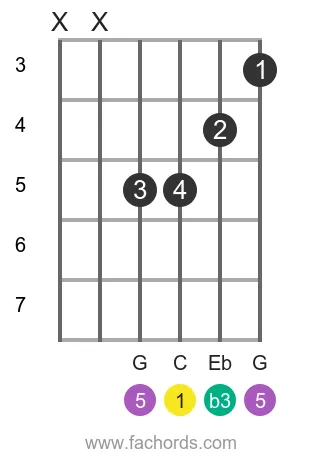
Position 9
Movable
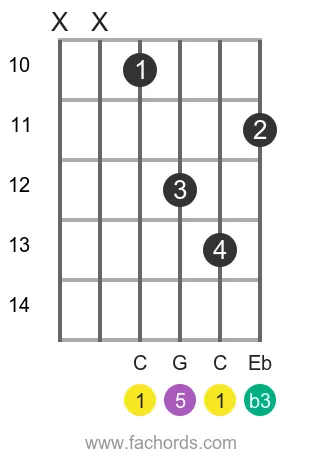
Position 10
Movable
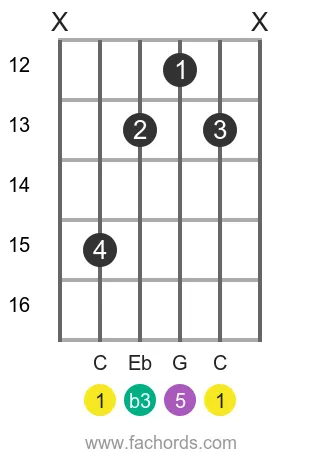
Position 11
Barre
Movable
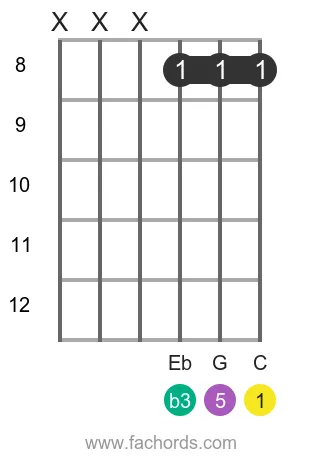
Position 12
Barre
Movable
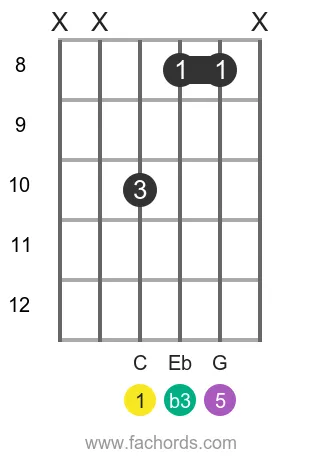
Position 13
Barre
Movable
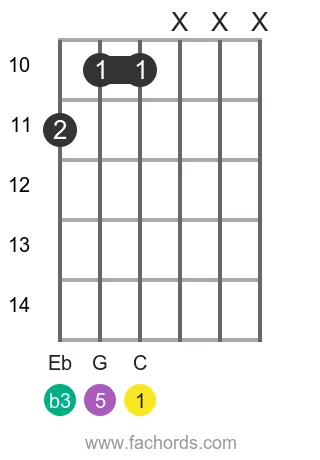
Position 14
Barre
Movable
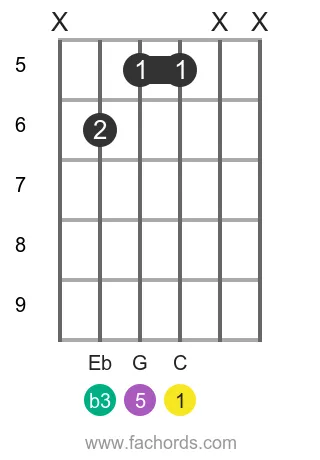
Position 15
Barre
Movable
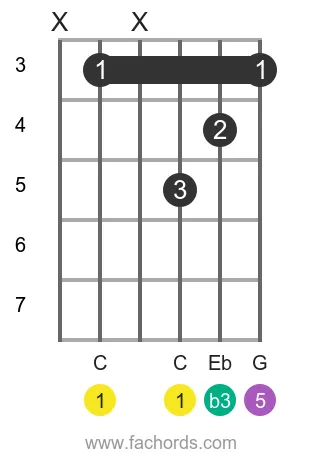
Position 16
Barre
Movable
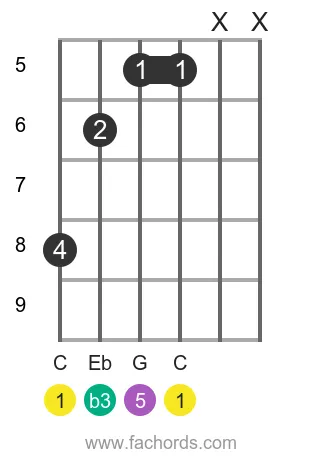
Position 17
Barre
Movable
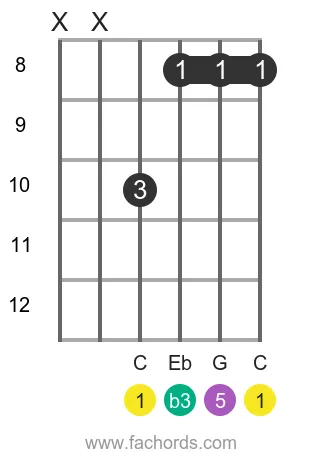
Position 18
Barre
Movable
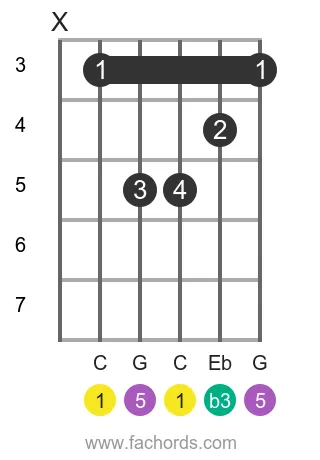
Position 19
Barre
Movable
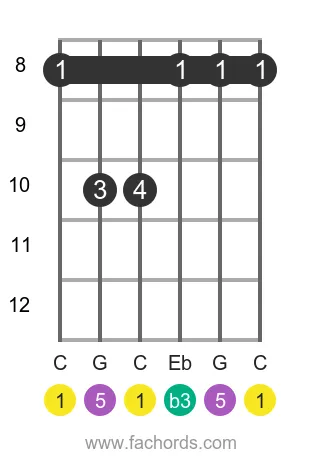
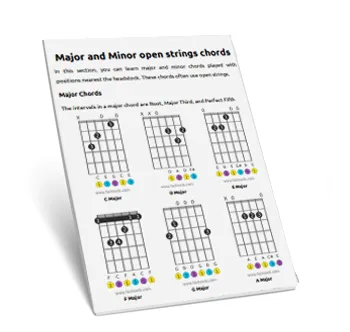
 Find more shapes in our all guitar chords online library. If you
prefer a printable pdf, download
the Free Guitar Chords Chart Pdf
Find more shapes in our all guitar chords online library. If you
prefer a printable pdf, download
the Free Guitar Chords Chart Pdf
You can also use this accessible Cm chord page, with written diagram instructions and screen-reader support for blind users.
FAQ
What notes and intervals make up the C minor chord?
The C minor (Cm) chord is constructed from the notes C, Eb, and G. These correspond to the Root (1), Minor Third (b3), and Perfect Fifth (5) intervals, which are the fundamental components defining any minor triad.
How does a C minor chord differ from a C major chord?
The key distinction between a C minor and C major chord lies in the third interval. A C major chord uses a major third (E), giving it the notes C-E-G. In contrast, a C minor chord utilizes a minor third (Eb), resulting in the notes C-Eb-G. This single note change produces their characteristic major and minor sounds.
What is a chord inversion, and when might I use one for the C minor chord?
A C minor chord inversion occurs when a note other than the root (C) is played as the lowest bass note in the chord (e.g., Eb or G). Inversions can offer unique harmonic textures and provide smoother voice leading or transitions between chords within a progression, sometimes sounding more musically appropriate than the root position.
Why are barre chords commonly used to play the C minor chord?
Barre chords are a common and effective way to play C minor because they utilize movable shapes. For example, adapting an open Am shape or Em shape allows you to play C minor at different positions on the fretboard (e.g., Am shape at the 3rd fret or Em shape at the 8th fret), making it versatile for various musical contexts.
What kind of mood or musical situations is the C minor chord best suited for?
The C minor chord is typically associated with conveying a sadder, slower, or more reflective mood in music. It's often used to create emotional depth or to change the feel from major to minor within a piece. You'll find it frequently in classical music, pop, rock, and funk genres.
In what musical keys will I commonly find the C minor chord?
The C minor chord appears naturally as a diatonic chord in several keys. It functions as the vi chord in Eb Major, the ii chord in Bb Major, and the iii chord in Ab Major. Additionally, it serves as the iv chord in G Minor and the v chord in F Minor.