A 13#9 Guitar Chord | Play, Hear and Practice Interactively
Want a structured chord roadmap instead of jumping between pages?
Go to the full guitar chords tutorial.
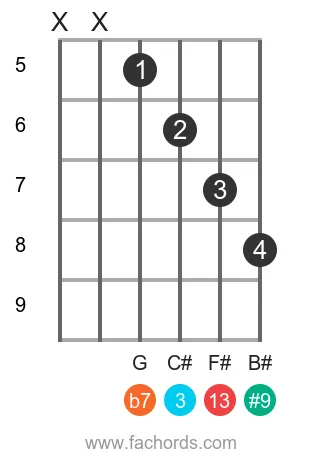
The A 13(#9) chord is a complex and rich sounding chord belonging to the Dominant Chords family. It is built from the notes A, C#, E, G, B#, D, and F#, corresponding to the intervals 1, 3, 5, b7, #9, 11, and 13. Use the interactive fretboard tool at the top of this page to visualize every fingering, listen to the chord played as a strum or arpeggio, and check your own playing with real-time microphone feedback to ensure perfect execution.
The A 13(#9) chord, while sounding complex, adds incredible depth and tension, particularly favored in jazz for its rich harmonic possibilities. Understanding how it's built and its role in a progression is key to mastering it. Explore its characteristics further with our dedicated guide to Dominant Chords and delve into its specific structure with our Ninth Chords tutorial. For a broader understanding of how such complex harmonies are constructed, our Chord Construction resource provides a solid foundation.
Scroll down the page, and you'll find a wealth of information, including chord diagrams ranked from the easiest open positions to more advanced movable shapes. We also dive deeper into the music theory behind this intriguing chord, list popular songs that feature it, and show you the common keys where it appears. But before you explore the static content, take a moment to engage with the interactive tool above. Set a tempo with the drum tool, strum the chord, and let the mic feedback guide your practice – it's the fastest and most effective way to truly integrate the A 13(#9) chord into your playing.
Notes that compose the A 13(#9) chord:
Chord structure of the Dominant Thirteen Sharp Ninth chord:
How To Play The A13(#9) chord on guitar
Position 1
Movable
 Find more shapes in our all guitar chords online library. If you
prefer a printable pdf, download
the Free Guitar Chords Chart Pdf
Find more shapes in our all guitar chords online library. If you
prefer a printable pdf, download
the Free Guitar Chords Chart Pdf
You can also use this accessible A13(#9) chord page, with written diagram instructions and screen-reader support for blind users.

Created by
Giancarlo is a musician (teaching guitar since 2000), software engineer, AI consultant and published researcher
FAQ
What makes the A 13(#9) chord a member of the "Dominant Chords" family?
The A 13(#9) chord is classified as a dominant chord because it fundamentally creates a sense of tension and expectation. This inherent tension typically leads the listener to anticipate a resolution to another chord, providing a satisfying sense of musical completion.
What specific notes and intervals define the A 13(#9) chord?
The A 13(#9) chord is composed of the notes A, C#, E, G, B#, D, and F#. From the root note A, these correspond to the musical intervals of the 1st (root), 3rd, 5th, flat 7th (b7), sharp 9th (#9), 11th, and 13th.
Why is the A 13(#9) chord described as "complex and rich sounding"?
This chord earns its description as complex and rich due to the large number of notes and intervals it contains. Beyond the basic triad, it incorporates several advanced extensions like the flat 7th, sharp 9th, 11th, and 13th, which create a dense harmonic texture and unique tonal color.
What is the particular role of the "#9" interval in the A 13(#9) chord?
The "#9" interval is a distinctive altered extension that is crucial to the A 13(#9) chord's unique character. It introduces a specific type of dissonance and harmonic color that strongly contributes to the chord's tension-creating capabilities and its use in genres like jazz.
What does the "13" signify in the A 13(#9) chord name?
The "13" in the chord name indicates that the chord includes the 13th interval (F# in the context of an A root) as one of its extended tones. This interval further expands the chord's harmonic palette, contributing to its full, complex sound beyond what would be present in a 7th or 9th chord.
