Explore A# Major Guitar Chord: Interactive Fretboard Tool
Want a structured chord roadmap instead of jumping between pages?
Go to the full guitar chords tutorial.
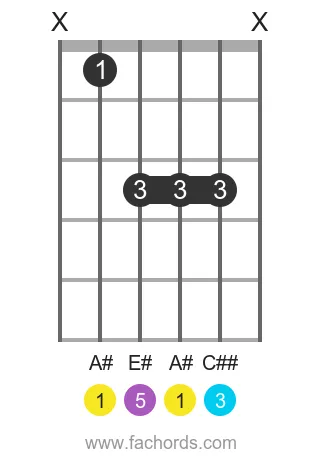
Major chords often evoke a bright and resolved sound, forming the harmonic bedrock of countless songs. The A# maj chord, a fundamental part of the Major Chords family, brings this powerful quality, built from the notes A#, C##, and E#. These correspond to the intervals 1 (Root), 3 (Major Third), and 5 (Perfect Fifth). To truly grasp its feel and sound, use the interactive fretboard tool at the top of this page as your personal exploration lab. Visualize fingerings and instantly hear the chord played as a strum or arpeggio. What makes this tool unique is its ability to provide real-time feedback on your playing accuracy using your microphone, guiding your hand placement with immediate insights.
The stability of a major chord like A# maj makes it a strong tonal center, and understanding its fundamental intervals is key to mastering the fretboard. Dive deeper into how chords are structured with our guide on Chord Construction. Given that A# Major often involves barre shapes, our Guitar Bar Chords tutorial can significantly enhance your technique. Once you've solidified the shape, focus on smooth transitions; our tips on Improve Chords Change will help you integrate it fluidly into your playing.
Below, you'll find a comprehensive collection of A# maj chord diagrams, progressing from beginner-friendly positions to more advanced barre shapes. We also explore the underlying music theory, common songs featuring this chord, and the keys where it naturally appears. But before you dive into the details, make music! Engage with the interactive tool above first. Use the built-in drum and BPM tool to set your tempo, and let the real-time feedback verify your accuracy as you play. This direct, hands-on experience is the most effective way to truly internalize new chords before analyzing them.
Notes of the A# maj chord:
Chord Formula:
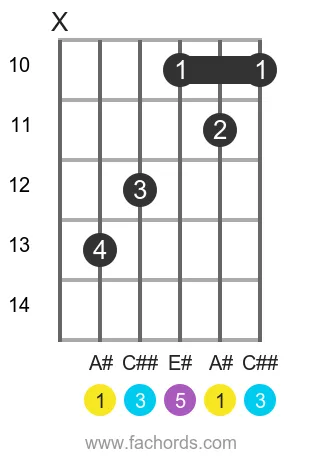
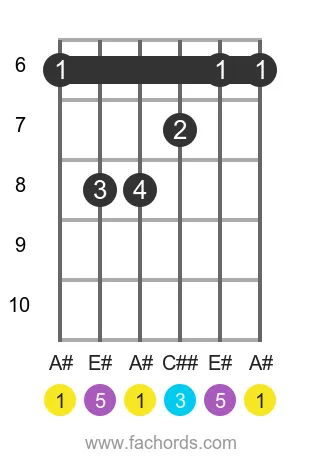
A#maj Guitar Chord Voicings
Position 1
Barre
Movable
Position 2
Barre
Movable
Position 3
Barre
Movable
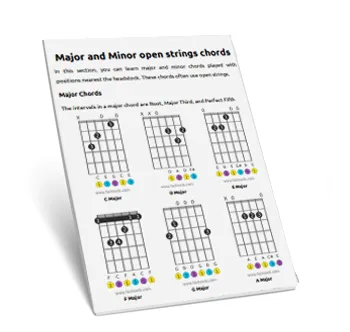
 Find more shapes in our all guitar chords online library. If you
prefer a printable pdf, download
the Free Guitar Chords Chart Pdf
Find more shapes in our all guitar chords online library. If you
prefer a printable pdf, download
the Free Guitar Chords Chart Pdf
You can also use this accessible A#maj chord page, with written diagram instructions and screen-reader support for blind users.

Created by
Giancarlo is a musician (teaching guitar since 2000), software engineer, AI consultant and published researcher
FAQ
Why are the notes C## and E# used in the A# Major chord instead of simpler note names?
The specific notes A#, C##, and E# are used because they correctly represent the theoretical intervals that define a major chord when built from an A# root. The '##' (double sharp) ensures that the major third and perfect fifth intervals are accurately maintained from the root A# according to music theory principles, even if they might sound enharmonically equivalent to other notes on an instrument.
What do the numbers 1, 3, and 5 represent when describing the A# Major chord?
These numbers represent the intervals from the root note of the chord. '1' is the Root (A#), '3' is the Major Third (C##), and '5' is the Perfect Fifth (E#). Understanding these numerical intervals helps guitarists identify the essential components of a chord and how it's constructed.
Why is the A# Major chord considered 'not a beginner's chord'?
The A# Major chord is not typically for beginners due to a combination of factors. Its root note (A#) often requires playing on higher frets or with barre shapes. Additionally, understanding and correctly identifying the notes with double sharps (C##, E#) involves a more advanced grasp of music theory, making it more complex than basic open position or natural key chords.
How does knowing the intervals (1, 3, 5) of the A# Major chord help me play it on the guitar?
Understanding the intervals (Root, Major Third, Perfect Fifth) helps you master the fretboard by allowing you to locate these specific note types (A#, C##, E#) across different strings and frets. Instead of just memorizing a finger shape, you can build the chord from any A# note on the neck, find different voicings, and understand the chord's relationship to scales and other musical elements.