Understand and Play the A#m Guitar Chord with Interactive Tools
Want a structured chord roadmap instead of jumping between pages?
Go to the full guitar chords tutorial.
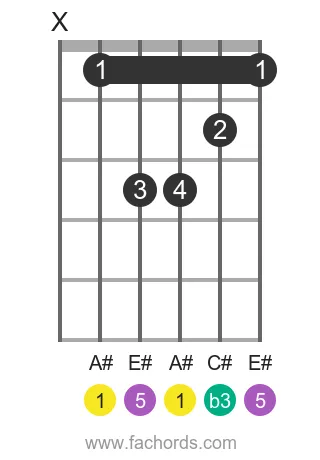
The A# minor chord is fundamentally built upon the notes A#, C#, and E#. These specific notes define its structure through the intervals 1 (Root), b3 (Minor Third), and 5 (Perfect Fifth), clearly placing it within the Minor Chords family. To deepen your understanding and apply this theory directly, utilize the interactive fretboard tool at the top of this page. Here, you can visualize every fingering, listen to the chord played as a strum or arpeggio, and receive immediate verification of your accuracy with real-time microphone feedback.
Minor chords, like the A#m, are essential for conveying a wide range of emotional colors in music, often associated with melancholy or drama. Mastering their construction is vital for expressive playing across the fretboard. For a deeper dive into how intervals form chords, our comprehensive Chord Construction guide offers a solid foundation. Many effective fingerings for A#m will involve barre techniques, and if these present a challenge, our Guitar Bar Chords tutorial can provide essential guidance. To ensure fluid musicality, focus on smooth transitions between chords; tips from our Improve Chords Change guide will prove invaluable.
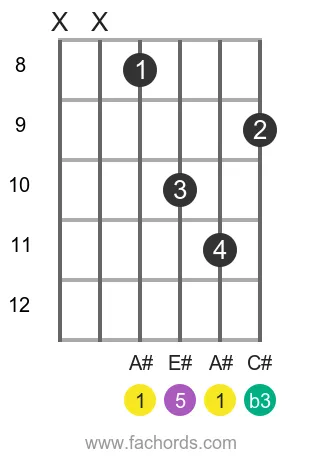
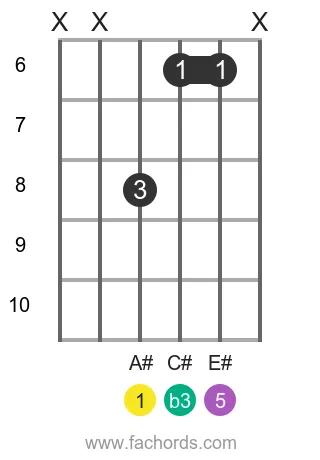
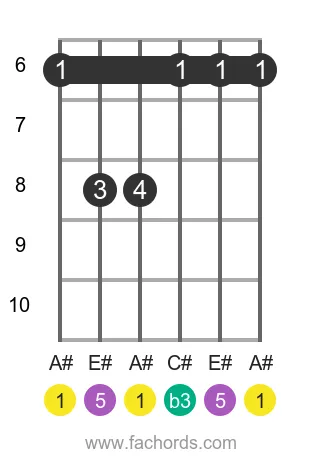
Further down this page, you will discover various chord diagrams, carefully ranked from the most accessible open positions to advanced full barre shapes. Additionally, explore more music theory, find popular songs that feature the A#m chord, and understand the musical keys where it frequently appears. Before analyzing these static diagrams, engage with the interactive tool above to develop muscle memory and ear training; utilize the drum tool for rhythmic practice, strum the A#m chord, and rely on the precise mic feedback to validate your finger placement. This disciplined, interactive approach is fundamental for truly integrating new chords into your repertoire.
Notes that compose the A# m chord:
How the Minor chord is built:
How To Play The A# Minor chord on guitar
Position 1
Movable
Position 2
Barre
Movable
Position 3
Barre
Movable
Position 4
Barre
Movable
 Find more shapes in our all guitar chords online library. If you
prefer a printable pdf, download
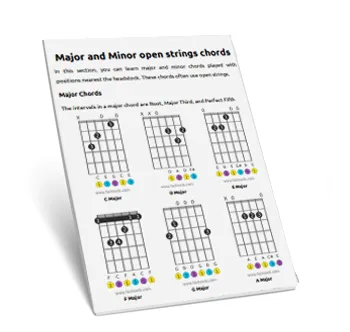
the Free Guitar Chords Chart Pdf
Find more shapes in our all guitar chords online library. If you
prefer a printable pdf, download
the Free Guitar Chords Chart Pdf
You can also use this accessible A#m chord page, with written diagram instructions and screen-reader support for blind users.

Created by
Giancarlo is a musician (teaching guitar since 2000), software engineer, AI consultant and published researcher
FAQ
What notes are included in the A#m chord?
The A#m (A# minor) chord is built from three specific notes: A#, C#, and E#. These notes form the fundamental sonic structure of the chord.
What do the intervals 1, b3, and 5 mean for the A#m chord?
For the A#m chord, these intervals define its construction: '1' represents the Root (A#), 'b3' signifies the Minor Third (C#), and '5' stands for the Perfect Fifth (E#). Understanding these intervals is essential for grasping the theory behind all guitar chords.
Why is it called an A# 'minor' chord?
The A#m chord is classified as a 'minor' chord because of the specific interval of the Minor Third (b3) present in its structure. The C# note, as the Minor Third relative to the A# root, gives the chord its characteristic minor quality.
Is the A#m chord commonly used in music?
Yes, the A#m chord is widely used across various musical styles. It is a commonly encountered chord in genres such as rock, pop, and jazz, making it a valuable chord to learn for expanding your musical repertoire.
