How To Play Twin Guitars
Simple Way To Harmonize Melodies and Solos
If you always loved the sound of Thin Lizzy, or the epic guitar duels of Iron Maiden, Judas Priest and Metallica, you'll certainly want to learn more about guitar lines harmonization.
In this article, I'll show you a simple method that will allow creating twin guitars solos easily. Keep in mind that can different types of harmonization exist, in this article we're going to learn harmonization in thirds.
Harmonization In Thirds
The process of guitar harmonization in simple:
- The first guitar plays a melody using a scale, major or minor.
- The second guitar plays the same melody using a scale one third above the first scale.
- It's important to use only the notes in the first scale, so the thirds will be major or minor.
- What we are doing here is basically harmonizing the scale by stacking thirds intervals
How To Apply This Method To The Guitar
We're going to harmonize a minor scale, instead of a major one, because the minor sound is typical of bands like Iron Maiden and Judas Priest.
Applying this method is straightforward: one guitar will play the melody using the A minor scale shape; the second guitar will play the same melody, with the same notes order, but using the C major scale
In the video above I show you the sound created by the two scale played ad the same time.

A Minor Scale - The first guitar plays on this pattern

C Major Scale - The second guitar plays on this pattern
Harmonic Analysis
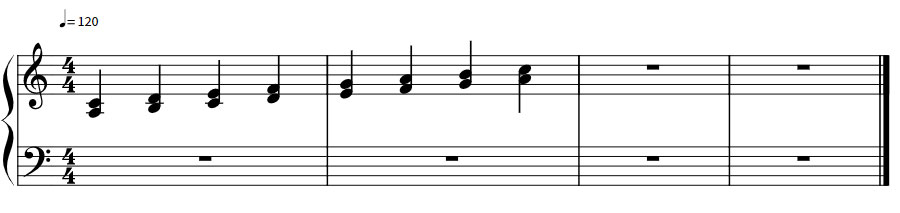
Let's analyze a bit the intervals created by this kind of harmonization:
First guitar: A minor scale
Second guitar: C major scale. Why C? Because C is a minor third above A, and it's a note of the A minor scale. C# (a major third above A) does not belong to the A minor scale so we can't use it.
Major and Minor Thirds
- 1) Between A and C there are 3 half-steps, so it's a Minor Third
- 2) Between B and D there are 3 half-steps, so it's a Minor Third
- 3) Between C and E there are 4 half-steps, so it's a Major Third
- 4) Between D and F there are 3 half-steps, so it's a Minor Third
- 5) Between E and G there are 3 half-steps, so it's a Minor Third
- 6) Between F and A there are 4 half-steps, so it's a Major Third
- 7) Between G and B there are 3 half-steps, so it's a Minor Third
Other Types Of Harmonization
We have just scratched the surface of the fascinating world of harmony. We could also harmonize solos with Sixth intervals, or with Parallel Fourths ( have you ever heard of Frank Zappa?), or other kind of intervals. The process is the same: choose a scale, harmonize it by stacking thirds or other interval qualities, and listen to the sound you've just created.
Notable Examples of Lead Guitar Twin Solos
I'll conclude this article by leaving some popular songs that elevated the twin guitars concept at its best:
- The Eagles, "Hotel California" (the solos at the end is an awesome example of twin guitars)
- Iron Maiden - Aces High (in the live version of Life After Death the guitar tracks are clearly isolated to the left and to the right channels)
- Cacophony - Concerto (with the one and unique Jason Becker)
- Helloween Future World (wizardry starts at 2:45)
- Racer X - "Scarified"
- Thin Lizzy - "The Boys Are Back In Town"
- Slayer - "South of Heaven" (a great example of harmonization with dissonant intervals)
That's all! As always, experiment with this new material, create your own lines, record yourself on one track and play an harmonized line over. And don't forget to request your free access the the download area to get chords and scales pdfs.
FAQ
What does 'twin guitar harmonization in thirds' actually mean for guitar players?
Twin guitar harmonization in thirds is a technique where two guitarists play the same melody simultaneously, but the second guitarist plays their part exactly a third interval higher or lower than the first guitarist's notes. This creates a fuller, harmonized sound, with the crucial rule that all notes used by both guitars must belong to the original scale of the melody.
How do I choose the correct second scale when harmonizing a melody in thirds, as shown with A minor and C major?
To choose the correct second scale for harmonization in thirds, you need to find a scale that starts a third above the root of your original melody's scale, and whose notes fit within the original scale's tonality. For an A minor melody, the second guitar plays notes from the C major scale because C is a minor third above A, and the C major scale contains many of the same notes as the A minor scale, ensuring the harmonization sounds coherent and 'in key'.
Why do the harmonized intervals in thirds sometimes result in a major third and other times a minor third, even within the same scale?
The intervals produced when harmonizing in thirds will naturally alternate between major thirds (4 half-steps) and minor thirds (3 half-steps). This happens because you are stacking thirds *diatonically* within the chosen scale (e.g., A minor). The specific notes available in the A minor scale dictate whether the interval formed by going up a third from each scale degree is a major or minor third, not an arbitrary choice. For example, A to C is a minor third, but C to E is a major third, both originating from notes within the A minor scale.
Can I use other intervals besides thirds to harmonize lead guitar melodies?
Yes, while this lesson focuses on harmonization in thirds, the principles can be applied to other intervals. The article mentions that you could also harmonize solos with sixths, parallel fourths (like Frank Zappa), or various other intervals. The general method involves choosing a base scale and then stacking a consistent interval quality above each note of the melody to create the harmonized line.