Sweep Picking on Guitar
Introduction For Beginners (and 5 Easy Exercises to Get You Started)
The actual technique of sweep picking on the guitar is a pretty straightforward process.
As you can guess the name comes from the sweeping motion used, which leads to a final sound that is fast and flowing.
But despite the simplicity it takes long hours of practice before that fluid motion and speed can even occur.
What is Sweep Picking?
The sweep picking technique (also called economy picking) can be referred to as shredding, but it is not limited to metal genres.
With this technique, the guitarist plays single notes as they move down or up the strings.
The main aspect to remember is that the picking and fretting hands must move in unison or the desired effect will not happen.
When playing guitar, we often use alternate picking which is hitting the strings in both small downward and upward motions.
However, that pattern makes it hard to play big arpeggios.
With sweep picking we are only moving in one direction at a time and we always keep it as a long smooth motion.
You want the picking hand relaxed yet hitting every note at just the right time.
To get a better idea, have a look at video at the top of this article, in which I play some easy arpeggios with sweep picking
Sweep picking is not limited to specific note patterns, but most use it to play arpeggios across more than one octave at lightning speed.
If you are going for the metal genre you will want to focus your early practice on arpeggiated minor chords as they will be more common.
It is one of the more difficult techniques to learn as it requires a few different factors coming together all at once.
It can take some players a year before they even have both hands synchronized, it clearly is not a short-term goal!
How to Sweep Pick
The biggest issue for new players when it comes to sweep picking is jumping ahead before you have mastered the basic skills.
This is definitely not a technique where you can skip parts, and before both hands work together, each one needs lots of practice.
It is very important to keep it simple and slow at first.
Coordination is the key word when it comes to the best sweep pickers.
All your fretting hand is doing is simply playing the notes of chords (arpeggios) in different octaves along the neck of the guitar.
And the key is to fret those notes at the same time that your picking hand plucks the string.
It is very easy and obvious when done slowly, but difficult to master with speed.
You can start by playing a simple chord one string at a time all the way up and down.
Along with your picking and fretting fingers making contact with the string simultaneously, it is essential to only fret one string at a time. Any adjacent strings must be muted so they do not interfere with a clean tone.
To achieve this muting effect, you will need to learn to roll your fretting fingers to immediately silence a string after it is played.
It is important that the pick plucks the strings at tempo, which is why you have to start so slow.
Once you can do all these things in sync the sweep picking will have that awe inspiring sound. Now you only need to start playing exercises all of the time to unlock that achievement!
Exercises and Tips
In the video at the top of this tutorial, I show you 5 easy exercises to help you get familiar with this technique.
Here are some helpful tips:
- It's important to play only one fret at a time; do not let ring notes together otherwise you'll sound like a chord
- Let the pick rest on each adjacent string as you cross the previous one (both in ascending and descending movement)
- It's crucial to mute all the other strings, by using the palm of your right hand and the free fingers of the left hand
- Sweep picking it's like a controlled strumming, it's easy to get out of tempo. Put extreme care on timing, with the help of a metronome
- In the beginning, practice without distorsion, delay, or any other effect that can hide any little mistake.
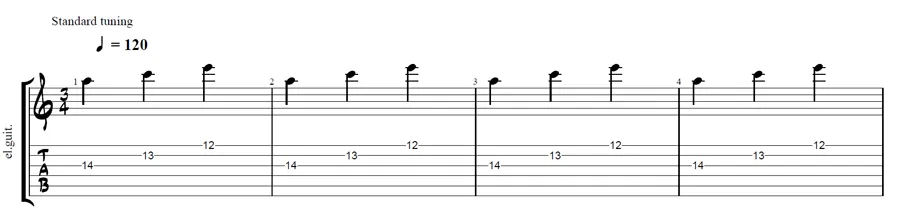
Sweep Picking Exercises 1
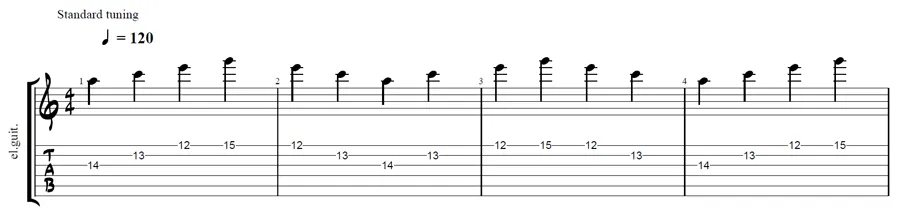
Sweep Picking Exercises 2
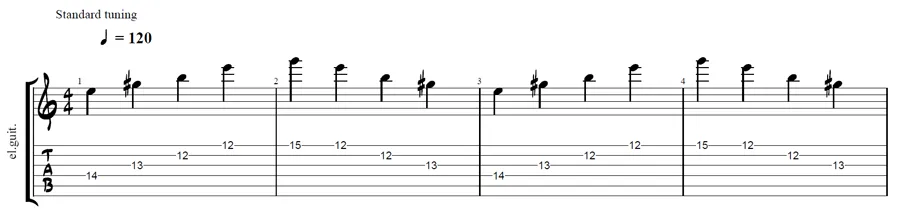
Sweep Picking Exercises 3
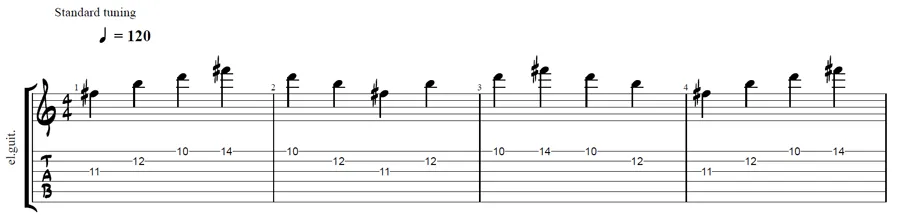
Sweep Picking Exercises 4
Sweep Picking Exercises 5
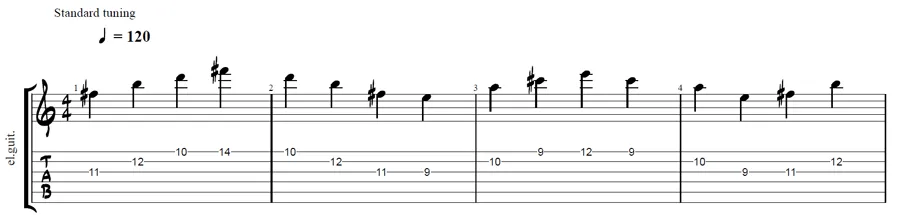
First isolate each hand and work on them individually.
Memorize the fretting hand on an easy practice routine and then move to watching your right hand hit each string perfectly.
Don’t rush putting them together, make those hand muscles work!
Playing is all about efficiency of movement, not how quick your hands move.
By starting properly and at a very slow speed we can avoid time consuming mistakes.
Speaking of sense of time, you will need a metronome to practice sweep picking, but first you need to familiarize yourself with the necessary motions.
Start with three string sweeps (exercise 1 in the video) and work your way up to six when you are first practicing your sweep.
Don’t move up until each grouping sounds good.
Sweep picking is a true test of patience, as it is necessary to keep at it over and over.
You play slow enough until you have mastered it in your muscle memory, and then you move the pick faster.
Do not underestimate the importance of muting the strings, it is an integral part and needs to be done just right.
If notes bleed into one another it ruins the intended effect.
Because it is such a large motion involving your arm instead of the wrist, it is much harder to get the right sound. With larger movements you have less control and fluidity.
As you may notice small wrist motions are easier to control.
Some players suggest a pick size between 1-2mm, but that may vary.
However, it is important to try some different kinds out to see what may suit you.
Notable Players.
It has been used since the birth of the electric guitar by greats like Les Paul and Chet Atkins.
There was never a focus on the style but playing arpeggios as sweeps was certainly mixed in with other techniques.
Later artists like Ritchie Kotzen and Frank Gambale took it to new levels, even before it was associated with shredders.
Eventually though Yngwie Malmsteen mixed his love of classical musicians and modern rock to cement sweep picking as an integral part of metal.
Malmsteen was convinced it was the fastest way to play and yet still have a fluid motion.
He went on to influence musicians like Jason Becker, Jeff Loomis, and Tosin Abasi.
Pick any sweep picking guitarist and their videos will usually leave you amazed.
Sweep Picking - Conclusion
Synchronization and speed will only come with lots of practice.
No guitarist has a special trick or secret to becoming an adept sweep picker.
It is essential to start slow and have a solid foundation for each hand before you move on.
After that you simply have to practice exercises and songs with a metronome all the time.
It takes lots of work!
Happy sweeping, and don't forget to subscribe for free.

Created by
Giancarlo is a musician (teaching guitar since 2000), software engineer, AI consultant and published researcher
FAQ
What is the main difference between sweep picking and alternate picking?
Alternate picking involves distinct down and up strokes for each individual note. In contrast, sweep picking uses a continuous, single-direction motion (either all downstrokes or all upstrokes) across multiple strings to play a sequence of notes. This makes sweep picking highly efficient for playing arpeggios quickly and smoothly.
Why is string muting so crucial for effective sweep picking?
Muting is absolutely essential in sweep picking to ensure that only one note rings out cleanly at a time. Without proper muting, adjacent strings can inadvertently sound, leading to a muddy, cluttered sound that resembles a chord rather than the desired clear, flowing arpeggio. This is typically achieved by a combination of precise fretting hand rolls and light right-hand palm muting.
How long should a beginner expect to practice before becoming proficient at sweep picking?
Sweep picking is considered one of the more challenging techniques and requires significant time and patience. It's a long-term goal, not a quick win. For many players, achieving synchronized hand movement and a fluid, clean sound can take up to a year of consistent and dedicated practice.
What types of musical patterns are best suited for sweep picking practice?
Sweep picking is predominantly used for playing arpeggios, especially those that span across multiple strings and octaves. As a beginner, it's best to start with simple 3-string arpeggio patterns, as demonstrated in the provided exercises, and gradually work your way up to more complex 5- or 6-string arpeggios. For metal genres, practicing arpeggiated minor chords is a common and effective starting point.
Should I use guitar effects like distortion or delay when I'm first learning sweep picking?
It is highly recommended to practice sweep picking without any effects like distortion or delay, especially in the beginning. These effects can mask imperfections in your technique, making it difficult to clearly hear and correct mistakes such as ringing open strings, inconsistent timing, or unclear notes. Practicing with a clean tone provides the most honest and beneficial feedback for your technique development.
Is sweep picking a technique exclusively for metal or shred guitarists?
No, sweep picking is not exclusively for metal or shred guitarists. While it gained significant popularity and recognition in metal through pioneers like Yngwie Malmsteen, the underlying technique of sweeping through notes for fast arpeggiated lines has been utilized by guitarists across various styles, including early players like Les Paul and Chet Atkins, and later in jazz and other genres.
