Shifting Pentatonics On Guitar
How To Create New Sounds With a Scale You Already Know
The Minor Pentatonic scale shown in the picture below is probably the most used and abused pattern in the history of lead guitar:

Today I want to show you an easy way to introduce new feelings using this same exact pattern.
Suppose you have to play for some bars over a A minor chord.
The A Minor Pentatonic scale would be the perfect candidate for this job, but after a while, it will become boring!
What should you do to keep the audience awake? Just shift this pattern along the neck. Keep reading to learn how!
Playing Over a Minor Chord: Shift The Pentatonic For New Sounds
Let's stick with our A minor chord, that is composed of the note:
Shift 2 frets up: B minor pentatonic
The first thing to try is to shift the A minor pentatonic 2 frets up, to get a B minor pentatonic. The notes in this last scale are:

You'll notice that this scale introduces a new palette of feeling; you could use this shifting here and there to create new colours in your playing.
Shift 7 frets up: E minor pentatonic
Another cool jump is to move the A minor pentatonic up by 7 frets: you'll get an E minor pentatonic that have the notes:

Again, another spectrum of new sounds!
Example
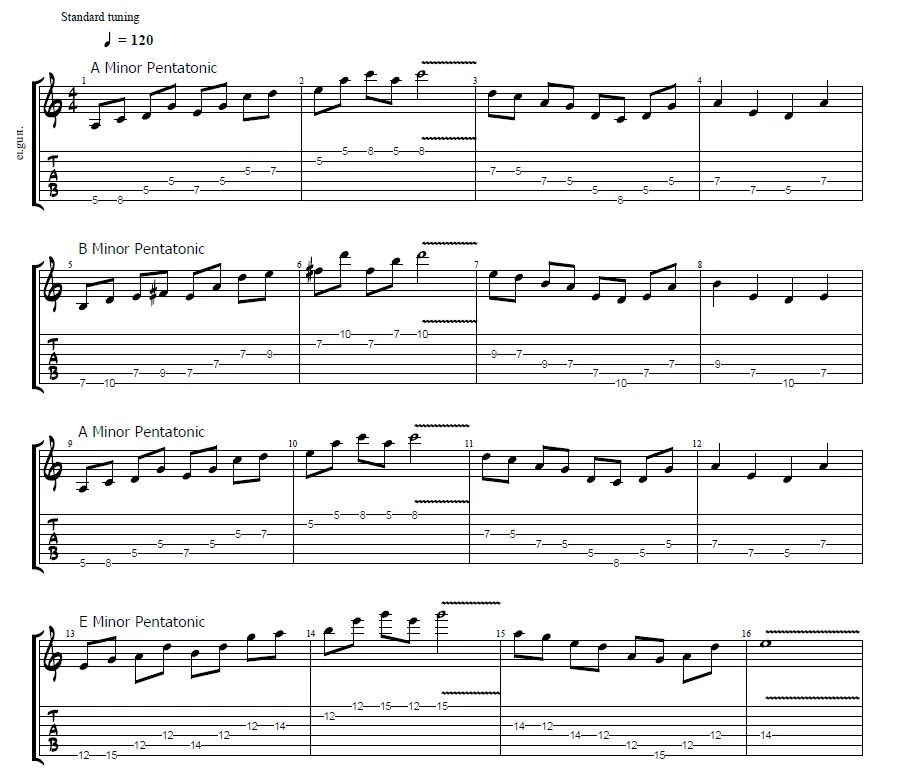
Listen to this example in which the three scales are played over an A minor chord (click here for the pdf guitar tab)
Why This Trick Works Well?
The Minor Pentatonic Scale lacks of the 2nd and the 6th , that frequently cause dissonant effect with the backing harmony. The E Minor Pentatonic, as well as the B minor pentatonic, do not have notes that clash with the notes in the A minor chord; however, they both don't have the minor third of the A minor chord (C), so using them introduce a vague feeling, something similar to suspended chords.
This trick works also with a minor seventh chord; for example, a A minor seventh chord is composed of:
The minor 7th, (G) do not clash with any note in the B minor pentatonic, and it's even present in the E minor pentatonic!
General Rule For Playing Over a Minor Chord
Of course this method hold true for all the keys.
If we would have to play over a E minor chord, we could use the E minor pentatonic, the F# minor pentatonic (2 frets up) or the B minor pentatonic (7 frets up).
So, generalizing the concept, over a minor chord (or a minor seventh chord) you can use:
- The minor pentatonic on the same root (A minor -> A minor pentatonic)
- The minor pentatonic 2 half-steps (2 frets) up (A minor -> B minor pentatonic)
- The minor pentatonic 7 half-steps (7 frets) up (A minor -> E minor pentatonic)
Shifted Pentatonics For a Major Chord
Of course we can also shift pentatonic over major chords.
Let's take a C major chord:
C Major Pentatonic over a C Major Chord
This is the classic choice. All the notes in the C major chord belong to this scale, and the absence of the 4th (F) and the 7th (B) avoids any possible clash.

7 Frets Up. G Major Pentatonic Over a C Major Chord
We can get interesting effects if we shift the pattern 7 half-steps up, or 5 half-steps down (from C to G):
Note: the 3rd of the G Major Pentatonic scale (B) is the maj7 of C, then this scale works great also on C Major 7 chords.

Things to try: playing Over a Dominant Chords
Like many things in music theory, rules are there only to show you the way; it's up to you to learn and break them them experimenting with new things.
It should be clear now that the nutshell of shifting pentatonic is to use known patterns in neck position that do not clash too much with the underlying harmony;
Don't feel yourself trapped in any particular shape or pattern; you can change a note or two based on your ear judgment.
Here are some interesting shifting that you can try over a dominant chord
Notes in a C7 chord
- Minor Pentatonic shifted 3 half-steps down (C7 -> A Minor Pentatonic)
- Minor Pentatonic shifted 7 half-steps up (C7 -> G Minor Pentatonic)
- Minor Pentatonic shifted 2 half-steps up (C7 -> D Minor Pentatonic)
- Minor Pentatonic shited 5 half-steps up (C7 -> F Minor Pentatonic)
- Minor Pentatonic shifted 2 half-steps down (C7 -> Bb minor pentatonic)
Use our scale finder tool to see the patterns for these scales.
Note: some of these scales introduce an 11th interval (F in case of tonic C), that has an unstable sound; it's good for creating tension and movement, or for playing over a 7sus4 chord.
Shifted Pentatonics: conclusion
Our experiments in moving pentatonic patterns up and down that neck have come to an end. Of course, there's more to learn: other types of scales, chords, intervals.
But now you should have solid fundamentals to experiment by yourself, maybe with the help of FaChords interactive guitar tools. To stay updated, enter your email here.

Created by
Giancarlo is a musician (teaching guitar since 2000), software engineer, AI consultant and published researcher
FAQ
How does shifting familiar pentatonic shapes create "new sounds" for my guitar solos?
Shifting pentatonic shapes allows you to introduce different sets of notes into your improvisation over the same chord progression. By moving a known pentatonic pattern up or down the fretboard, you access a new palette of melodic choices that complement the underlying chord in unique ways, adding fresh emotional colors and preventing your playing from becoming repetitive.
Why do specific minor pentatonic shifts, like B minor or E minor, work well over an A minor chord?
These specific shifts work because the notes in the B minor pentatonic and E minor pentatonic scales largely avoid clashing with the A minor chord (A, C, E). The minor pentatonic scale inherently lacks the 2nd and 6th intervals, which often cause dissonance. When shifted, these scales introduce new consonant notes or create a "vague" or "suspended" feeling, similar to suspended chords, by often omitting the minor third (C) of the A minor chord while still harmonizing effectively.
What are the general rules for choosing shifted minor pentatonic scales to play over a minor chord?
For any given minor chord, you can generally use three effective minor pentatonic scales: the minor pentatonic on the same root (e.g., A minor over A minor), the minor pentatonic two half-steps (two frets) up (e.g., B minor over A minor), or the minor pentatonic seven half-steps (seven frets) up (e.g., E minor over A minor). These shifts introduce new melodic possibilities without creating strong dissonances.
How does the approach to shifting pentatonics differ when playing over a major chord compared to a minor chord?
The core principle of shifting for new sounds remains, but the specific intervals and resulting scales change. Over a major chord, like C major, you can use the C major pentatonic (the classic choice). Another effective shift is to use the major pentatonic seven half-steps up (a perfect fifth), such as G major pentatonic over C major. The G major pentatonic introduces notes like the major 7th of C (B), which can create a sophisticated sound, especially suitable for major 7 chords.
Can I apply pentatonic shifting techniques to dominant seventh chords, and what are some examples?
Yes, you can apply pentatonic shifting to dominant seventh chords to create interesting textures. For a C7 chord (C, E, G, Bb), you can experiment with minor pentatonics such as A minor (3 half-steps down from C), G minor (7 half-steps up from C), D minor (2 half-steps up from C), F minor (5 half-steps up from C), or Bb minor (2 half-steps down from C). Some of these scales may introduce an 11th interval, which can have an unstable sound useful for creating tension or playing over a 7sus4 chord.
Why does the minor pentatonic scale avoid the 2nd and 6th intervals to prevent dissonance over minor chords?
The minor pentatonic scale is designed to sound naturally harmonious over minor chords by intentionally omitting the 2nd (major second) and 6th (major sixth) intervals relative to the root. These intervals, when played directly against a minor chord's fundamental structure, often create strong dissonances or 'clashes' that can sound harsh or unstable. By leaving them out, the minor pentatonic ensures a consistently smooth and pleasing sound that complements the minor harmony.