The Locrian Scale
A Not So Common Mode, but Good to Know
The Locrian mode or scale is likely going to be one of your least used on the guitar, but there are times when it comes in handy. Even if you do not plan on using it often, it is worth looking into, as understanding why it is so dissonant is important.
The mode happens to be built in a way that is not generally appealing to our ears.
What is the Locrian Mode?
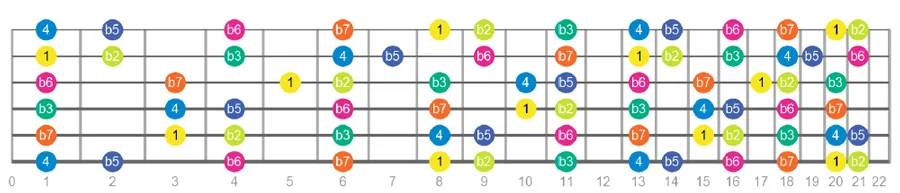
Locrian Scale Full Fretboard Map
First we must recall that a mode is simply another term for a scale, but each mode has a particular beginning. The major scale has 7 positions to start from, and Locrian happens to be the last.
- Ionian C
- Dorian D
- Phrygian E
- Lydian F
- Mixolydian G
- Aeolian A
- Locrian B
The mode is built on the 7th degree of the major diatonic scale so B Locrian has the notes B C D E F G A.
These are the same notes as the C Ionian mode C D E F G A B, but the different orders produce very different intervals.
Play both on your guitar and you will see the quality changes with the new steps.
It is obvious the Locrian has a very dissonant quality, this is the main reason it is not a commonly used scale. As we will see from the way it's created, the notes don't mix all that well and create more tension than resolution.
Locrian Scale Formula
The basic Locrian scale formula is:
If the Locrian was a tire, it would certainly be flat! It is like a minor scale, but also with the 2nd and 5th lowered.
It is the only mode without a perfect fifth above its root. This is what creates all the dissonance!
When we build the tonic chord from the 1 b3 and b5 it gives us a diminished chord. Our brains do not like diminished chords, as they do not resolve.
You will also notice this tonic chord has tritones. Because of these tritone intervals there are not many examples of songs in pure Locrian mode. Almost every piece uses Locrian for short sections or variations of the scale.
It is rare to find true Locrian and when you do, it sounds strange! There is also the altered scale or Super Locrian with the formula:
The altered scale has a few more uses in jazz than plain Locrian. But even though it is a mode you will rarely use; it should now give you an idea of why the other modes sound so much better. A mode with stable tonics and perfect fifths will always sound "correct" to the ears of those who play modern Western scales.
Locrian Scale Guitar Patterns
Here below you find some diagrams that show how to play the Locrian scale in different positions. These examples are provided in the key of C, you can move the shapes up or down the neck to play the scale in another key.
You'll find more scale patterns across the entire fretboard in my ebook Scales Over Chords | Learn How To Play The Right Scales Over Any Chord
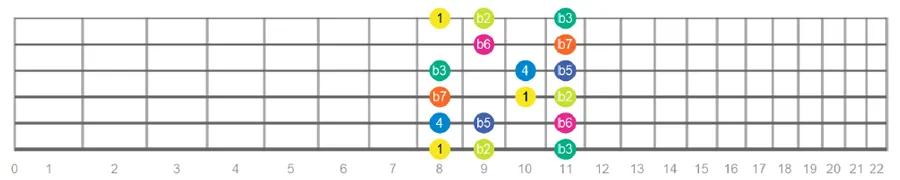
Locrian Scale Guitar Pattern 1
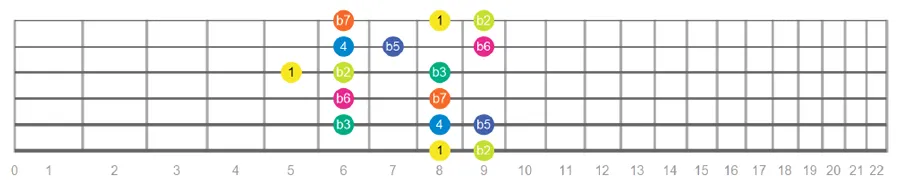
Locrian Scale Guitar Pattern 2
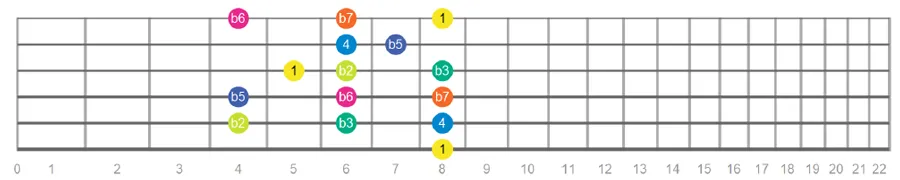
Locrian Scale Guitar Pattern 3
Locrian Scale Note Names in all Keys
| 1 | b2 | b3 | 4 | b5 | b6 | b7 |
|---|---|---|---|---|---|---|
| C | Db | Eb | F | Gb | Ab | Bb |
| G | Ab | Bb | C | Db | Eb | F |
| D | Eb | F | G | Ab | Bb | C |
| A | Bb | C | D | Eb | F | G |
| E | F | G | A | Bb | C | D |
| B | C | D | E | F | G | A |
| F# | G | A | B | C | D | E |
| Gb | Abb | Bbb | Cb | Dbb | Ebb | Fb |
| C# | D | E | F# | G | A | B |
| Db | Ebb | Fb | Gb | Abb | Bbb | Cb |
| G# | A | B | C# | D | E | F# |
| Ab | Bbb | Cb | Db | Ebb | Fb | Gb |
| D# | E | F# | G# | A | B | C# |
| Eb | Fb | Gb | Ab | Bbb | Cb | Db |
| A# | B | C# | D# | E | F# | G# |
| Bb | Cb | Db | Eb | Fb | Gb | Ab |
| F | Gb | Ab | Bb | Cb | Db | Eb |
Common Chords and Progressions
There are not many chord progressions associated with such a tension filled scale, but there are some key chords that we can use the Locrian over.
As mentioned above the tonic is made up of 1 b3 b5 and is a diminished chord mb5. And if we add the b7 we get the m7b5. This half-diminished 7th chord is what you will be using the Locrian mode over.
In a ii-V-I normal jazz progression you could use the scale when playing over m7b5 chords that may appear.
The Super Locrian is played over altered dominant chords like 7#5b9 or 7b5b9.
Basically any dominant 7th chord that have sharp or flat 5th and 9th degrees. This scale is usually just called the altered scale and is used only over these handful of chords.
The applications are limited because you generally still must leave the mode at some point and resolve the piece. Here is one of the more prominent examples of a song in the mode, it is not played on a guitar, but gives you a great idea of the overall feel.
It has some great uses, but in limited amounts and short passages.
The Locrian mode is often confused with Phrygian as it has a similar scale. But the Phrygian is slightly more stable, that makes all the difference in the scale sounding better and having more uses.
So be careful when someone mentions an example of Locrian that has anything but a diminished fifth and tritone.
Chords From The Locrian Scale
Triads
| C dim | Db maj | Eb min | F min | Gb maj | Ab maj | Bb min |
|---|---|---|---|---|---|---|
| Gb (b5) Eb (b3) C (1) |
Ab (b6) F (4) Db (b2) |
Bb (b7) Gb (b5) Eb (b3) |
C (1) Ab (b6) F (4) |
Db (b2) Bb (b7) Gb (b5) |
Eb (b3) C (1) Ab (b6) |
F (4) Db (b2) Bb (b7) |
Four Notes Chords
| C m7/b5 | D m7/b5 | Eb m(maj7) | F m7 | Gb aug(maj7) | Ab 7 | Bb 7 |
|---|---|---|---|---|---|---|
| Bb (b7) Gb (b5) Eb (b3) C (1) |
C (1) Ab (b6) F (4) D (2) |
D (2) Bb (b7) Gb (b5) Eb (b3) |
Eb (b3) C (1) Ab (b6) F (4) |
F (4) D (2) Bb (b7) Gb (b5) |
Gb (b5) Eb (b3) C (1) Ab (b6) |
Ab (b6) F (4) D (2) Bb (b7) |
Notable Examples
Again, very few pieces exist only in Locrian, so any examples given are going to have other modes mixed in. One of the more popular tunes often mentioned is "Army of Me" by Bjork, some sections are in Locrian.
Notice much of the imagery in her video is dark or strange, as that is the feeling the mode induces.
Another famous example is the bassline intro to "Juicebox". Even when used in a pop rock way, it still has the odd vibe. Same with hip hop like "Green Velvet". It is hard not to notice when music dips into the unresolved.
Fantasy, movie soundtracks, jazz, and metal are the ones most likely to use Locrian riffs.
It is often said that a lot of heavy metal music uses Locrian mode, but the examples often show they still resolve with their power chords and perfect fifths. As always it is only Locrian briefly or partially. This same process is used for Phrygian metal riffs also.
If you research more you will find quite a lot of arguments over what is and isn't in this mode. And many people often try to compose pieces themselves, only to discover they aren't purely modal.
So finding examples is not going to be easy. The Locrian mode is most often used over the m7b5 chord as a transition to a mode with better resolution.
When you find you need a disturbing or strange sound, try the Locrian, just remember to leave it or have an underlying sound with more consonance
The Locrian Mode - Conclusions
When you hear music that seems a little off, odd, or gives you a sense of unease, there is a good chance the Locrian mode is being used.
As you have seen, it sometimes doesn't produce the greatest sounding music, but it sure sticks out!
If you aim to get a tense and dissonant feel to your guitar playing, the Locrian scale is great to practice. Just remember moderation and resolution
For more scale diagrams across all the neck, check my complete ebook Scales Over Chords | Learn How To Play The Right Scales Over Any Chord .
Subscribe here to stay updated on new tutorials.

Created by
Giancarlo is a musician (teaching guitar since 2000), software engineer, AI consultant and published researcher
FAQ
Why does the Locrian mode sound so dissonant and create an 'uneasy' feel?
The Locrian mode's dissonant sound comes primarily from the absence of a perfect fifth above its root; instead, it features a diminished fifth (b5) and a lowered second (b2). This unique structure means its tonic chord is a diminished chord (1-b3-b5) or a half-diminished 7th (m7b5), which contains tritone intervals. These intervals inherently create tension without a natural sense of resolution, making the mode generally unappealing to our ears in traditional Western harmony.
How is the Locrian mode derived from the major scale?
The Locrian mode is the 7th mode of the major diatonic scale. This means if you take a major scale, like C Major (C D E F G A B), and start and end on its 7th degree (B), you get the B Locrian scale (B C D E F G A). While it uses the same notes as the parent major scale, beginning on a different degree fundamentally changes the intervallic relationships, resulting in a distinct and dissonant sound quality.
When would a guitarist typically use the Locrian mode in their playing?
Guitarists would typically use the Locrian mode in limited amounts for specific effects, rather than as a primary scale for an entire piece. It is most commonly applied when soloing over a half-diminished 7th (m7b5) chord, which is its natural tonic chord. It's effective for creating brief moments of extreme tension, an 'odd,' 'strange,' or 'disturbing' feel, often found in genres like jazz, fantasy soundtracks, or metal, usually transitioning to a more stable mode for resolution.
What is the primary chord associated with the Locrian mode?
The primary chord associated with the Locrian mode is the half-diminished 7th chord (m7b5). This chord is built from the 1st, b3rd, b5th, and b7th degrees of the Locrian scale. Its inherent diminished fifth (b5) gives it the tense quality that defines the mode and makes it suitable for creating unresolved sounds.
What is the difference between the Locrian mode and the Phrygian mode?
Both Locrian and Phrygian modes share a lowered second (b2) that gives them a somewhat 'dark' or exotic sound. However, the crucial difference lies in their fifth degree: Phrygian has a perfect fifth, making it relatively stable and more commonly used. Locrian, on the other hand, features a diminished fifth (b5), creating a tritone with the root, which is the main source of its extreme dissonance and lack of harmonic resolution, making it much less stable than Phrygian.
Is the 'Altered Scale' the same as the Locrian mode?
No, the 'Altered Scale' is a specific jazz scale also known as 'Super Locrian' which is a variation, but not identical to the basic Locrian mode. While it shares the lowered second, fifth, and seventh, its formula includes a natural third (1 b2 b3 3 b5 b6 b7) where the standard Locrian has a perfect fourth (1 b2 b3 4 b5 b6 b7). The Altered Scale is specifically used over altered dominant chords (like 7#5b9 or 7b5b9) to create intense chromatic tension, whereas the plain Locrian is primarily associated with m7b5 chords.
