Main Challenges for the Fretting Hand
Some Technical Difficulties You Should Be Aware Of
Often when playing the guitar beginners and intermediate players tend to focus on the picking hand more. Beyond making sure the chord is fretted right, our attention moves to the strumming or playing of the notes.
However we need to spend more time on developing our strength and working on the main challenges of the fretting hand.
Finger Strength
One of the first challenges we encounter with our fretting hand (which is the left hand for most players, but not all) is strength in general. If we are having trouble playing chords, scales, or arpeggios it may mean we need to develop a stronger hand, or potentially have the action on the guitar checked.
A common way to develop more power in the fingers is to try new songs and chords often.
While it is important to practice in repetitive ways to develop muscle memory, we also need to jar that repetition every now and again. Try different inversions of chords, barre them higher up the frets, and even add new bass notes in.
Adding melodies and riffs into your chord progressions are not only great practice, but they also help develop core strength.
The Pinky in Particular
It's not just the guitar, almost all plucked string instruments cause pinky troubles. For most people that smallest digit does not get much use or exercise so it is always a pain to develop it.
And the word pain is not used lightly, you must take care when training your pinky as you can injure it with over use. Always add pinky guitar practice in small amounts at first, little flourishes amongst your chord playing.
Pinky exercises are perfect for practice but they can get boring, one genre that uses a lot of that finger is funk. That style consists of muted chords and times where we use our pinky to play 9th or 13th chords. It also helps build fretting hand strength when playing muted chords, so working through some basic funk riffs is perfect for the whole hand and the pinky.
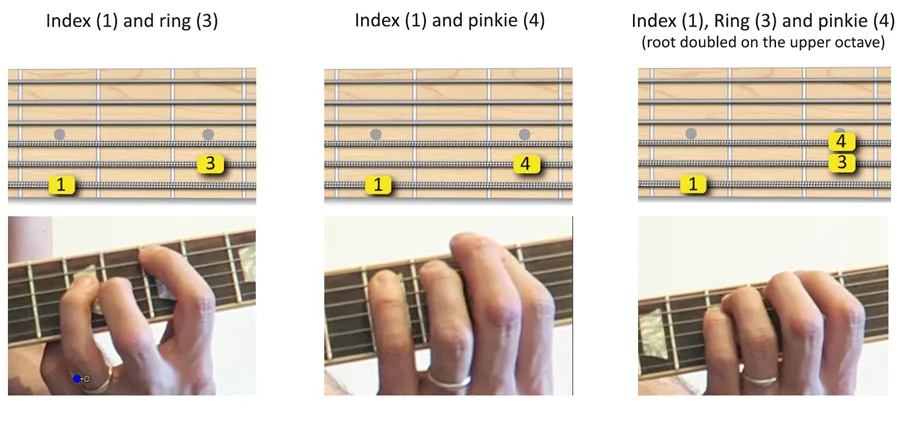
Another straightforward way to use the pinky more often is to play powerchords using the index and the pinky finger (image 2 and 3 in the picture below)
The Correct Thumb Position
When we first start playing guitar we are taught to keep the thumb in the back of the fretboard for support, which is good advice for beginners. But as you advance in skill it becomes clear that the thumb has different positions depending on what you are playing.
In some cases we will end up wrapping the thumb around the top partially for grip and sometimes to play bass notes in muted chords.
When we shred or play arpeggios up the neck our thumb position may be better suited as support from behind. When we pick the goal is to conserve as much movement as possible, the same goes for fretting our notes.
We need to make sure the thumb is being used right and not getting in the way or slowing us down. Besides knowing the various thumb positions you must be mindful of where you are using them.
A proper thumb position is crucial to achieve good bending skills.
Relax and Find a Better Hand Position
As a guitarist you will find your practice revolves so much around building strength that your fretting hand seems to be in a constant state of tension. This is a common problem and you must practice keeping your hand from being overtightened and stressed.
This not only leads to short-term fatigue but will contribute to longer term issues like pain and arthritis.
There are multiple hand and thumb positions and we need to be mindful of using the right ones. Switch from a muted funky strum where your fingers are held tight to a slow B.B. King style blues solo that drifts across the fretboard.
Practice these contrasts in hand tension to stay more mindful of being relaxed while playing. And while the guitar takes some pain to gain, if it is too much then you need to look at your fretting hand tension and position.
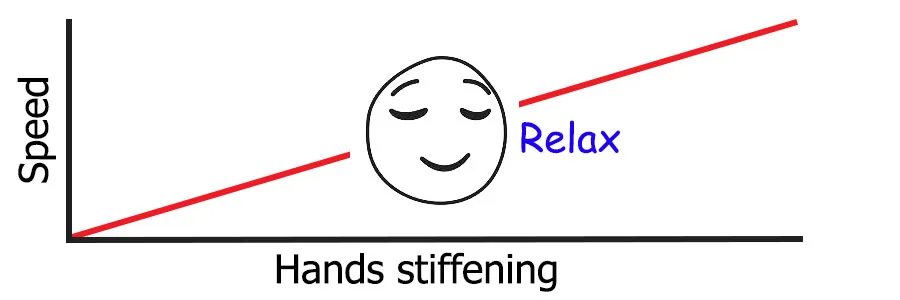
Relaxation and smooth movements are key for achieving speed and dexterity on guitar
Making Big Stretches
Moving up the octaves and stretching your hand across three to five frets can be quite challenging. If you are a complete beginner that will almost feel impossible, like pinky strength it takes time to build the skill.
The best way to start is to always play up and down the fretboard with scales and melodies using various barre chords. Then start adding in flourishes with the ring and pinky fingers, slowly conditioning your hand into stretching more.
Playing across the fretboard and using specific hand exercises will provide the basics for playing big chords and making big leaps. However you will also need the real playing experience of these big stretches.
Practice songs that have complicated chords and solos so you can get an idea of how to make big movements in real-time. Also, arpeggios and particular scale patterns such
as 3-notes-per-string require challenging stretches for the left
Notes On The Same Frets: Finger Rolling
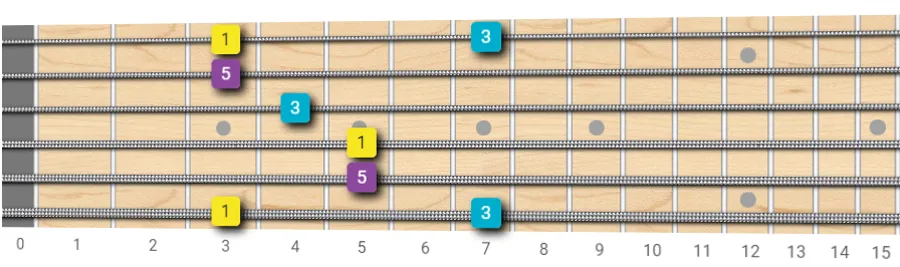
Finger rolling is a fretting hand technique that is used for playing and muting adjacent strings. When we are moving to another string on the same fret it can be easy to just let our finger roll to the next placement.
However as we get to the new note we must make sure that our old note is muted, so the flesh of our finger must dampen one string while playing another.
In a perfect world we would use a different finger for each note, and in some cases like shredding that is even stressed. But sometimes it is just not practical to do this and it is just easier to roll the same finger into the new note. If it is done correctly there are times when it is not only fine, but helpful.
Suspended arpeggios are a great way to practice finger rolling. Here's a free pdf with many suspended arpeggios patterns
Try also to play pentatonic scale in third intervals.
Coordinate with the Picking Hand
All these challenges are basically leading up to the ultimate reason you need mastery over your fretting hand, and that is because it must move in sync with the other. Your fretting, hammering, pulling off, muting, rolling, and more must all coordinate with the movement of the picking hand.
You can build all the hand and pinky strength in the world, but it will not matter if you are not capable of using it in time.
Sweep picking is a great way to practice coordination between both hands as that requires the left hand and right to perfectly sync up.
If that is a bit too advanced you can always stick to songs that have a mixture of melody and chords, that way you must pick a melody and strum. That is an easier way to learn to integrate the fretting and picking hand as one.
Besides strength training many of our fretting hand challenges are like the picking aspect.
We need to make sure errant strings are muted while the correct note is played, and this all needs done quickly to keep the song moving. When guitarists focus on speed and skill they often spend hours picking away, when sometimes the secret to better guitar success was in the fretting
Left Hand Practice - Conclusions
This ends our recap on the main challenges for the left-hand, when it comes to developing technique. Be sure to deal with all these aspects in your practice regime.
To stay updated on new tutorials, subscribe here.
FAQ
How can I effectively build strength in my fretting hand for guitar playing?
To develop a stronger fretting hand, consistently try new songs and chords. Practice various chord inversions, barre chords higher on the fretboard, and incorporate new bass notes. Integrating melodies and riffs into your chord progressions also significantly helps build core hand strength and muscle memory.
What are the best ways to safely develop and strengthen my pinky finger for guitar?
To strengthen your pinky, start with small, controlled amounts of practice to avoid injury from overuse. Incorporate little pinky flourishes into your chord playing. Exploring genres like funk, which often utilize the pinky for 9th or 13th chords and muted strumming, is beneficial. Practicing power chords using your index and pinky finger is also an effective exercise.
When is it appropriate to change my thumb position from behind the guitar neck?
While keeping the thumb behind the neck is good for beginners, advanced playing often requires varied positions. You might wrap your thumb partially over the fretboard for better grip or to play bass notes in muted chords. However, for shredding or arpeggios up the neck, the thumb is typically better positioned behind for support and stability. A proper thumb position is also vital for good bending technique.
How can I avoid tension and maintain a relaxed fretting hand while playing guitar?
Many guitarists experience tension in their fretting hand, which can lead to fatigue and long-term issues. To combat this, practice being mindful of your hand's state. Actively switch between styles that require different levels of tension, such as a tight muted strum and a flowing blues solo. This contrast helps you learn to relax your hand and maintain fluidity when needed, improving speed and dexterity.
What are effective ways to increase my finger stretches across the guitar fretboard?
To improve finger stretches, begin by playing scales and melodies up and down the fretboard, incorporating various barre chords. Gradually add flourishes using your ring and pinky fingers to condition your hand. Specific hand exercises are helpful, but also practice songs with complicated chords and solos that naturally require larger movements. Arpeggios and 3-notes-per-string scale patterns are excellent for challenging your stretch.
What is finger rolling on guitar and when is it a useful technique?
Finger rolling is a fretting hand technique where you use the same finger to play notes on adjacent strings within the same fret. The key is to roll your finger in a way that simultaneously plays the new note and mutes the previously played string with the flesh of your finger. This is particularly useful when it's not practical to use a separate finger for each note, such as when playing suspended arpeggios or pentatonic scales in third intervals.