Guitar Fingering Guide
How To Fret Scales and Arpeggios
Playing scales and arpeggios is an exciting technique that fascinates millions of guitar aficionados.
Pentatonic scales, diminished arpeggios, major and minor triads, an infinite palette of colors lies on our fretboards.
In this post, I want to give some answers to a question often asked:
What is the correct fingering for this scale/arpeggio?
We're going to analyze the various fretboard pattern options for a given scale or arpeggio: 4 frets box, 3 notes per strings, diagonal arpeggios and scales, even 2 notes per string shapes.
Here's the demonstration video for this tutorial:
How To Finger Scales and Arpeggios | Introduction
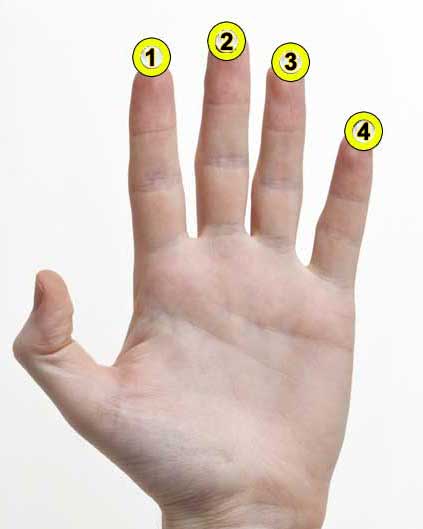 As a quick refresher,
here below you find a diagram that shows you the standard convention for denoting the fingers of the left
hand (or right hand if you are a left-handed guitar player):
As a quick refresher,
here below you find a diagram that shows you the standard convention for denoting the fingers of the left
hand (or right hand if you are a left-handed guitar player):
- 1 = Index finger
- 2 = Middle finger
- 3 = Ring finger
- 4 = Pinky finger
The thumb, denoted with T, unless you are Django Reinhardt, is not used; but this is not a set-in-stone rule, if it works for you, feel free to use this finger too.
Interactive Guitar Fretboard
Use the tool below to see the suggested fingerings animated on the fretboard:
How Do I Know With Fingers To Use?
First of all, you should know that there are not too many strict rules for fingerings. The only rule is "efficiency of motion".
This translates to using one finger per fret: as we have 4 fingers, and most of the scale patterns are 4 frets wide, each finger must take care of one fret only, limiting the movements of the left hand at the minimum, saving energy and time, thus allowing precision and speed.
There are scale exercises specifically conceived for developing dexterity and agility in all fingers (pinky too!)
Of course, particular patterns like arpeggios or 3-notes-per-string are larger than 4 frets, so a certain amount of stretch is required.
But the efficiency rule still applies: you want to keep left-hand shifting as small as possible.
If an arpeggio extends from fret 3 to fret 7, we could use the index finger on fret 3, the pinkie on fret 7, and the middle finger for the frets between 3 and 7, keeping your left hand in place all the time. In the video you can observe a practical application of this suggestion.
Left Hand Fingering for Different Fretboard Patterns
Here below you find some fingering suggestions for various scale and arpeggio patterns.
For the purpose of this tutorial, we're going to use the G major scale and the G major arpeggio. My complete ebook Scales Over Chords shows you various fretboard patterns for more than 30 types of different scales. Check the ebook here
G Major Scale 4 Frets Box
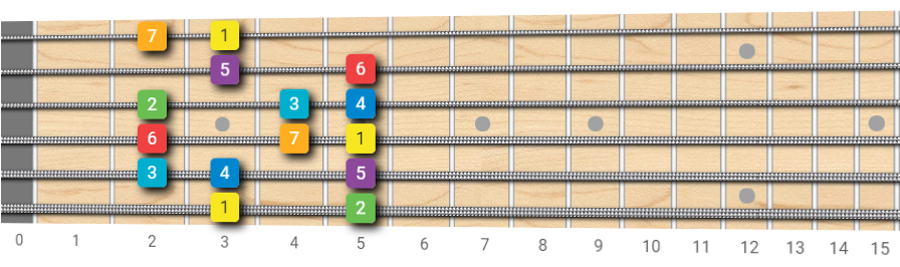
This is the most common way to fret a scale. The majority of scale types fit exactly a fretboard area four frets wide; some scales, like the minor scale, requires 5 frets; with this configuration, using one finger for fret is the natural approach.
G Major Scale 3 Notes Per String
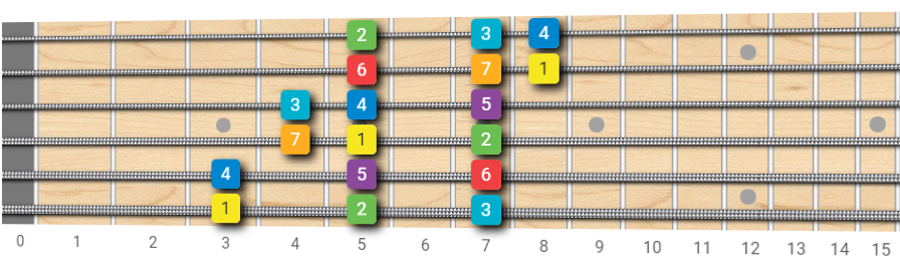
3 notes per string patterns require a bit of stretch but they provide the advantage to having an equal number of notes on each string (3).
This symmetry is helpful in many shredding techniques, such as legato and fast alternate picking.
In fact, with legato you pick the first note, and you do a hammer-on for the other two.
This process repeats for each string.
G Major Scale 2 Notes Per String
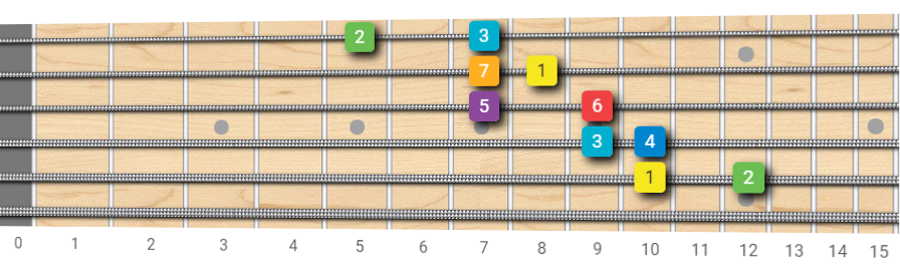
This is an uncommon way to fret a scale, but it helps move along the fretboard horizontally and come out with new ideas.
Also, this kind of shape highlights really well the chords contained in the scales; you can learn more about this like in my two notes per strings tutorial.
G Major Arpeggio 4 Frets Box
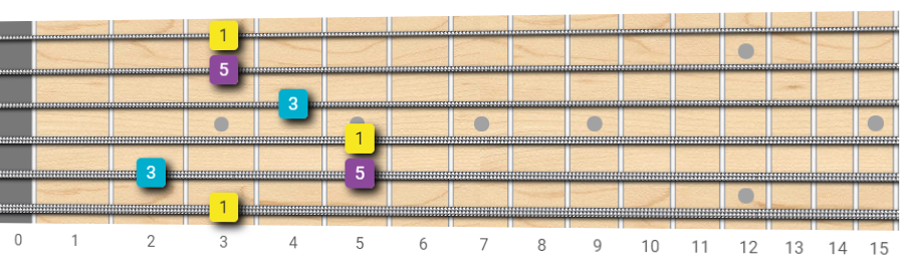
The logic for this pattern is the same for 4 notes box scale shapes.
In this case you only play the tones of the arpeggio.
The most difficult part of playing arpeggios occurs when you need to play two notes on the same frets of adjacent strings, with the same finger.
This movement involves the finger rolling technique, in which you use the tip of the finger on the lowest string, and then you roll onto the flat of your finger to play the note on the higher string.
G Major Arpeggio Big Stretch (2 variations, index and middle)
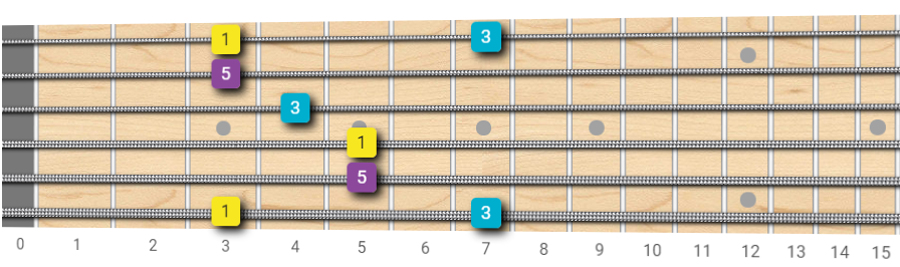
Another way to play arpeggios is to use a shape extended more horizontally.
Again, this requires a bit of left-hand stretch, but once you acquire the proper flexibility this kind of shape allows you high speed and precision. Always remember to use one finger for fret so that you don't have to shift your left-hand too much.
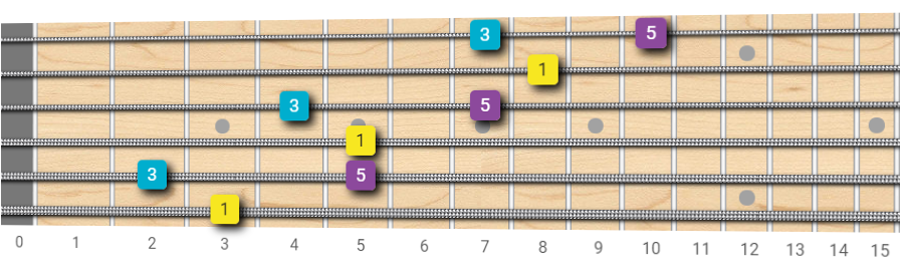
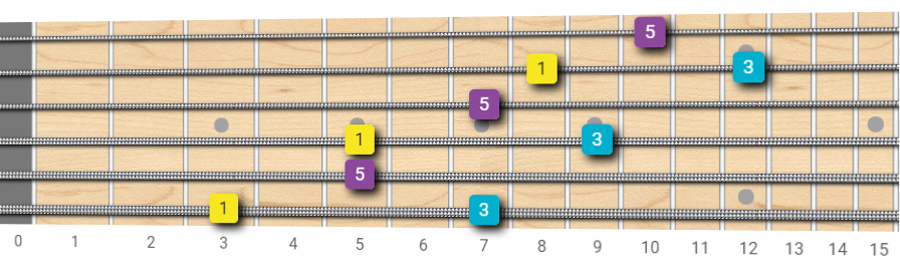
G Major Arpeggio Diagonal
Diagonal arpeggios are a cool way to use the whole fretboard and get unstuck from fixed patterns.
Basically, you play the same pattern on different octaves, by shifting the schema up to the neck. Pay attention to the distance between the G and B strings, that is 4 half-steps instead of 5 half-steps; this requires shifting the pattern in the last octave one half-step higher.
Usually, the one-octave pattern that will be repeated along the fretboard can be played in two ways: compact and extended.
Guitar Scales and Arpeggios Fingering: Conclusion
I hope I gave useful suggestions about the best way to fret a scale or arpeggio.
Remember, these are just general suggestions that you can adapt or change as you need.
It's also possible to rely on open strings to play scales in open position.
But please, be sure to train all your fingers: a weak pinky limits severely your ability to play interesting patterns (here's a detailed article on pinky training)
Often, we tend to follow the path of least resistance and do only what is easy. I suggest forcing yourself to use always all your four fingers; with time and patience, you'll be amazed by your skills level.
If you want to stay updated on new tutorials, subscribe here: you'll also get access to the free download area, which contains many scales, chords and theory pdfs to download for free.
FAQ
What is the fundamental rule for effective guitar scale and arpeggio fingering?
The fundamental rule for effective fingering is "efficiency of motion." This means aiming to minimize left-hand movement as much as possible. For many patterns, this translates to using one finger per fret within a four-fret span, which helps save energy and improves precision and speed.
When should I use the 'one finger per fret' rule, and what if the scale or arpeggio pattern is wider?
The 'one finger per fret' rule is primarily applied to patterns that fit within a four-fret box on the fretboard. For wider patterns, such as '3 notes per string' scales or 'big stretch' arpeggios, some stretching between fingers is necessary. However, the core principle of minimizing overall left-hand shifting still applies to maintain efficiency.
Why are there different fingering patterns for scales, such as '3 notes per string' and '2 notes per string'?
Different fingering patterns offer distinct advantages for various musical applications and techniques. '3 notes per string' patterns are symmetrical and beneficial for techniques like legato and fast alternate picking. '2 notes per string' patterns encourage horizontal movement across the fretboard and can help highlight underlying chord shapes within the scale.
How do I correctly fret notes on the same fret across two adjacent strings in an arpeggio?
To fret notes on the same fret across adjacent strings, you use a technique called 'finger rolling.' You start by fretting the note on the lower string with the tip of your finger, then gently roll that same finger onto its flatter part to fret the note on the higher adjacent string without lifting the finger completely.
What are diagonal arpeggios, and how can they improve my guitar playing?
Diagonal arpeggios involve playing a one-octave pattern and then shifting it across the fretboard to cover multiple octaves horizontally, rather than just vertically within a fixed position. This approach helps you explore the entire fretboard, break free from conventional box shapes, and discover new melodic ideas. Remember to adjust the pattern between the G and B strings due to their unique interval.
Is it really necessary to train and use my pinky finger for scales and arpeggios?
Yes, it is highly recommended to train and consistently use all four fingers, especially your pinky. A strong and independent pinky significantly expands your ability to fret complex patterns efficiently, maintain speed, and execute technically demanding passages, preventing limitations that arise from relying solely on your stronger fingers.