Ear Training For Guitar Players
Have You Heard About Ear Training?
Ok, so that title is a terrible pun, but in all seriousness ear training is one of the more integral parts of music. You can train yourself to hear pitches, intervals, melody, chords, and rhythms , in fact some musicians have learned their entire instrument with this alone.
That is one reason why many folks, even famous musicians, did not know how to read sheet music. The Beatles, Elvis Presley, Jimi Hendrix, and many more famous artists completely learned to play guitar by simply listening to records .
Before moving on, be sure to download this big Mp3 Ear Training pack from your download area.
Table Of Contents
Free Ear Training Course
If you are looking for a complete ear training course that will make you able to identify on the fly chords, intervals, times and signatures, I strongly recommend taking this 10 Day Ear Training Free Course from the guys of Musical-U : it will make you discover what your ears can really do!
Pros and Cons of Technology
One of the reasons artists in the past often learned to play by ear had to do with the available technology. Years ago a musician was limited on how-to books, TV, there was no video tech, and of course no Internet and online lessons, so that left one option. The listener would buy a record and play it a million times all while sitting with their guitar and they would attempt to copy what they heard on the album. This had its benefits and eventual pitfalls. This is a great way to learn to play in a band, however when the musician wanted to write their own complicated score, it posed a bit of difficulty.
These days it seems we have lost some of our ability to train our ears. One of the risks is to definitely become way too dependent on the Internet and tabs when you first begin guitar. Your ear simply did not receive the training it should have.
Pitch Recognition
One of the main ways to train your ear is to be able to find the Tonic in a piece of music. Remember the tonic is the root note of a key , and by finding this root we can then start to flesh out other aspects of a song.
If we listen and find the pitch to be in the Key of G it helps us find other notes and chords because we have G as a reference point. Of course there are apps, software, and machines that will allow us to figure out the tonic pitch, but that defeats the purpose of ear training !
One simple way to recognize tonic pitch is to sit down with your guitar and listen to a song. By playing notes and listening, it is possible to find the root note of the song by trial and error.
Interval Ear Training
The next step in ear training is intervals. After we have the tonic or root note we can than listen to various intervals to figure out what is going on in the song.
A root note to a fifth has a specific sound to it, so the jump from G-D and C-G are both a 1st to 5th interval and they both have a similar sound. While interval recognition is limited to two notes, it can help us slowly figure out a song.
One of the best ways to start on interval training is to listen to famous songs that have well known intervals. For example, a famous song that has the 1st to 5th interval happens to be the first two notes of the Star Wars Theme! Here are some more examples of famous heavy metal songs
- Here you find a full Functional Ear Training Mp3 Set that will allow to practice interval ear training on the go . Simply upload the mp3s on your player, and start the playlist in shuffle mode. Your mission is to guess the kind of the intervals your hear
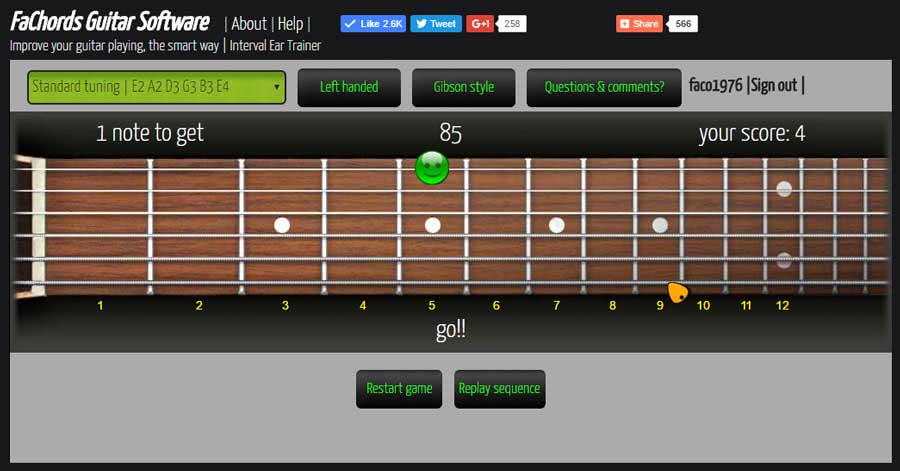
- To help you practice interval ear training directly on the guitar fretboard, we developed this Visual Interval Ear Training Game : playing this game is a great way to develop fretboard geometry and sounds awareness. Check it out!
Chords and Chord Progressions Recognition
This can get a little more complicated, and is always easiest when the chords of a song are simple. In a past article we discussed how many songs share similar chord progressions , with this in mind it helps our ear training.
If you are listening to a song that is R&B or Funk, there is a decent chance that it will have a variant of the Doo Wop chord progression. While a pop song is likely to be covered by the Axis of Awesome progression . Of course songs always deviate a little, but if you know the most commonly used progressions it is a good place to start when attempting to find the chords of a song.
After you find the tonic of a song, figure out a few note intervals , and the next step is to find some chord intervals. If the tonic is G there is a very good chance you will find some C and D chords in the song. Over time you will also begin to catch on when one chord is a minor and one a major .
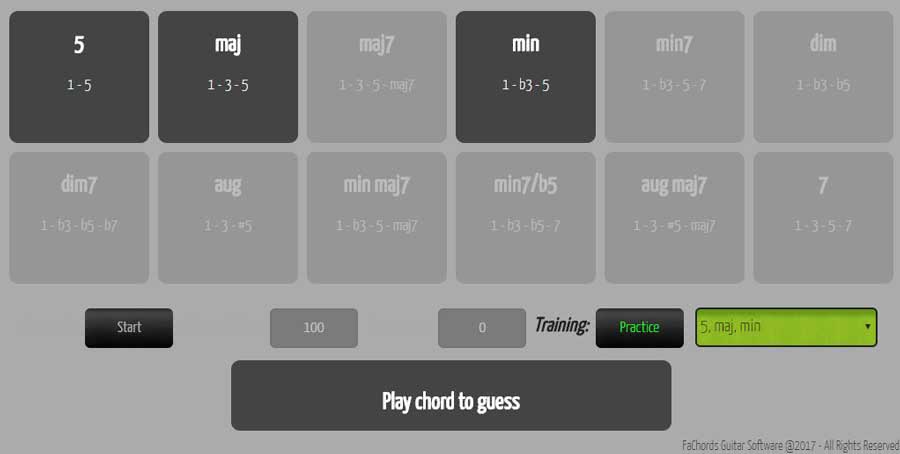
To help you pratice chords recognition, we developed an online game that allow you practice chords recognition : it has exercises on recognizing if a given chord is major, minor, dominant, major seventh and so forth. It's a fun way to develop your ability to recognize different chord qualities. You find the chords recognition game here
Melody, Rhythm, and Bass
 During ear training you also have the goal of being able to identify different aspects of the song. This
can be done even when you are in your car or at work, it’s not necessary to have your
guitar with you. Of course it helps to have good speakers, that way you can pick out what the bass line
is and what the melody is. In music it is legal to reuse rhythms and bass lines… for the
most part. Over time you will start to notice
many bass lines and drum parts are very
similar
.
During ear training you also have the goal of being able to identify different aspects of the song. This
can be done even when you are in your car or at work, it’s not necessary to have your
guitar with you. Of course it helps to have good speakers, that way you can pick out what the bass line
is and what the melody is. In music it is legal to reuse rhythms and bass lines… for the
most part. Over time you will start to notice
many bass lines and drum parts are very
similar
.
If you notice a melody line is similar, well than that may be a future lawsuit! If you apply critical listening to every song you listen to, with practice you will be able to discern the different parts of a song. Once you can pick the bass line , solo, or rhythm guitar out it makes it easier to then dissect these parts into tonic, intervals, and chords.
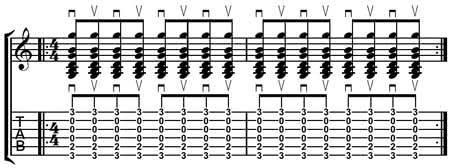
The more you pick a song apart, over time you will see how similar music is, especially if you stick to one genre. For example, reggae has a handful of bass lines and rhythms , hip hop specific drum beats and fills, and country music will often use the same chord progressions . Of course there are always songs that break the mold.. which is a good thing, but they make it hard to learn by ear. This tool allows you creating different rhythmic patterns and practice tempos and time divisions.
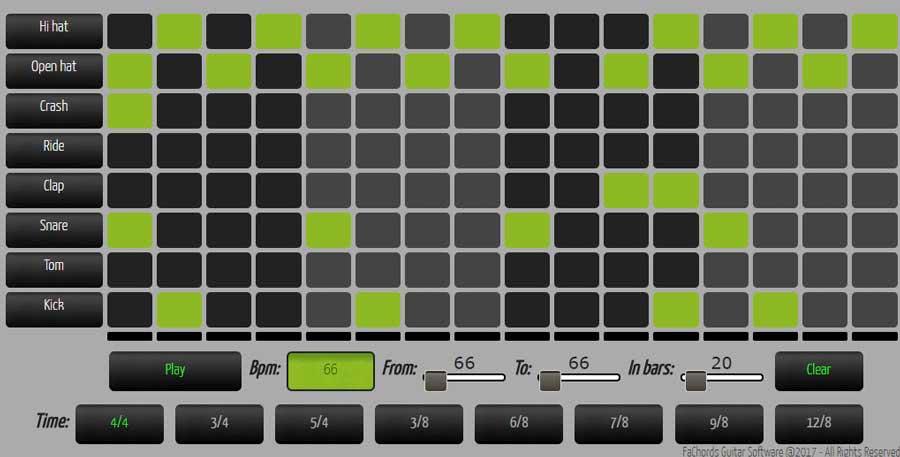
How to practice ear training
Ok there is only so far with ear training that we can go by writing, at the end of the day we just have to listen and practice. The first step is to stop depending so much on chord sheets and tabs, and just listen. FaChords has provided you with a few starter resources;
To help with identifying intervals try this ear training mp3 . After listening to the mp3 get your guitar out and start practicing those same intervals, here we provide interval practice with the guitar fretboard. And once you feel ready, step up to practicing your chord recognition with this game .
Ear training takes time , use the links we provided, search out some more games, and just critically listen to music as much as possible. Just like playing guitar, ear training takes near daily practice. One way I improved my listening skills was by buying a cheap record player and some old vinyl. For some reason when I put a record on I am more attentive to the music than when I play digital music. Of course this may not work for everyone, but the key is to find a way to focus on the music more. The only way to train your ears is by listening , find what it takes to make you a more active listener, and with practice your ears will be able to break a song down in no time!
Ear Training for Guitar Players: conclusions
I hope you're now convinced that ear training is a fundamental practice if you want to become a complete musician. If music is a language, you must be able to understand the words! To start your adventure in ear training, take this 10 day free ear training course and play around with the resources listed on this page.
To stay updated on new tutorials, subscribe to the free newsletter (you'll also get access to the download area with lots of free printable resources)
Ear Training Tutorials:
FAQ
Why is ear training crucial for guitarists, even if I rely on tabs or sheet music?
Ear training helps you understand music by sound, enabling you to identify pitches, intervals, chords, and rhythms without visual aids. This deepens your musical comprehension, allows you to play by ear, and can even aid in composition, as seen with iconic musicians who learned without formal notation. Over-relying on visual tools can prevent your ears from developing this essential skill.
What's the fundamental first step a guitarist should take to begin ear training?
The most crucial first step is to develop pitch recognition by finding the 'tonic' – the root note of a song's key. You can practice this by listening to a piece of music and, with your guitar, trying different notes until you find the one that sounds like the musical home base. This tonic then serves as a reference point for understanding other notes and harmonies.
How do interval ear training and chord recognition differ, and how do they relate for guitarists?
Interval ear training focuses on identifying the distance and sound relationship between two individual notes, which helps you understand melodic and harmonic structure. Chord recognition, on the other hand, involves identifying the quality of entire chords (major, minor, etc.) and how they progress. Interval training typically builds upon pitch recognition and serves as a foundational step towards recognizing full chords.
Can I practice ear training effectively without my guitar in hand?
Yes, absolutely. Ear training primarily involves active and critical listening. You can practice identifying melodies, bass lines, and rhythmic patterns in any song you hear, even when you're away from your instrument. The goal is to consciously dissect and understand the different musical components, which is a mental exercise applicable anywhere.
How often should a guitarist practice ear training to see tangible improvement?
Consistent, almost daily practice is key for significant improvement in ear training, similar to how you practice your instrument. It takes time and focused listening. The goal is to consistently shift from passive listening to actively trying to discern and understand the pitches, intervals, chords, and rhythms in all the music you encounter.
How can knowing common chord progressions assist my ear training when learning songs on guitar?
Familiarity with common chord progressions (like those found in many pop or blues songs) acts as a powerful guide in ear training. Once you've identified the tonic of a song, recognizing a common progression allows you to anticipate and quickly identify many of the subsequent chords, significantly speeding up the process of figuring out a song's harmony by ear.
Why is it important for guitarists to reduce reliance on tabs and technology for ear training?
Over-dependence on visual aids like tabs or apps can prevent your natural ability to hear and understand music from fully developing. While technology can be a tool, the essence of ear training is to train *your own* auditory perception. Actively listening and figuring things out by ear, even through trial and error, builds a much stronger and more intuitive musical foundation.
What specific musical elements should a guitarist aim to recognize through ear training?
As a guitarist developing your ear, you should aim to recognize pitches (especially the tonic), intervals (the distance between notes), melodies, chords (their qualities and progressions), and rhythms. Being able to distinguish the bass line and different instrumental parts within a song is also a key aspect of comprehensive ear training.