Understand and Play the G7(#5) Guitar Chord with Our Tools
Want a structured chord roadmap instead of jumping between pages?
Go to the full guitar chords tutorial.
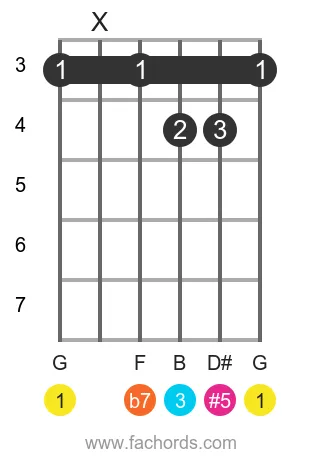
The G7(#5) chord, a distinctive member of the Augmented Chords family, is constructed from the intervals 1, 3, #5, and b7. These correspond to the notes G, B, D#, and F – the Root, Major Third, Augmented Fifth, and Minor Seventh, respectively. Explore its unique sound on our interactive virtual fretboard, offering instant chord playback and real-time mic feedback to verify your playing accuracy.
The G7(#5) is a dominant chord with an augmented fifth, giving it a unique, tension-filled quality often utilized in jazz and fusion. Its specific interval structure, featuring the #5, creates a distinct color compared to a standard dominant 7th. To deepen your understanding of how such complex chords are formed and denoted, refer to our comprehensive guide on chord construction. Further explore the broader category of dominant chords to grasp their fundamental role in harmony. Mastering this chord’s fretboard logic will significantly expand your harmonic palette.
To truly internalize the G7(#5) chord, start by experimenting with the interactive fretboard above. After practicing, scroll down to discover various diagrams, presented from easiest to most challenging, along with deeper theory insights, suggested songs, and different keys where this chord shines. Consistent and disciplined practice is key to seamlessly integrating this advanced chord into your playing.
Notes that compose the G 7(#5) chord:
How to create the Dominant Seventh Sharp Fifth chord:
G Dominant Seventh Sharp Fifth Guitar Chord Shapes
Position 1
Movable
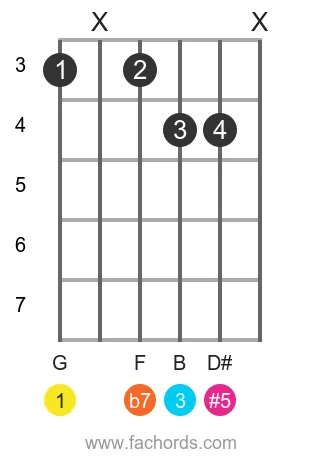
Position 2
Barre
Movable
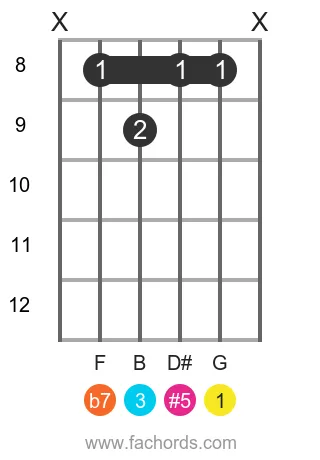
Position 3
Barre
Movable
Position 4
Barre
Movable
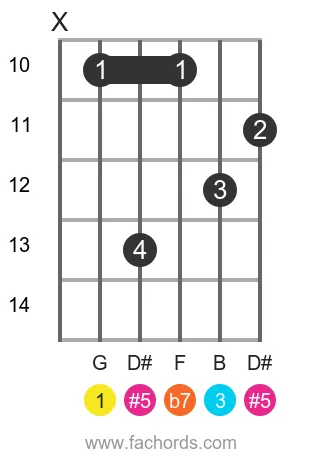
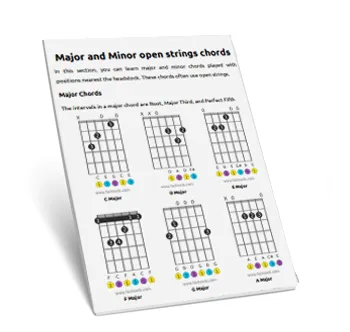
 Find more shapes in our all guitar chords online library. If you
prefer a printable pdf, download
the Free Guitar Chords Chart Pdf
Find more shapes in our all guitar chords online library. If you
prefer a printable pdf, download
the Free Guitar Chords Chart Pdf
You can also use this accessible G7(#5) chord page, with written diagram instructions and screen-reader support for blind users.

Created by
Giancarlo is a musician (teaching guitar since 2000), software engineer, AI consultant and published researcher
FAQ
What does the notation "G7(#5)" mean, specifically the "(#5)" part?
The 'G' indicates the root note of the chord. The '7' signifies that a minor seventh interval is included. The '(#5)' specifically means that the perfect fifth interval, which would typically be a D for a G chord, is augmented (raised a semitone) to a D#.
What are the notes and intervals that make up the G7(#5) chord?
The G7(#5) chord is composed of the notes G, B, D#, and F. These correspond to the intervals of the Root (1), Major Third (3), Augmented Fifth (#5), and Minor Seventh (b7) respectively.
Why is the G7(#5) chord considered a member of the Augmented Chords family?
The G7(#5) chord is part of the Augmented Chords family because it specifically contains an augmented fifth interval. In this case, the D# is an augmented fifth above the root G, which gives the chord its characteristic 'augmented' quality.
How does the G7(#5) chord differ from a standard G7 chord?
The primary difference lies in the fifth interval. A standard G7 chord contains a perfect fifth (D). The G7(#5) chord, however, features an augmented fifth (D#), while retaining the root, major third, and minor seventh of a dominant 7th chord. This altered fifth creates a more tension-filled and unique sound.
Is the G7(#5) chord considered a dominant chord, and what does that imply?
Yes, the G7(#5) is considered a dominant chord because it includes the minor seventh interval (F, which is a b7 of G). Dominant chords are foundational in many musical styles, particularly jazz, as they create a strong sense of tension that typically resolves to the tonic, driving the music forward.
When would I typically use the G7(#5) chord in my guitar playing?
You would use the G7(#5) chord to create a richer, more complex, and interesting soundscape in your playing. It's often employed to add tension, provide a strong sense of dominant function, or introduce an 'exotic' flavor, commonly found in genres like jazz, where players look to expand their harmonic vocabulary beyond basic chords.
