G Dominant Thirteen Sharp Fifth Guitar Chord Charts & Variations
Welcome to our tutorial on the G 13(#5) chord, a complex, richly textured chord that belongs to the Augmented Chords family. This chord is composed of the notes G, B, D#, F, A, C, and E, making it a seven-note chord that spans several octaves. The intervals that build this chord are 1, 3, #5, b7, 9, 11, and 13, which are also known as the Root, Major Third, Augmented Fifth, Minor Seventh, Major Ninth, Perfect Eleventh, and Major Thirteenth respectively.
The G 13(#5) chord is not a beginner's chord, but rather one that requires a deep understanding of chord notation and a good grasp of fretboard intervals. If you are new to these concepts, we recommend checking out our tutorials on these topics before diving into this complex chord.
In this tutorial, we will provide chord diagrams and fretboard patterns that show the tones composing the G 13(#5) chord. These visual aids will help you understand how the chord is constructed and how to play it on the guitar. We will also provide tips on how to incorporate this chord into your playing, whether you are into jazz, blues, rock, or any other style of music.
The G 13(#5) chord is a staple in jazz chord progressions, but it can also add a unique flavor to other genres. Whether you are a seasoned guitarist looking to expand your chord vocabulary or an ambitious beginner ready to tackle more advanced chords, this tutorial will provide you with the knowledge and skills you need to master the G 13(#5) chord.
So, grab your guitar and get ready to dive into the world of Augmented Chords with the G 13(#5) chord!
Notes of the G 13(#5) chord:
Tones in the Dominant Thirteen Sharp Fifth chord:
 Download
the Free Guitar Chords Chart Pdf
Download
the Free Guitar Chords Chart Pdf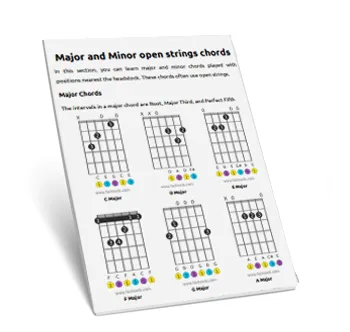
FAQ
What specifically makes the G 13#5 chord an 'Augmented Chord'?
The defining characteristic that places the G 13#5 in the 'Augmented Chords family' is its augmented fifth (#5) interval. In the G 13#5 chord, the fifth is D#, which is an augmented fifth above the root G, creating a distinctive sound compared to a perfect fifth found in standard dominant chords.
Why does the G 13#5 chord have seven notes, and how does this affect playing it on guitar?
The G 13#5 chord theoretically comprises seven distinct intervals: the Root, Major Third, Augmented Fifth, Minor Seventh, Major Ninth, Perfect Eleventh, and Major Thirteenth. While it's a seven-note chord, practical guitar voicings often involve selecting a subset of these notes, typically the essential ones like the Root, 3rd, #5, and b7, and strategically adding extensions like the 9th or 13th to create a playable and characteristic sound on the fretboard, especially since the full chord can span several octaves.
In which musical genres can I effectively use the G 13#5 chord?
While the G 13#5 chord is a staple in jazz chord progressions due to its complex and rich texture, its unique sound can also add a sophisticated flavor to other genres. You can incorporate it into blues, rock, or fusion to introduce tension, color, and an advanced harmonic palette into your playing.
What is the key difference between a G13 chord and a G 13#5 chord?
The primary difference lies in the quality of the fifth interval. A standard G13 chord includes a perfect fifth (D), which is common in dominant 13th chords. In contrast, the G 13#5 chord features an augmented fifth (D#), which creates a sharper, more dissonant tension and gives the chord its distinctive 'augmented' quality.