Play the F7 Guitar Chord with Our Interactive Trainer
Want a structured chord roadmap instead of jumping between pages?
Go to the full guitar chords tutorial.
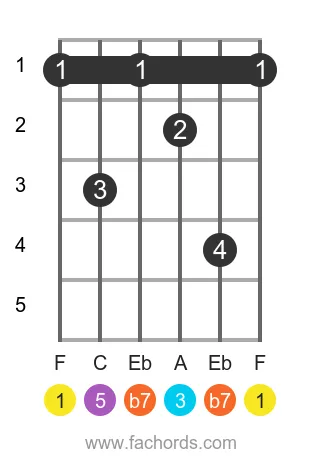
The F7 chord is a cornerstone in Blues and Jazz, recognized for its distinctive dominant tension. Comprising the notes F, A, C, and Eb, this chord is built on the 1st (Root), 3rd (Major Third), 5th (Perfect Fifth), and b7th (Minor Seventh) intervals. Discover the rich sound of this essential chord and practice its voicings instantly on our interactive fretboard. Get immediate, accurate feedback on your playing through your device's microphone, ensuring you hit every note correctly.
As a dominant seventh chord, the F7 plays a crucial role in creating harmonic tension, often leading melodically to a resolution, particularly in blues and rock music. Understanding its construction, by stacking specific intervals like the root, major third, perfect fifth, and minor seventh, is fundamental to mastering its application across various keys. Explore the broader concept of Dominant Chords and how they function, or deepen your knowledge of Chord Construction to unlock more complex harmonies.
To truly internalize the F7 chord, experiment with its different voicings and shapes on the virtual fretboard, from the easiest open positions to more challenging barre forms. Afterward, you can delve into detailed chord diagrams, grasp the underlying theory, and discover how this chord fits into countless songs and keys. Begin your hands-on exploration and feel the F7 chord's character before diving deep into its analysis.
Notes in the F 7 chord:
Tones of the Dominant Seventh chord:
F7 Chord Tutorial
Once again before we practice some different positions for F7 let’s take a look at what notes make this chord up.
Remember the notes for the F major scale are:
F G A Bb C D E
An F major triad or chord is made up of the root , major third , and fifth note of that scale, thus F major is:
F A C
Now an F7 is otherwise known as a dominant seventh , and to make a dominant seventh chord we use the formula; root, major third, fifth, and minor seventh.
So the F7 chord will be made up of the notes:
F A C Eb
As mentioned before there are multiple seventh chords that exist and the dominant seventh is the most important of all.
Where to use F7 dominant chord
The main function of the dominant seventh is to lead up to a tonic resolution.
For example, one very common place you will find dominant sevenths is in blues music and the seventh is often played right before the root or tonic chord.
The dominant seventh is often used in rock n roll, pop, and blues.
Try playing the progression:
Bb Eb F Bb
Now play:
Bb Eb F7 Bb
you will notice how different it sounds.
For experimenting further with chord sequences, you might find useful our chord progression generator tool
Keys with the F7 chord
The most common keys we will find with the F7 chord is the Keys of Bb, C, and F.
However you will also potentially find it in some more random places depending on where the songwriter was looking for some tension leading to resolution.
You will not see F7 as often as other sevenths, unless you are playing blues in the Key of C, and then you will have plenty of F7’s.
Chords in the key of Bb major
| Key | I | ii | iii | IV | V | vi | vii |
|---|---|---|---|---|---|---|---|
| Bb | Bb | Cm | Dm | Eb | F | Gm | Am/b5 |
Chords in the key of F major
| Key | I | ii | iii | IV | V | vi | vii |
|---|---|---|---|---|---|---|---|
| F | F | Gm | Am | Bb | C | Dm | Em/b5 |
Songs with the F7 guitar chord
- The old time tune " Lazy Bones" by Hoagy Carmichael and Johnny Mercer uses F7 along with a few other dominant seventh notes.
- "Moon River" also uses a ton of sevenths including F7.
It is chord often seen in pop and jazz standards and of course in lots of blues tunes.
How to play the F7 chord on the guitar
The picture below shows the F7 tones on the guitar fretboard:

Using the tones above we can come up with some of the more popular versions of how to play the F7 chord. Usually when we play a chord we want the root note (here F) to be the lowest played bass note.
Sometimes we will find a chord shape where that isn’t the case, which means the chord is an inversion.
If the lowest note is A, C, or Eb instead of the F than that is an inversion .
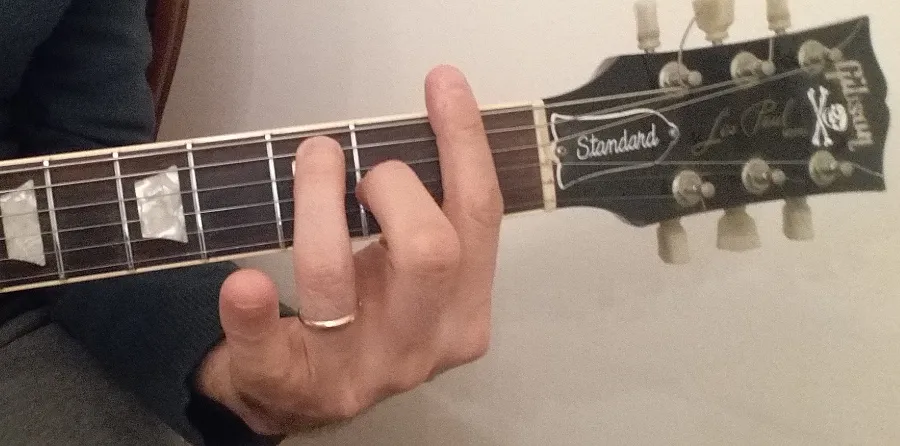
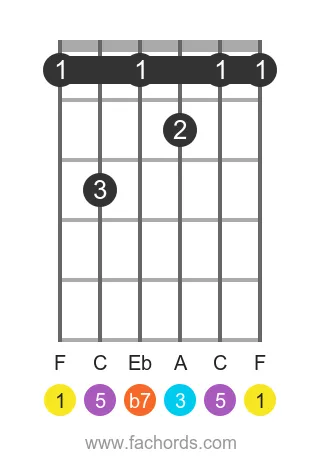
The most common position for F7 is the barred E7 chord .
A regular E7 is 020100 if we barre it and move it up one position we get 131211 :

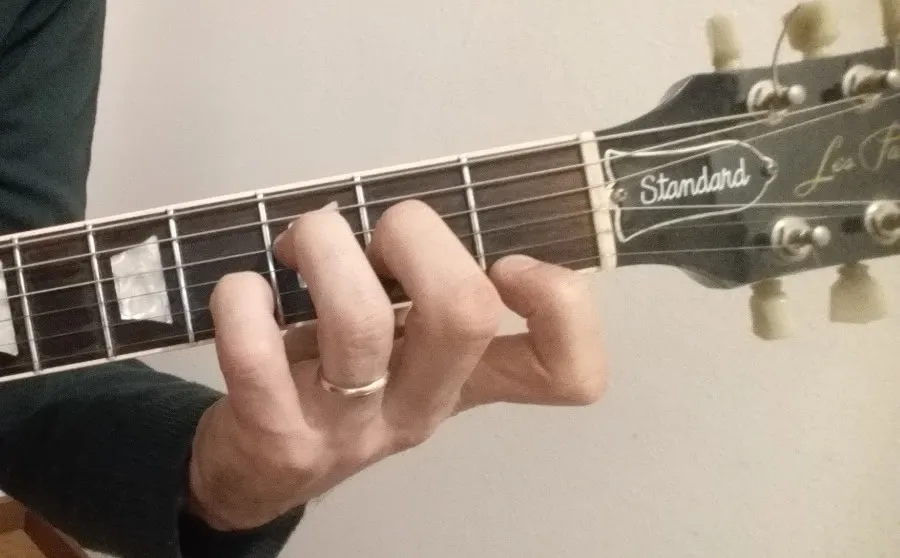
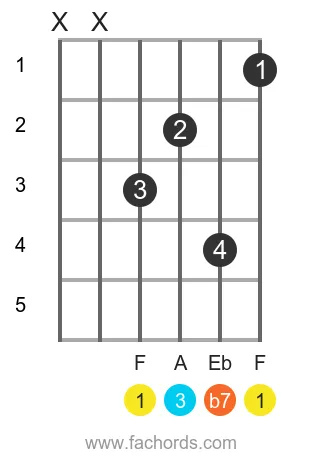
If you are not yet comfortable with barre chords another way to play F7 is XX3241 .

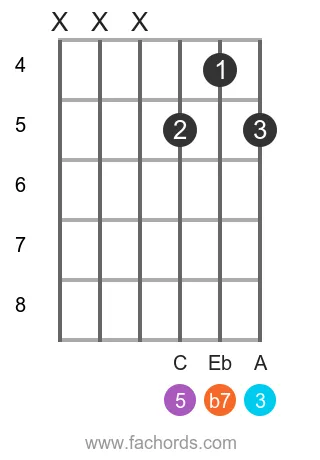
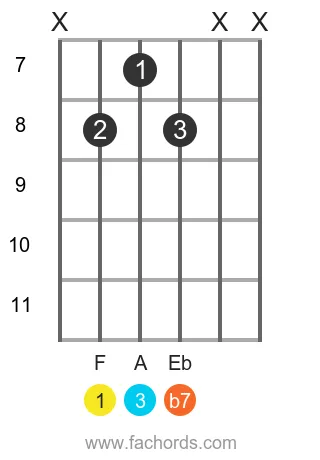
A three string version of F7 is X878XX , a rootless three string version is XXX545 (there is no F in that position just C, Eb, and A).

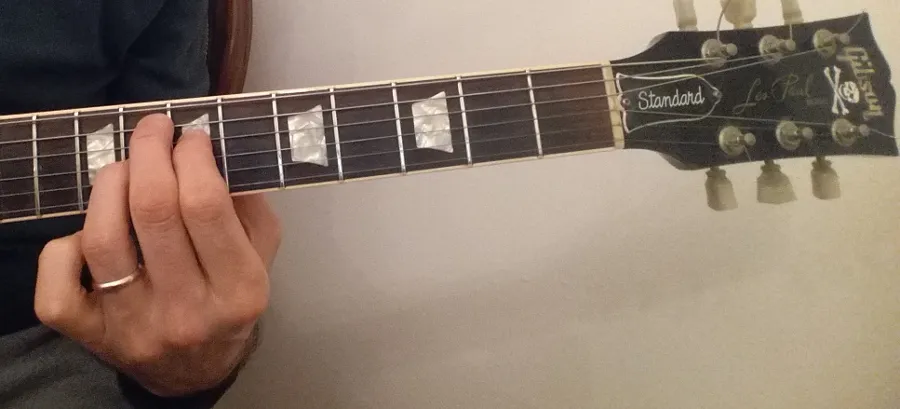
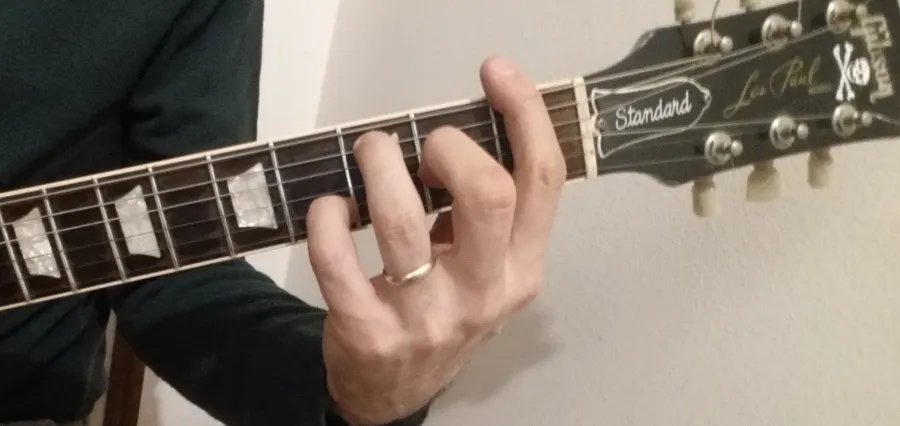
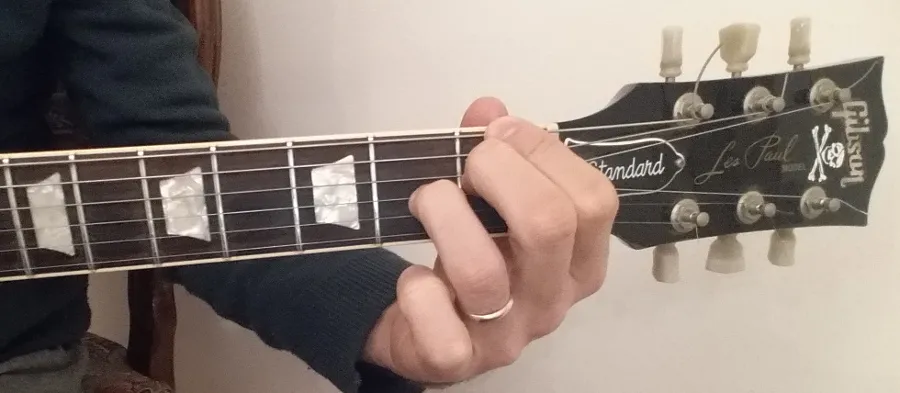
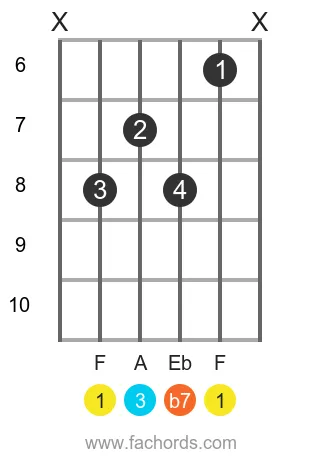
And a few complicated F7 chord shapes are 131241 (which is a tough barre chord) and 1X12XX which may be hard for people who aren’t that good at muting strings.


F7 Guitar Chord Diagrams
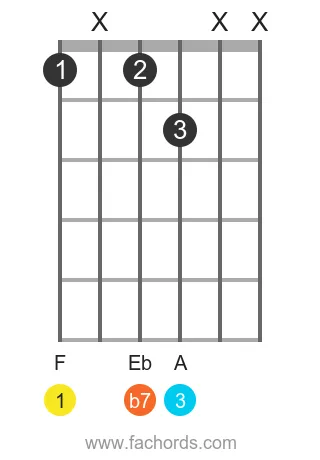
Position 1
Movable
Position 2
Movable
Position 3
Movable
Position 4
Movable
Position 5
Movable
Position 6
Movable
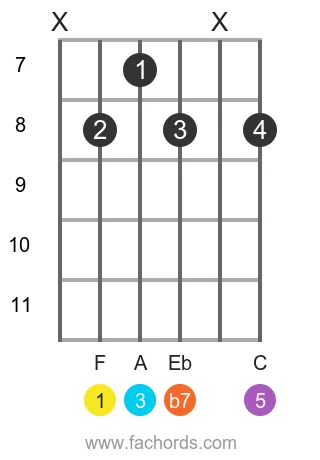
Position 7
Movable
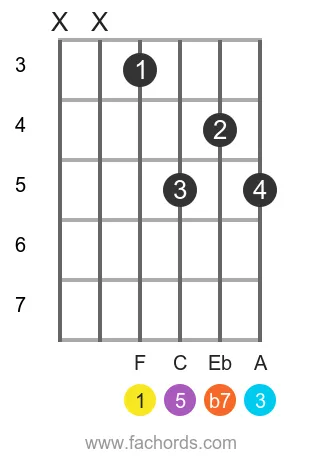
Position 8
Barre
Movable
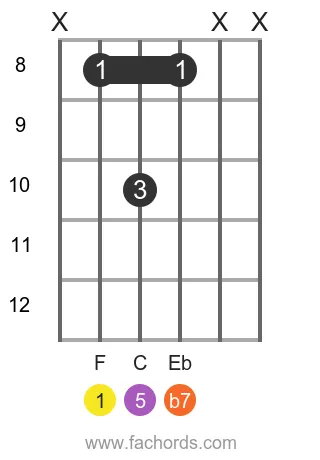
Position 9
Barre
Movable
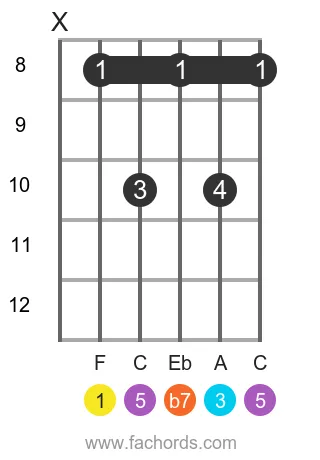
Position 10
Barre
Movable
Position 11
Barre
Movable
 Find more shapes in our all guitar chords online library. If you
prefer a printable pdf, download
the Free Guitar Chords Chart Pdf
Find more shapes in our all guitar chords online library. If you
prefer a printable pdf, download
the Free Guitar Chords Chart Pdf
You can also use this accessible F7 chord page, with written diagram instructions and screen-reader support for blind users.
FAQ
What are the specific notes and intervals that form an F7 chord?
The F7 chord is composed of the notes F, A, C, and Eb. These correspond to the music intervals of the Root (1), Major Third (3), Perfect Fifth (5), and Minor Seventh (b7) of the F major scale.
Why is F7 considered a 'dominant' chord, and what is its primary function in music?
The F7 is a dominant chord because of its inherent tension and unresolved sound, primarily created by the Minor Seventh (Eb) interval. Its main function is to create a strong pull, leading up to a tonic resolution, which means it naturally wants to resolve to a stable, 'home' chord.
How does the Eb (minor seventh) contribute to the F7 chord's distinctive sound?
The Eb, or Minor Seventh, is crucial for the F7's sound because it introduces the tension that characterizes dominant chords. This specific interval creates an unstable quality, making the chord sound like it needs to resolve, which is key to its role in progressions.
What is the difference between an F major chord and an F7 chord?
An F major chord consists of the notes F, A, and C (Root, Major Third, Perfect Fifth). An F7 chord adds one more note: the Eb (Minor Seventh). So, an F7 chord is F, A, C, Eb. The addition of the Eb gives the F7 its dominant, more tense sound compared to the stable F major chord.
What is a chord inversion, and how does it relate to playing F7 on the guitar?
A chord inversion occurs when a note other than the root (F in the case of F7) is the lowest-sounding note in the chord. When playing F7 on the guitar, if the lowest note you strum is A, C, or Eb instead of F, you are playing an inversion of the F7 chord.
Are there alternative ways to play the F7 chord if I find barre chords challenging?
Yes, there are several variations. If the full barre chord (like 131211) is difficult, you can try an easier position such as XX3241, or a three-string shell shape like X878XX. These allow you to play the essential notes without needing to barre multiple strings across the fretboard.
In what musical genres and keys is the F7 chord commonly used?
The F7 chord is a fundamental component in genres like Blues, Jazz, Rock 'n' Roll, and Pop music. You will frequently find it in the keys of Bb, C, and F, where it often functions as the V (dominant) chord, particularly in the key of Bb.