Explore F11 Chord Shapes on Guitar and Practice Playing
Want a structured chord roadmap instead of jumping between pages?
Go to the full guitar chords tutorial.
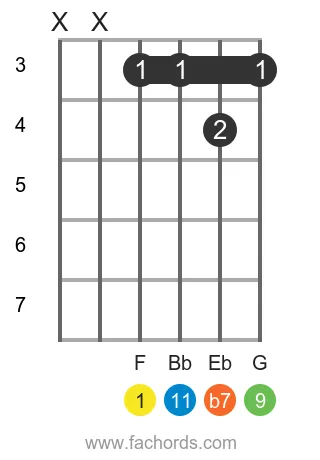
Dive into the spatial layout of the F 11 chord on your guitar fretboard. This rich Dominant chord, composed of the notes F, A, C, Eb, G, and Bb, forms through the intervals Root, Major Third, Perfect Fifth, Minor Seventh, Major Ninth, and Perfect Eleventh. Our interactive virtual fretboard helps you visualize these complex shapes across the strings, and you can instantly check your playing accuracy using the real-time mic feedback feature. Practice alongside dynamic chord playback to truly grasp its unique sound.
The F 11 chord, an advanced extension within the Dominant Chords family, introduces sophisticated color tones that are a staple in jazz and fusion. Understanding its construction, by stacking intervals beyond the seventh, is crucial to mastering extended harmony. If you're keen to delve deeper into how these complex voicings are built, our tutorial on Chord Construction offers valuable insights. This chord expands upon the concept of Dominant Chords and further enriches the harmonic palette, similar to how Ninth Chords add color.
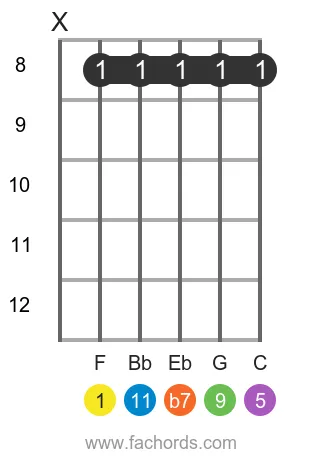
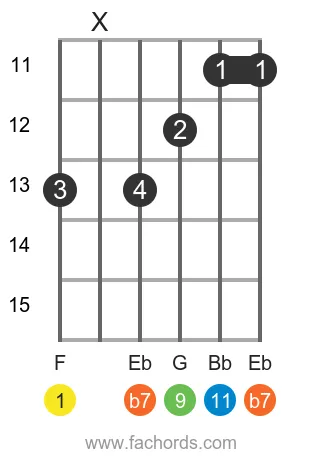
We present a range of fretboard diagrams for the F 11 chord, organized from the easiest shapes to the most challenging, allowing you to gradually build your proficiency. Before committing them to memory, we encourage you to first explore these voicings on our interactive fretboard. You'll gain a deeper understanding of the underlying theory and discover how the F 11 chord can be applied to various songs and musical keys. Start experimenting today!
Notes in the F 11 chord:
Chord formula for the Dominant Eleventh chord:
Guitar Patterns for the F Dominant Eleventh chord
Position 1
Barre
Movable
Position 2
Barre
Movable
Position 3
Barre
Movable
 Find more shapes in our all guitar chords online library. If you
prefer a printable pdf, download
the Free Guitar Chords Chart Pdf
Find more shapes in our all guitar chords online library. If you
prefer a printable pdf, download
the Free Guitar Chords Chart Pdf
You can also use this accessible F11 chord page, with written diagram instructions and screen-reader support for blind users.
FAQ
What is an F11 chord and what makes it a 'dominant' chord?
The F11 chord is a dynamic and rich-sounding chord composed of the notes F, A, C, Eb, G, and Bb. It is built using the intervals Root (1), Major Third (3), Perfect Fifth (5), Minor Seventh (b7), Major Ninth (9), and Perfect Eleventh (11). It's classified as a 'dominant chord' because it inherently contains a Minor Seventh interval (Eb in this case), which creates a characteristic tension that often leads strongly to a resolution, adding depth to musical progressions.
What are the specific notes and their corresponding intervals that make up the F11 chord?
The F11 chord is comprised of six distinct notes and their respective intervals from the root (F): F (Root), A (Major Third), C (Perfect Fifth), Eb (Minor Seventh), G (Major Ninth), and Bb (Perfect Eleventh).
Why is the F11 chord considered more advanced than typical beginner guitar chords?
The F11 chord is considered more advanced due to its complex structure, which involves six notes and extended intervals (the 9th and 11th). Beginner chords typically consist of three or four notes (triads or seventh chords). The presence of these higher extensions creates a lush, intricate sound and often requires more finger dexterity and understanding of the fretboard to play effectively.
In what musical genres or situations is the F11 chord commonly used?
With its complex and lush sound, the F11 chord is often used in genres like jazz. As a dominant chord, it adds significant depth and richness to music, making it a valuable tool for enhancing chord progressions and creating more sophisticated harmonic textures.
What do the complete interval names like 'Major Third' or 'Perfect Eleventh' indicate for the F11 chord?
The complete interval names (Root, Major Third, Perfect Fifth, Minor Seventh, Major Ninth, Perfect Eleventh) precisely describe the quality and distance of each note from the root (F) within the F11 chord. Understanding these names is fundamental to grasping the chord's unique sonic character and its theoretical construction, differentiating it from other chord types.