Explore the Esus2 Chord: Your Interactive Guitar Guide
Want a structured chord roadmap instead of jumping between pages?
Download the step-by-step Guitar Chord Ebook
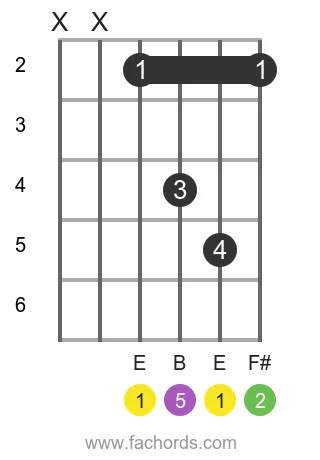
The E sus2 chord offers a unique, open quality, often found in genres from folk to cinematic scores, providing an expansive sound that is neither strictly major nor minor. This intriguing member of the suspended chords family is composed of the notes E, F#, and B, defined by the intervals Root (1), Major Second (2), and Perfect Fifth (5). Dive into this distinct tonality using our interactive virtual fretboard, where you can play and hear the chord's nuances. Our real-time mic feedback verifies your accuracy as you experiment with different voicings, ensuring you truly grasp its character.
The defining characteristic of the E sus2, and all suspended chords, is the deliberate absence of a major or minor third. This creates a harmonic tension, giving the chord its distinctive open and often unresolved sound, moving beyond the traditional major-minor dichotomy. Understanding how intervals build chords is crucial; for a deeper dive into this fundamental concept, explore our comprehensive guide on chord construction. To fully harness the unique expressive power of these non-resolving harmonies, be sure to also consult our dedicated tutorial on suspended chords.
As you scroll down, you'll discover various diagrams for the E sus2 chord, presented from easiest to hardest, alongside deeper theoretical insights and practical applications in songs across different keys. Before memorizing shapes, we encourage you to use our interactive fretboard to intuitively feel and hear the chord. Begin by exploring its sound and musical character, then layer on the theory and fingerings to integrate it into your playing.
Notes in the E sus2 chord:
Chord Formula:
Esus2 Guitar Chord Voicings
Position 1
Barre
Movable
Position 2
Barre
Open
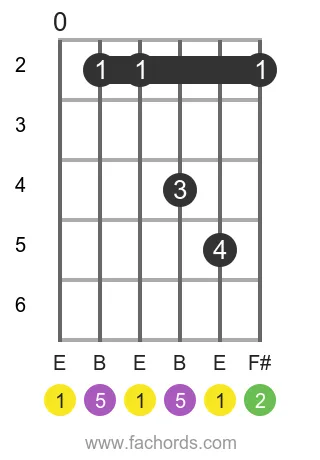
Position 3
Barre
Movable
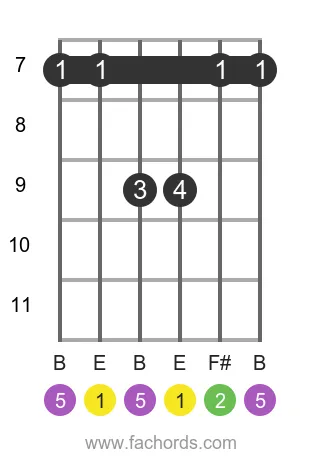
 Find more shapes in our all guitar chords online library. If you
prefer a printable pdf, download
the Free Guitar Chords Chart Pdf
Find more shapes in our all guitar chords online library. If you
prefer a printable pdf, download
the Free Guitar Chords Chart Pdf
You can also use this accessible Esus2 chord page, with written diagram instructions and screen-reader support for blind users.

FAQ
What defines an E sus2 chord, and what notes make it up?
An E sus2 chord is a type of suspended chord characterized by the absence of a major or minor third. Instead, it features a major second above the root. For the E sus2 chord specifically, it is composed of the notes E (the root), F# (the major second), and B (the perfect fifth).
Why does the E sus2 chord have an 'ambiguous tonality'?
The E sus2 chord's ambiguous tonality comes from the absence of the third. The third is the note that typically determines whether a chord sounds major or minor. Without it, the E sus2 chord doesn't clearly convey either a happy (major) or sad (minor) feeling, resulting in an open, somewhat unresolved sound.
What do the intervals 1, 2, and 5 represent in the E sus2 chord?
In the context of the E sus2 chord, these numbers represent the intervals, or specific distances, from the root note (E). '1' signifies the Root itself (E). '2' stands for the Major Second above the root (F#). '5' denotes the Perfect Fifth above the root (B). Understanding these intervals helps clarify how the chord is built.
How does an E sus2 chord differ from a standard E major or E minor chord?
The key difference is the presence or absence of the third. A standard E major chord includes a G# (major third), and an E minor chord includes a G (minor third). The E sus2 chord replaces this third with an F# (major second), giving it a distinct, more open, and less tonally defined sound compared to the definite major or minor quality.
What is the significance of the missing third in a suspended chord like E sus2?
The missing third is the defining characteristic of a suspended chord. By replacing the major or minor third with a major second (as in sus2) or a perfect fourth (as in sus4), the chord loses its inherent major or minor quality. This creates a unique, often tension-filled or 'suspended' sound that doesn't immediately suggest a clear resolution, adding an interesting color to music.
