Understand and Play the E9 Guitar Chord
Want a structured chord roadmap instead of jumping between pages?
Go to the full guitar chords tutorial.
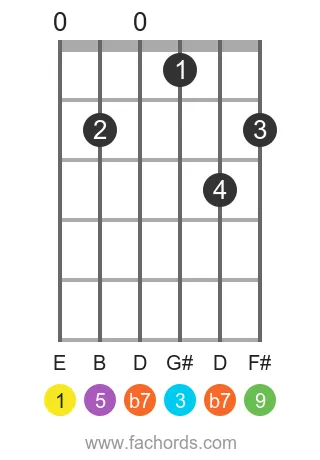
The E9 chord, a vibrant member of the Dominant Chords family, is constructed by stacking specific intervals: 1, 3, 5, b7, and 9. These correspond to the notes E, G#, B, D, and F#, providing its characteristic rich and extended harmony. To truly grasp its construction and sound, explore our interactive virtual fretboard, which allows you to visualize these notes and even play the chord or arpeggio. Use the integrated mic feedback feature to verify your accuracy in real-time, ensuring your fingers hit every note perfectly.
Understanding the intricate structure of ninth chords, like the E9, is key to unlocking richer harmonic possibilities. These chords extend beyond the basic triad and seventh, adding a 'color tone' that enriches their sound, making them a staple in jazz and R&B. For a deeper dive into how chords are built from scratch, our Chord Construction tutorial is an excellent resource. You can further expand your knowledge of these complex harmonies by exploring our dedicated guide on Ninth Chords, and for more on their foundational role in music, check out the Dominant Chord family.
Scroll down to find comprehensive chord diagrams for the E9, ranging from the most common voicings to more advanced fingerings, along with detailed theory. Each diagram shows you the notes, intervals, and finger positions. Practice diligently with our interactive tools; explore different keys, incorporate this chord into your songwriting, and witness your playing evolve. This disciplined practice is essential for mastering advanced chords and integrating them seamlessly into your musical vocabulary.
Notes of the E 9 chord:
How the Dominant Ninth chord is built:
E9 Guitar Chord Shapes
Position 1
Open
Position 2
Open
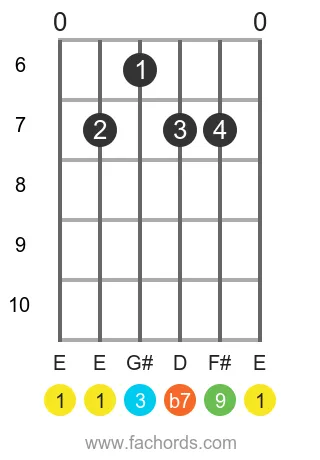
Position 3
Open
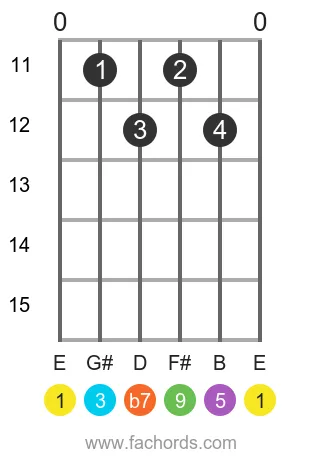
 Find more shapes in our all guitar chords online library. If you
prefer a printable pdf, download
the Free Guitar Chords Chart Pdf
Find more shapes in our all guitar chords online library. If you
prefer a printable pdf, download
the Free Guitar Chords Chart Pdf
You can also use this accessible E9 chord page, with written diagram instructions and screen-reader support for blind users.

Created by
Giancarlo is a musician (teaching guitar since 2000), software engineer, AI consultant and published researcher
FAQ
What notes make up the E9 chord on guitar?
The E9 chord is composed of the notes E, G#, B, D, and F#. These notes correspond to the Root, Major Third, Perfect Fifth, Minor Seventh, and Major Ninth intervals respectively.
What is the interval structure of an E9 chord?
The E9 chord is constructed using a specific series of intervals from its root note: the 1 (Root), 3 (Major Third), 5 (Perfect Fifth), b7 (Minor Seventh), and 9 (Major Ninth).
Why is the E9 chord considered a 'Dominant Chord'?
The E9 chord belongs to the Dominant Chords family because it incorporates a minor seventh interval (b7). This characteristic is a defining feature of dominant type chords, often creating a sense of forward motion in music.
What does the '9' signify in the E9 chord name?
The '9' in the E9 chord name signifies the inclusion of the Major Ninth interval (F#) in addition to the standard dominant seventh chord structure. This ninth interval adds to the chord's rich and complex sound.
What kind of musical depth does the E9 chord add to guitar playing?
The E9 chord adds a 'rich and complex sound' to guitar playing. The inclusion of the minor seventh and major ninth intervals creates a full, nuanced texture, opening up new musical possibilities and adding significant depth to your music.