Explore the E7#5 Chord on Guitar with Interactive Tools
Want a structured chord roadmap instead of jumping between pages?
Go to the full guitar chords tutorial.
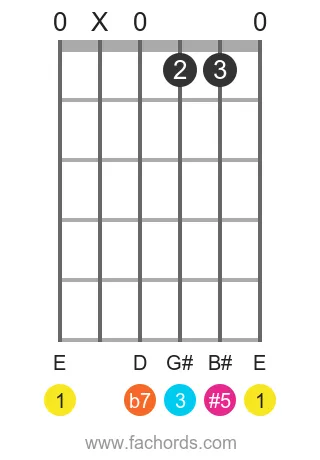
Add a sophisticated flavor to your guitar playing with the E7#5 chord, a member of the Augmented Chords family, often heard in jazz and blues. This unique sound comes from its notes E, G#, B#, and D, which correspond to the intervals 1, 3, #5, and b7 (Root, Major Third, Augmented Fifth, and Minor Seventh). Use our interactive fretboard as your personal exploration lab: practice playing the chord, verify your accuracy with real-time mic feedback, and hear how it sounds with the chord playback feature.
The E7#5 is a sophisticated take on a dominant chord, where the augmented fifth provides its distinctive, often jazz-infused sound, differentiating it from a standard dominant chord. Mastering its construction requires understanding chord construction and how intervals are stacked. This knowledge will not only expand your chord vocabulary but also deepen your understanding of harmony.
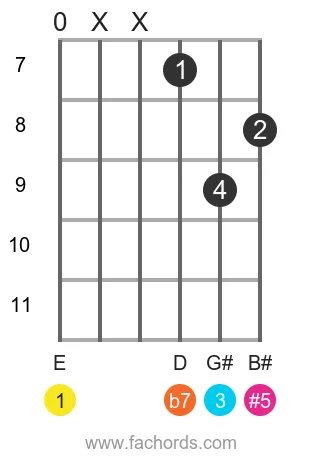
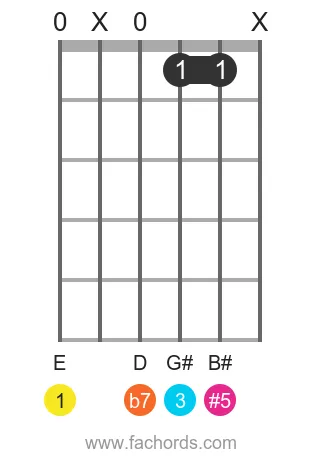
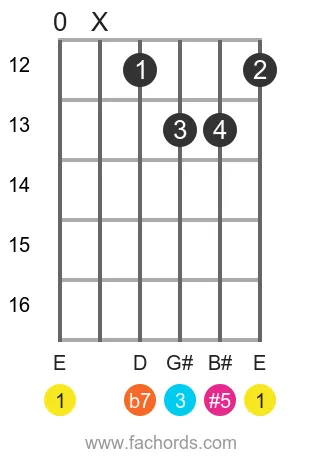
Before diving into the diagrams below, which present the E7#5 chord from easiest to hardest, we encourage you to spend time with the interactive fretboard. Experiment with different voicings, understand the underlying theory, and imagine how this chord can be used in songs across various keys. Start playing and let your ears guide you before analyzing all the details.
Notes that compose the E 7(#5) chord:
Chord structure of the Dominant Seventh Sharp Fifth chord:
Guitar Patterns for the E Dominant Seventh Sharp Fifth chord
Position 1
Open
Position 2
Open
Position 3
Barre
Open
Position 4
Open
Position 5
Barre
Open
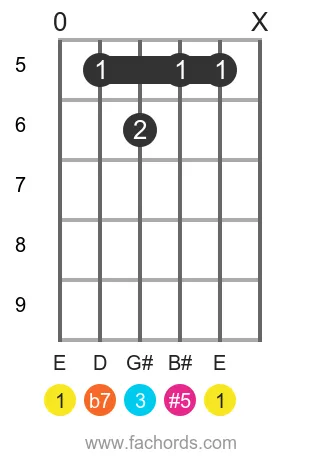
Position 6
Barre
Open
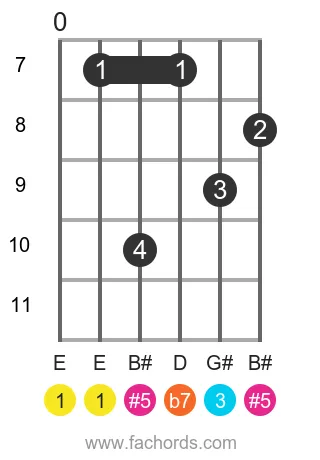
 Find more shapes in our all guitar chords online library. If you
prefer a printable pdf, download
the Free Guitar Chords Chart Pdf
Find more shapes in our all guitar chords online library. If you
prefer a printable pdf, download
the Free Guitar Chords Chart Pdf
You can also use this accessible E7(#5) chord page, with written diagram instructions and screen-reader support for blind users.


Created by
Giancarlo is a musician (teaching guitar since 2000), software engineer, AI consultant and published researcher
FAQ
What defines the E7#5 as an "Augmented Chord"?
The E7#5 chord is categorized as an 'Augmented Chord' because it includes an augmented fifth (#5) interval. This specific interval is what gives the chord its characteristic sound and places it within the augmented chord family.
What is the key difference between an E7#5 and a standard E7 chord?
The E7#5 is a type of dominant (7) chord, but its main difference from a standard E7 chord is the fifth interval. While a regular E7 would contain a perfect fifth, the E7#5 features an *augmented fifth* (#5), which contributes to its unique and sophisticated sound.
Why is B# listed as a note in the E7#5 chord instead of C?
The E7#5 chord is constructed using specific intervals relative to the root E: 1, 3, #5, and b7. From the root E, the augmented fifth (#5) interval naturally falls on B#. Although C is enharmonically equivalent to B#, using B# accurately reflects its function as an *augmented fifth* within the chord's theoretical structure.
What is the role of the "#5" (Augmented Fifth) interval in the E7#5 chord?
The "#5" or Augmented Fifth interval is crucial for the E7#5 chord's identity. It gives the chord its distinctive and sophisticated sound, differentiating it from a standard dominant chord. This interval is key to its characteristic harmonic flavor.
What do "b7" and "Minor Seventh" refer to in the E7#5 chord?
"b7" and "Minor Seventh" are two ways to describe the same interval within the E7#5 chord. "b7" is a common shorthand notation for the minor seventh interval, which is an essential component of dominant 7th chords. It represents the interval from the root (E) to the note D.
In what musical genres or contexts is the E7#5 chord typically used?
The E7#5 chord is known for adding a unique and sophisticated flavor to music. It is commonly found in jazz and blues, where its distinct sound can be used to create interesting harmonic tension and color. It can also be incorporated into other genres seeking a similar distinctive quality.
