D13(b9) Guitar Chord Diagrams | D Dominant Thirteen Flat Nine
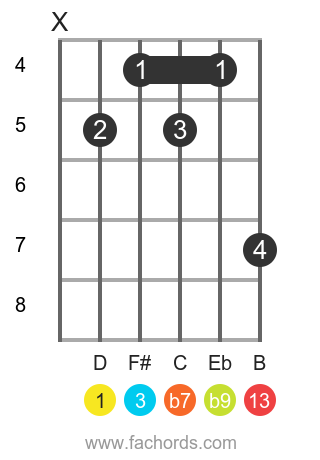
Welcome to our tutorial on the D 13(b9) chord. This chord is a member of the Dominant Chords family, known for its complex and rich sound. The D 13(b9) chord is composed of the notes D, F#, A, C, Eb, G, and B, which are built on the intervals 1, 3, 5, b7, b9, 11, and 13.
The full names of these music intervals are Root, Major Third, Perfect Fifth, Minor Seventh, Minor Ninth, Perfect Eleventh, and Major Thirteenth. Understanding these intervals is key to mastering the D 13(b9) chord and other similar chords. You might want to check out our tutorial about fretboard intervals for an in-depth understanding of these intervals.
The D 13(b9) chord is not a beginner's chord, but rather an intermediate or advanced one. If you're new to such complex chords, our tutorial on intermediate guitar chords could be a great starting point.
As part of the dominant family, the D 13(b9) chord is often used in jazz music, particularly in jazz chord progressions. To see how this chord can be used in context, you might want to explore our tutorial on jazz chord progressions.
Finally, if you're interested in learning how to denote this chord and others based on the intervals that compose it, our tutorial on how to denote chords can be quite helpful.
Whether you're a seasoned guitarist or just starting to explore more complex chords, the D 13(b9) chord offers a wealth of possibilities. We hope this tutorial will help you discover and master this fascinating chord.
Notes that compose the D 13(b9) chord:
Tones in the Dominant Thirteen Flat Nine chord:
D13(b9) Guitar Chord Fingers Positions
Chord boxes are sorted from the easiest to the hardest. Learn how to read chord diagrams.
If you have difficulties with bar chord shapes, check the Bar Chords Tips tutorial.
You can also use this accessible chords page with written diagrams instruction.
Position 1
Barre
Movable
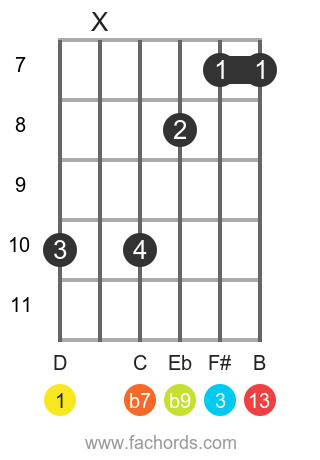
Position 2
Barre
Movable
 You can find more shapes in our all guitar chords online library. If you
prefer a printable pdf, download
the Free Guitar Chords Chart Pdf
You can find more shapes in our all guitar chords online library. If you
prefer a printable pdf, download
the Free Guitar Chords Chart Pdf
FAQ
What notes are included in the D 13(b9) guitar chord?
The D 13(b9) chord is composed of seven distinct notes: D, F#, A, C, Eb, G, and B. These specific notes give the chord its characteristic complex and rich sound.
What do the interval numbers 1, 3, 5, b7, b9, 11, and 13 signify in the D 13(b9) chord?
These numbers represent specific musical intervals built from the root note D. They correspond to the Root, Major Third, Perfect Fifth, Minor Seventh, Minor Ninth, Perfect Eleventh, and Major Thirteenth, respectively.
Why is the D 13(b9) chord classified as a 'Dominant Chord'?
The D 13(b9) chord is a member of the Dominant Chords family because its specific intervallic structure, including the minor seventh and altered extensions, gives it a dominant harmonic quality.
What musical quality or sound can I expect from the D 13(b9) chord?
The D 13(b9) chord is recognized for its distinctly complex and rich sound. This quality arises from the combination of its root, third, fifth, minor seventh, and the extended altered intervals of the minor ninth, perfect eleventh, and major thirteenth.
Is the D 13(b9) chord suitable for beginner guitarists?
No, the D 13(b9) chord is considered an intermediate or advanced chord. Its complexity, due to the number of notes and extended intervals, makes it challenging for those new to guitar or complex harmonies.
In what musical genres or situations is the D 13(b9) chord commonly used?
The D 13(b9) chord is frequently utilized in jazz music, particularly within jazz chord progressions. Its complex and rich sound makes it a valuable harmonic tool in this genre.