Mastering the D#9b5 Guitar Chord: Play & Get Instant Feedback
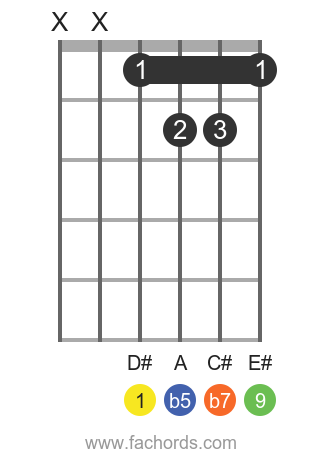
Struggling to nail the complex D#9b5 chord? Dive into our interactive fretboard tool and get instant, real-time microphone feedback on your playing accuracy. This unique feature guides your hands as you learn to visualize fingerings and hear the chord played as a strum or arpeggio. The D#9b5 chord is a distinctive member of the Dominant Chords family, comprised of the notes D#, F##, A, C#, and E#, built from the intervals 1 (Root), 3 (Major Third), b5 (Diminished Fifth), b7 (Minor Seventh), and 9 (Major Ninth). Challenge yourself to conquer its unique sound.
This chord offers a rich and distinctive sound, adding depth and complexity to your music. Understanding its construction, especially the flat fifth and ninth, is key to mastering its unique tension and resolution. Explore our guide to Ninth Chords to dive deeper into these extended harmonies, and see how it fits within the broader Dominant Chord family. To truly grasp how such complex chords are built, our Chord Construction tutorial provides valuable insights, helping you see the music theory behind the notes. Once you're comfortable with the fingering, improve your fluidity and musicality with our tips on how to Improve Chords Change.
As you scroll down, you'll find a comprehensive guide, including chord diagrams ranked from the easiest positions to more advanced voicings, detailed music theory explanations, popular songs that feature the D#9b5, and the keys where this chord naturally appears. Before you delve into static charts, take a moment to engage with the interactive tool above. Set your desired tempo with the drum and BPM tool, play the chord, and let the real-time feedback immediately confirm your accuracy. This active practice loop is the most effective way to internalize the chord shape and sound.
D# 9b5 chord Notes:
Chord formula for the Dominant Ninth Flat five chord:
How To Play The D#9b5 chord on guitar
Position 1
Barre
Movable
Position 2
Barre
Movable
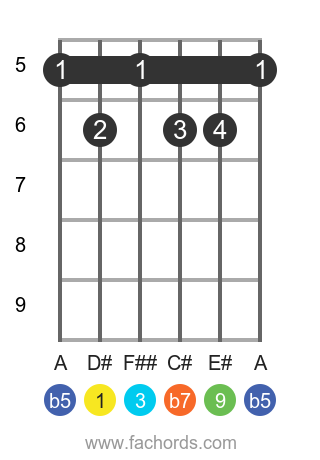
Position 3
Barre
Movable
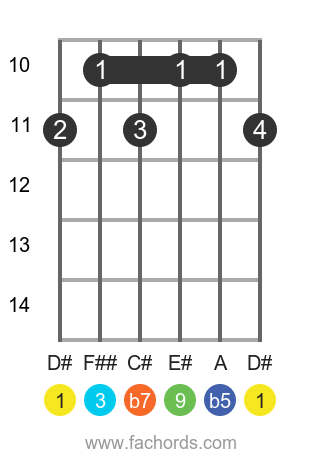
 Find more shapes in our all guitar chords online library. If you
prefer a printable pdf, download
the Free Guitar Chords Chart Pdf
Find more shapes in our all guitar chords online library. If you
prefer a printable pdf, download
the Free Guitar Chords Chart Pdf
You can also use this accessible D#9b5 chord page, with written diagram instructions and screen-reader support for blind users.
FAQ
What are the specific notes that form the D# 9b5 chord?
The D# 9b5 chord is comprised of five distinct notes: D# (the root), F## (the major third), A (the diminished fifth), C# (the minor seventh), and E# (the major ninth). These notes create its unique harmonic structure.
Why is the D# 9b5 chord categorized as a 'Dominant Chord'?
It belongs to the Dominant Chords family because it fundamentally includes a root, a major third (3), and a minor seventh (b7). These three intervals are characteristic of dominant chords, which typically create musical tension that seeks resolution.
What do the '9' and 'b5' in the D# 9b5 chord name signify?
The '9' indicates the inclusion of a major ninth interval (E#) above the root. The 'b5' signifies that the fifth interval of the chord (A) is flattened, or diminished, from its usual perfect or major state (which would typically be A#). This diminished fifth is a key element contributing to the chord's distinctive sound.
What gives the D# 9b5 chord its 'rich and distinctive sound'?
The rich and distinctive sound of the D# 9b5 chord comes from the specific combination of its dominant quality (major third and minor seventh), the added major ninth, and especially the diminished fifth. The 'b5' creates harmonic tension, while the '9' adds color and complexity, resulting in a unique and sophisticated sonic texture.
Why are there notes like F## and E# used in the D# 9b5 chord instead of simpler enharmonic equivalents?
F## and E# are used to accurately reflect the theoretical interval relationships within the chord. F## correctly represents the major third above D#, and E# represents the major ninth. Using enharmonic equivalents (like G natural for F## or F natural for E#) would technically mislabel the specific musical intervals and scale degrees involved in the chord's construction.
Is the D# 9b5 chord suitable for beginner guitarists?
No, the D# 9b5 chord is considered more advanced than beginner chords. Its complex structure and the requirement for specific fingerings make it more appropriate for intermediate guitarists who have a solid foundation in basic chords and music theory principles.