D# Dominant Ninth Guitar Chord (D#9) | Easy Ways to Play It
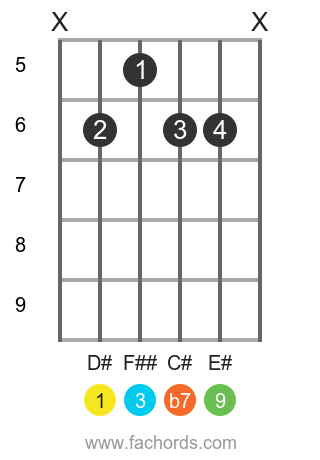
Welcome to our tutorial on the D# 9 chord. This chord is a member of the Dominant Chords family, and it's made up of the notes D#, F##, A#, C#, and E#. The intervals that construct this chord are 1, 3, 5, b7, and 9, which in complete terms are the Root, Major Third, Perfect Fifth, Minor Seventh, and Major Ninth.
If you're interested in learning more about how chords are built by stacking intervals, we recommend checking out this tutorial. It's a great resource for understanding the theory behind chord construction.
For those of you who are new to the world of dominant chords, we recommend starting with our complete dominant (7) guitar chords tutorial. This will provide you with a solid foundation before diving into the D# 9 chord.
Once you've mastered the basics, you can move onto our ninth (9) guitar chords tutorial which will introduce you to the D# 9 chord and other similar chords.
Understanding the fretboard intervals is key to mastering the D# 9 chord. Our fretboard intervals tutorial will guide you through this important aspect of guitar playing.
Finally, if you're unsure about how to denote this chord or others based on the intervals that compose it, our chord notation tutorial is a must-read.
Remember, practice is key when learning new chords. Happy strumming!
Notes in the D# 9 chord:
How to create the Dominant Ninth chord:
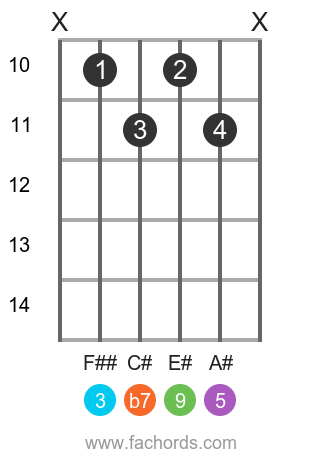
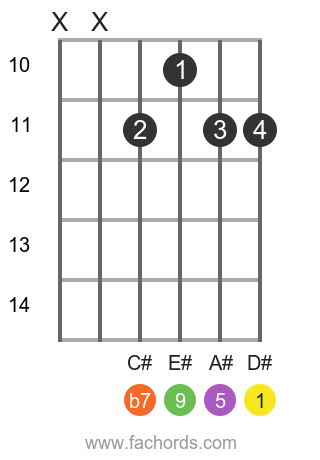
Fingerings for the D#9 guitar chord
Chord boxes are sorted from the easiest to the hardest. Learn how to read chord diagrams.
If you have difficulties with bar chord shapes, check the Bar Chords Tips tutorial.
You can also use this accessible chords page with written diagrams instruction.
Position 1
Movable
Position 2
Movable
Position 3
Movable
 You can find more shapes in our all guitar chords online library. If you
prefer a printable pdf, download
the Free Guitar Chords Chart Pdf
You can find more shapes in our all guitar chords online library. If you
prefer a printable pdf, download
the Free Guitar Chords Chart Pdf
FAQ
What makes the D#9 a "dominant chord"?
The D#9 chord is categorized as a dominant chord because it includes a minor seventh interval (b7) above its root (C# in this case). This specific interval creates harmonic tension and a strong pull, typically leading to a resolution to another chord, which is characteristic of dominant harmony.
What are the specific notes that form the D#9 chord?
The D#9 chord is built from five distinct notes: D# (the Root), F## (the Major Third), A# (the Perfect Fifth), C# (the Minor Seventh), and E# (the Major Ninth). These notes correspond directly to the chord's defining intervals.
How does a D#9 chord differ from a D# dominant 7th chord?
A D#9 chord is an extended version of a D# dominant 7th chord. Both chords share the root (1), major third (3), perfect fifth (5), and minor seventh (b7). The distinguishing feature of the D#9 chord is the addition of the major ninth interval (E#), which adds further harmonic color and complexity.
Why are notes like F## and E# used in the D#9 chord instead of their more common enharmonic equivalents?
The use of F## for the major third and E# for the major ninth in a D#9 chord is based on correct music theory spelling. When D# is the root, these specific spellings ensure that the intervals (1, 3, 5, b7, 9) are accurately represented, maintaining the theoretical integrity of the chord and avoiding confusion with other intervals or chord types.