D# Dominant Seventh Sharp Fifth Guitar Chord Charts & Variations
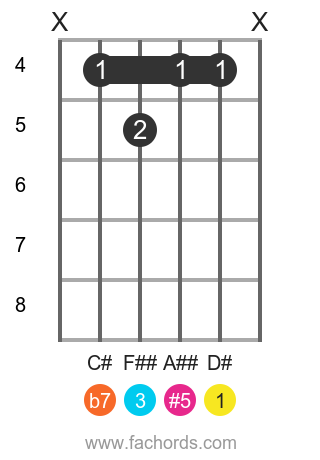
Welcome to this tutorial on the D# 7(#5) chord, a member of the Augmented Chords family. This chord, with its rich and complex sound, is composed of the notes D#, F##, A##, and C#. The D# 7(#5) chord is constructed using a series of intervals, specifically 1, 3, #5, and b7. To help you better understand these intervals, you can refer to our tutorial about fretboard intervals.
The D# 7(#5) chord belongs to the dominant (7) guitar chords family, which is a crucial part of many musical genres. If you want to delve deeper into this family of chords, check out our tutorial about dominant (7) guitar chords.
For those interested in the theory behind chord construction, we have a tutorial that teaches how to build chords by stacking intervals. This will help you understand how the D# 7(#5) chord, as well as other chords, are built.
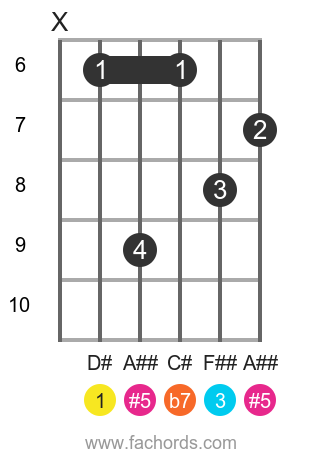
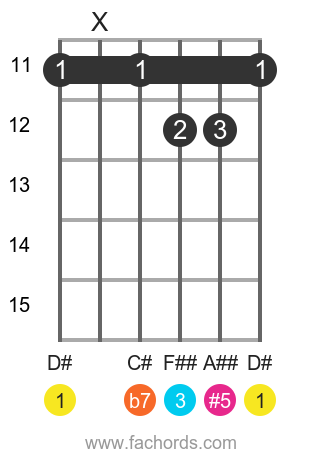
In this tutorial, we will provide chord diagrams and fretboard patterns to help you visualize and understand the tones composing the D# 7(#5) chord. If you find a chord shape that you're unsure how to name, you can use our interactive tool to analyze chord shapes.
Mastering the D# 7(#5) chord can open up a new world of sound for you, and can be a great addition to your chord repertoire, especially if you're interested in more advanced chords. For more advanced chords, visit our tutorial about intermediate guitar chords.
D# 7(#5) chord Notes:
Formula of the Dominant Seventh Sharp Fifth chord:
Guitar Patterns for the D#7(#5) chord
Chord boxes are sorted from the easiest to the hardest. Learn how to read chord diagrams.
If you have difficulties with bar chord shapes, check the Bar Chords Tips tutorial.
You can also use this accessible chords page with written diagrams instruction.
Position 1
Barre
Movable
Position 2
Barre
Movable
Position 3
Barre
Movable
 You can find more shapes in our all guitar chords online library. If you
prefer a printable pdf, download
the Free Guitar Chords Chart Pdf
You can find more shapes in our all guitar chords online library. If you
prefer a printable pdf, download
the Free Guitar Chords Chart Pdf
FAQ
What notes are included in the D# 7(#5) chord?
The D# 7(#5) chord is made up of four specific notes: D# (the root), F## (F double sharp), A## (A double sharp), and C# (C sharp).
What intervals define the construction of the D# 7(#5) chord?
The D# 7(#5) chord is constructed using a specific series of intervals from its root: the 1 (root), 3 (major third), #5 (augmented fifth), and b7 (minor seventh).
Which chord families does the D# 7(#5) chord belong to?
The D# 7(#5) chord is identified as a member of both the Augmented Chords family and the dominant (7) guitar chords family.
What kind of sound does the D# 7(#5) chord produce?
The D# 7(#5) chord is characterized by a rich and complex sound, making it a distinctive harmony for guitarists looking to expand into more advanced chord voicings.
How does the '#5' interval differentiate the D# 7(#5) from a regular dominant 7 chord?
The '#5' interval indicates an augmented fifth. This means the fifth degree of the chord is raised by a half step compared to a standard dominant 7 chord, which typically has a perfect fifth. This augmented fifth is what gives the D# 7(#5) its unique and complex character.
Why does the D# 7(#5) chord use F## and A## instead of their enharmonic equivalents?
The notes F## and A## are used to maintain the theoretical integrity of the chord's intervals. From the root D#, F## correctly represents a major third, and A## correctly represents an augmented fifth, preserving the stacked-third structure typical in chord construction.