Practice the C7 chord on Guitar with Live Feedback
Want a structured chord roadmap instead of jumping between pages?
Go to the full guitar chords tutorial.
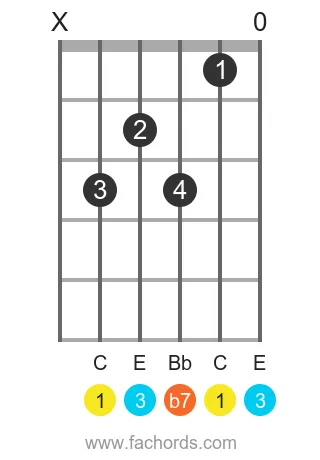
Struggling to get the C7 chord just right? Our interactive virtual fretboard is here to help you nail it. Engage your microphone to receive instant, real-time feedback on your playing accuracy, confirming each note you hit. This powerful chord, belonging to the Dominant Chords family, is constructed from the notes C, E, G, and Bb, corresponding to the intervals 1, 3, 5, and b7. You can also explore its sound through integrated chord and arpeggio playback.
The C7 chord, with its defining minor seventh interval, is a cornerstone of the Dominant Chords family, often used to create tension that yearns for resolution, particularly prominent in blues and rock. Understanding how these intervals come together is key, and our guide on Chord Construction can shed more light. This particular 7th chord functions as a dominant, making our Dominant Chord tutorial an excellent resource for deeper exploration into its characteristic sound and applications. You can also dive into how to play these 7th chords more efficiently by checking out Learn 3-Note 7th Chords.
Before you consult the comprehensive diagrams, theory breakdowns, and song examples provided below, we highly recommend you test yourself first with our virtual fretboard. Experiment with different fingerings for the C7 chord, understand its role in various musical keys, and commit its distinctive sound to memory. Let the interactive tools guide your hands and ears as you master this essential dominant chord.
Notes in the C 7 chord:
Formula of the Dominant Seventh chord:
How To Play The C Dominant Seventh chord on guitar
Position 1
Movable
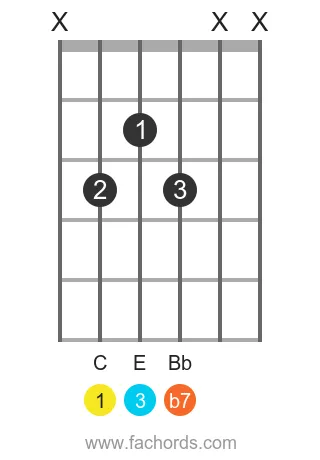
Position 2
Movable
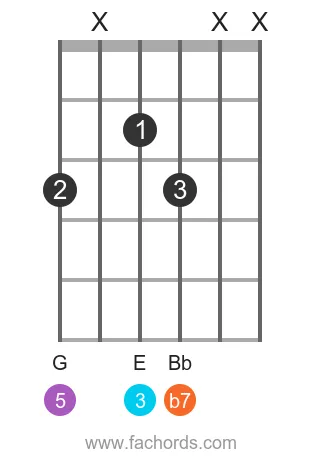
Position 3
Movable
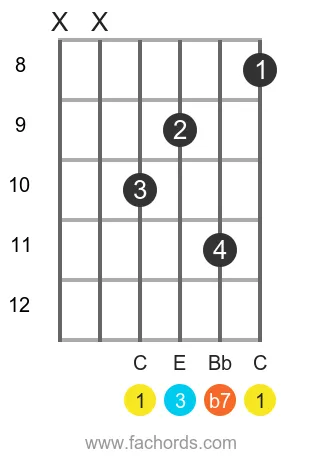
Position 4
Movable
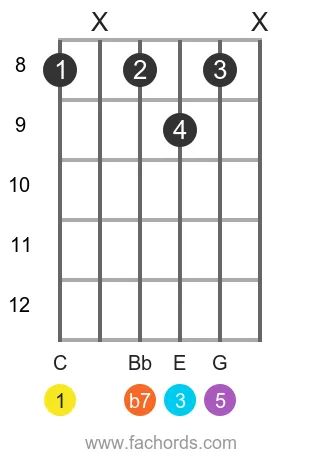
Position 5
Movable
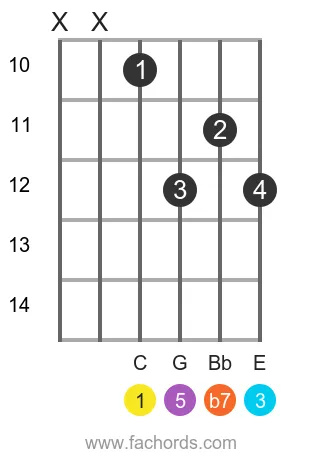
Position 6
Movable
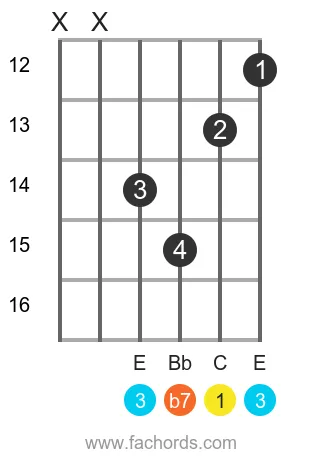
Position 7
Movable
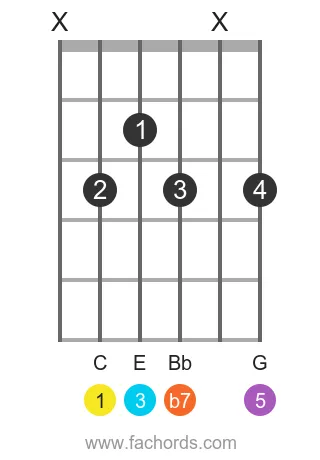
Position 8
Movable
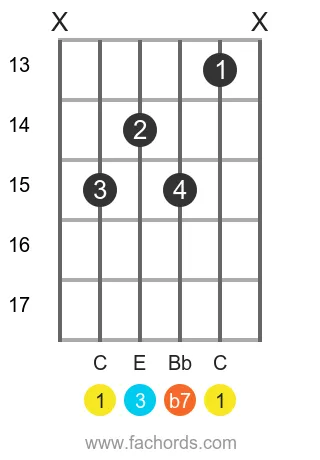
Position 9
Movable
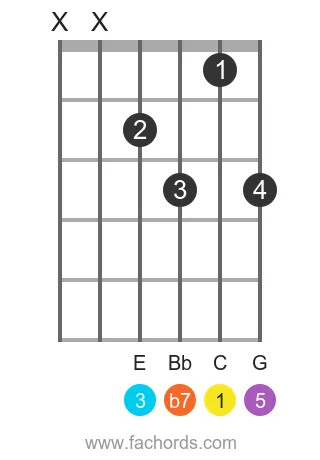
Position 10
Movable
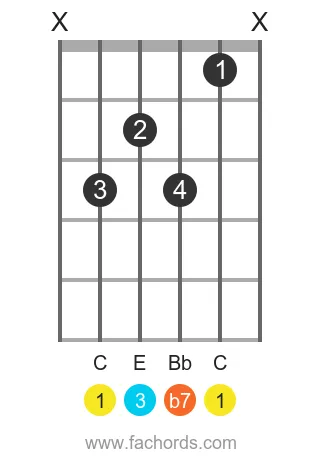
Position 11
Open
Position 12
Barre
Movable
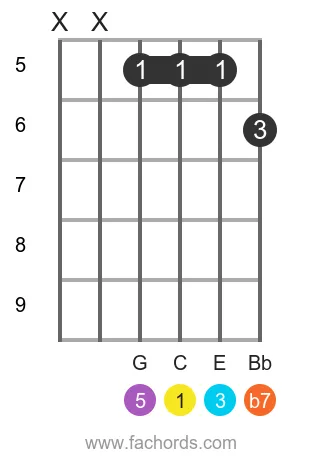
Position 13
Barre
Movable
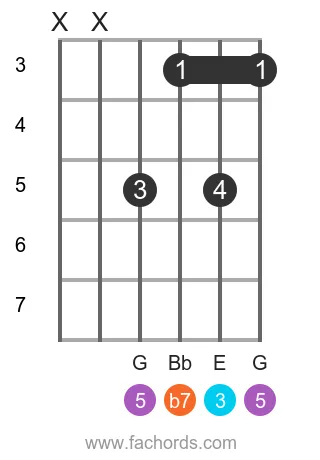
Position 14
Barre
Movable
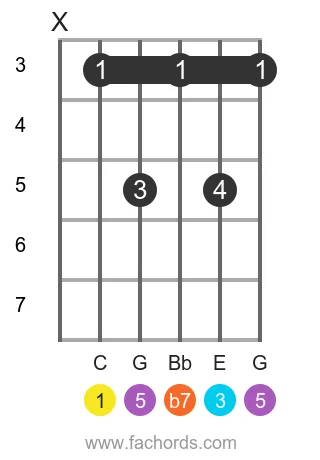
Position 15
Barre
Movable
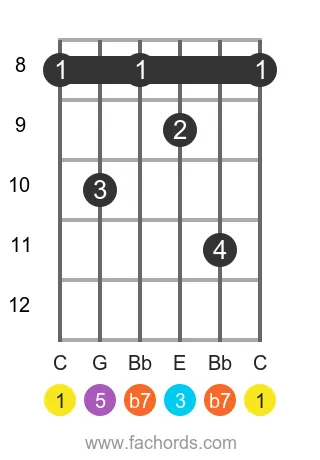
Position 16
Barre
Movable
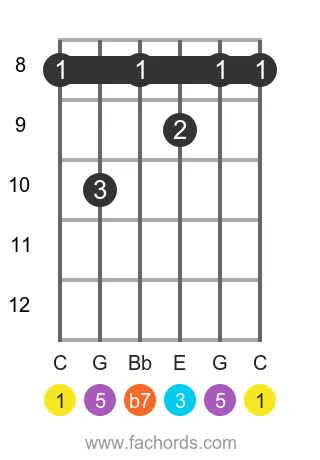
Position 17
Barre
Movable
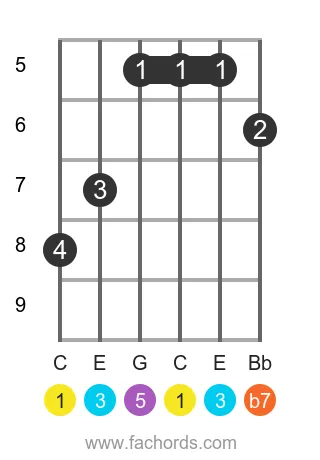
 Find more shapes in our all guitar chords online library. If you
prefer a printable pdf, download
the Free Guitar Chords Chart Pdf
Find more shapes in our all guitar chords online library. If you
prefer a printable pdf, download
the Free Guitar Chords Chart Pdf
You can also use this accessible C7 chord page, with written diagram instructions and screen-reader support for blind users.
FAQ
What notes make up the C7 chord on guitar?
The C7 chord is composed of four specific notes: C, E, G, and Bb. These notes correspond to the Root, Major Third, Perfect Fifth, and Minor Seventh intervals, respectively, when built from the root note C.
Why is the C7 chord referred to as a 'dominant chord'?
The C7 chord belongs to the 'Dominant Chords family' because it possesses a distinctive tension that inherently seeks resolution. This characteristic tension-and-resolution quality is what defines dominant chords in music theory.
What is the significance of the 'b7' (minor seventh) interval in the C7 chord?
The 'b7' or minor seventh interval (Bb in the case of C7) is a crucial component that gives the chord its dominant quality. It's built on the intervals 1, 3, 5, and b7, and this specific minor seventh interval creates the tension that dominant chords are known for.
In what musical contexts or genres is the C7 chord commonly used?
The C7 chord is a versatile chord frequently found in jazz chord progressions due to its inherent tension and resolution capabilities. Beyond jazz, you'll also encounter it in various other music genres where it's used to add complexity and harmonic interest.