Practice the C#m7b5 Guitar Chord with Interactive Feedback
Want a structured chord roadmap instead of jumping between pages?
Go to the full guitar chords tutorial.
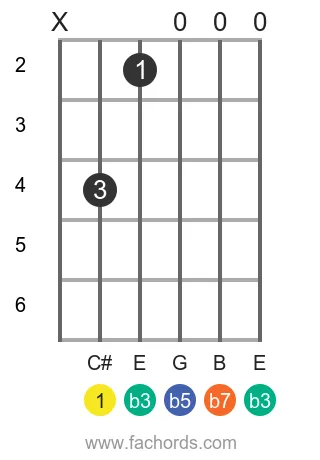
Struggling to perfect your C#m7b5 chord? Our interactive fretboard tool provides instant feedback, helping you pinpoint mistakes with real-time mic monitoring. This unique chord, also known as the C# half-diminished chord, belongs to the Diminished Chords family and is built from the notes C#, E, G, and B, corresponding to the intervals 1, b3, b5, and b7. Beyond mic feedback, you can explore every fingering visually and hear the chord played as a strum or arpeggio to train your ear.
As a half-diminished chord, the C#m7b5 plays a crucial role as the `iiø` chord in minor harmony, adding a distinct melancholic or jazz-infused quality with its unique intervallic structure (flattened fifth and seventh). To master the theoretical underpinnings of this and other similar structures, explore our comprehensive guide on Diminished Guitar Chords. For a foundational understanding of how these powerful four-note chords are constructed, our Learn 3-Note 7th Chords tutorial is invaluable, and you can always deepen your general knowledge with our Chord Construction guide.
Scroll down and challenge yourself with a comprehensive collection of C#m7b5 chord diagrams, ranked from open positions to advanced barre shapes. You'll also find deeper music theory insights, examples of songs that utilize this chord, and a list of keys where it commonly appears. But first, truly test your accuracy by engaging with the interactive tool above. Use the built-in drum tool to set your rhythm, strum the C#m7b5, and let the live mic feedback instantly verify your finger placement and sound. This direct, hands-on practice is crucial for mastering its unique character on the fretboard.
C# m7b5 chord Notes:
Chord formula for the Minor Seventh Flat five chord:
How To Play The C# Minor Seventh Flat five chord on guitar
Position 1
Open
Position 2
Movable
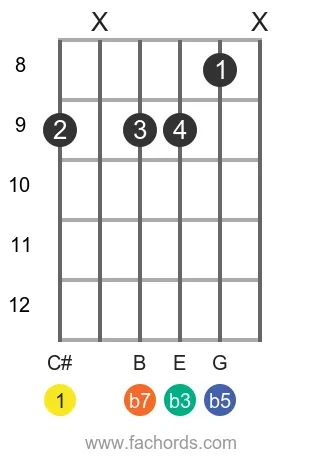
Position 3
Movable
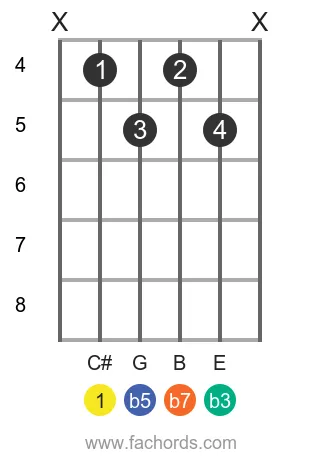
Position 4
Movable
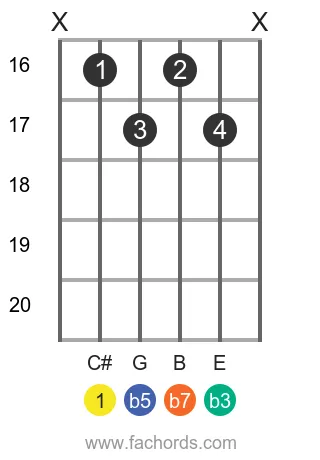
Position 5
Open
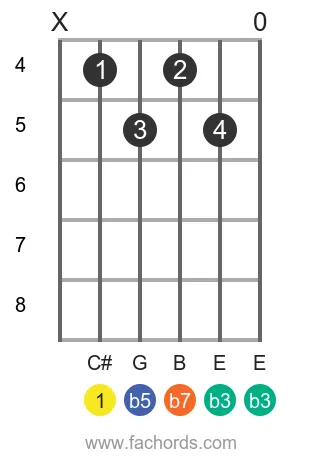
Position 6
Barre
Movable
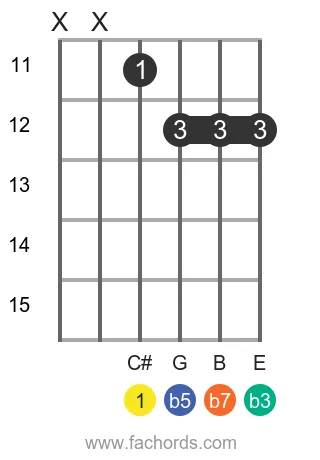
 Find more shapes in our all guitar chords online library. If you
prefer a printable pdf, download
the Free Guitar Chords Chart Pdf
Find more shapes in our all guitar chords online library. If you
prefer a printable pdf, download
the Free Guitar Chords Chart Pdf
You can also use this accessible C#m7b5 chord page, with written diagram instructions and screen-reader support for blind users.

Created by
Giancarlo is a musician (teaching guitar since 2000), software engineer, AI consultant and published researcher
FAQ
What defines the C#m7b5 chord?
The C#m7b5 chord, also known as the C# half-diminished chord, is defined by its specific notes and intervals. It's built from C#, E, G, and B, which correspond to the root, minor third (b3), flattened fifth (b5), and flattened seventh (b7) intervals.
What notes are included in the C#m7b5 chord?
The C#m7b5 chord is comprised of four specific notes: C#, E, G, and B. These notes form the foundation and unique sound of this chord.
What do the 'm7b5' in C#m7b5 refer to?
The 'm7b5' notation describes the chord's specific intervals relative to its root (C#). It indicates a minor third (m), a flattened fifth (b5), and a flattened seventh (b7). These intervals are 1, b3, b5, and b7 from the root note.
How does the C#m7b5 chord fit into the 'Diminished Chords family'?
The C#m7b5 chord is a member of the Diminished Chords family because it includes a flattened fifth (b5) and a flattened seventh (b7) interval. This gives it a characteristic sound that aligns with other chords in this family.
In what musical styles or situations is the C#m7b5 chord commonly used?
The C#m7b5 chord is particularly popular in genres like jazz. It's often used within chord progressions to add depth, complexity, and specific harmonic color to the music.