Bb13(b9) Guitar Chord - Guitar Chords Chart
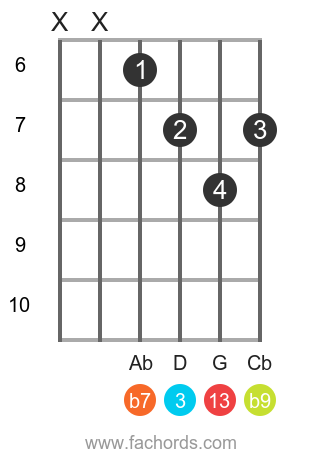
Welcome to our tutorial on the Bb 13(b9) chord. This is a complex chord that belongs to the Dominant Chords family and is often found in jazz and more advanced musical arrangements. The Bb 13(b9) chord is composed of the notes Bb, D, F, Ab, Cb, Eb, and G, and is built using the intervals 1, 3, 5, b7, b9, 11, and 13.
These intervals correspond to the Root, Major Third, Perfect Fifth, Minor Seventh, Minor Ninth, Perfect Eleventh, and Major Thirteenth respectively. Understanding the theory behind chord construction will greatly enhance your ability to play and create music on the guitar.
In this tutorial, we will provide chord diagrams and fretboard patterns to help you visualize and play the Bb 13(b9) chord. We will also delve into the fretboard intervals and how they contribute to the overall sound of the chord. If you are unfamiliar with the notation of these intervals, we recommend checking out our tutorial on chord notation.
While the Bb 13(b9) chord may be a bit challenging for beginners, it is a fantastic chord to add to your repertoire if you are an intermediate player looking to expand your chord knowledge. This chord can add a unique flavor to your jazz chord progressions and can take your guitar playing to the next level.
So, let's dive into the world of dominant chords and master the Bb 13(b9) chord together!
Notes in the Bb 13(b9) chord:
How the Dominant Thirteen Flat Nine chord is built:
How To Play The Bb Dominant Thirteen Flat Nine chord on guitar
Chord boxes are sorted from the easiest to the hardest. Learn how to read chord diagrams.
If you have difficulties with bar chord shapes, check the Bar Chords Tips tutorial.
You can also use this accessible chords page with written diagrams instruction.
Position 1
Movable
 You can find more shapes in our all guitar chords online library. If you
prefer a printable pdf, download
the Free Guitar Chords Chart Pdf
You can find more shapes in our all guitar chords online library. If you
prefer a printable pdf, download
the Free Guitar Chords Chart Pdf
FAQ
What makes the Bb 13(b9) chord part of the 'Dominant Chords' family?
The Bb 13(b9) chord is a dominant chord because its fundamental structure includes a root, major third, and minor seventh (1, 3, b7). This minor seventh interval (Ab in this case) is characteristic of dominant chords, creating a sense of tension that typically seeks resolution.
Why does the Bb 13(b9) chord contain so many notes like Bb, D, F, Ab, Cb, Eb, and G?
This chord is a highly 'extended' dominant chord. It includes the basic dominant 7th (1, 3, 5, b7) and then further extensions: a minor ninth (b9), a perfect eleventh (11), and a major thirteenth (13). Each of these intervals adds another note to the chord's full theoretical composition, making it complex.
What do the 'b9' and '13' in the Bb 13(b9) chord name refer to?
The 'b9' signifies a minor ninth interval, which is a half-step lower than a natural ninth. The '13' refers to a major thirteenth interval. Both are upper extensions added to a dominant seventh chord (which already includes the root, major third, perfect fifth, and minor seventh).
How does the note 'Cb' fit into the Bb 13(b9) chord, and is it the same as a B natural?
Cb is the minor ninth (b9) interval above the root Bb. While Cb is enharmonically equivalent to B natural on the fretboard, it is notated as Cb in this chord to correctly represent its specific function as a flatted ninth relative to the root Bb, adhering to standard music theory principles for chord construction.
Why is the Bb 13(b9) chord described as being 'often found in jazz' music?
The Bb 13(b9) chord's complex and extended nature, incorporating the b9, 11, and 13 intervals, provides a rich, colorful, and often dissonant sound. This harmonic complexity and the tension it creates are highly valued and frequently utilized in jazz chord progressions to add unique flavor and depth.