Explore the A#9 Guitar Chord: Play & Master Its Sound
Want a structured chord roadmap instead of jumping between pages?
Go to the full guitar chords tutorial.
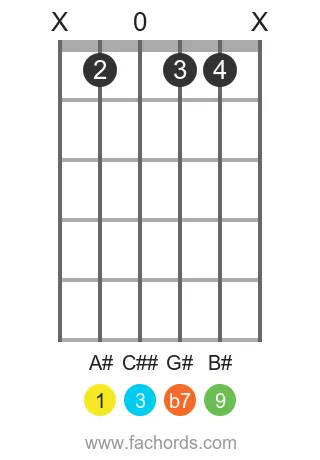
Often found enriching jazz, blues, and R&B progressions, the A#9 chord introduces a sophisticated color to your playing. This member of the Dominant Ninth family is built from the notes A#, C##, E#, G#, and B#, representing the Root (1), Major Third (3), Perfect Fifth (5), Minor Seventh (b7), and Major Ninth (9) intervals. Dive into its sonic possibilities using our interactive fretboard tool, where you can visually explore every fingering and immediately hear the chord as a strum or arpeggio. Get real-time verification of your accuracy with the microphone feedback feature, ensuring your technique is precise.
Understanding the intricate structure of ninth chords, like the A#9, can open up vast harmonic landscapes, adding depth and richness to your compositions. The presence of the ninth extends the dominant sound, creating a fuller, more expressive voicing. Explore its construction further with our dedicated Ninth Chords tutorial, or understand its foundational role within the broader Dominant Chord family. For those keen to grasp the underlying principles of how such complex chords are built, our Chord Construction guide provides invaluable insight. Many voicings of this particular chord utilize barre shapes, so refining your technique with our Guitar Bar Chords lesson will be highly beneficial.
Below, you'll find a comprehensive collection of A#9 chord diagrams, ranging from accessible open positions to more advanced barre shapes. We also delve into essential music theory, highlight popular songs featuring the A#9, and identify the musical keys where it frequently appears. Before diving into the visual diagrams, take a moment to engage with the interactive tool above. Experiment with the drum & BPM tool to find your rhythm, play the chord, and let the mic feedback guide your hands. This active exploration is the most effective way to truly integrate this sophisticated chord into your repertoire.
A# 9 chord Notes:
Tones in the Dominant Ninth chord:
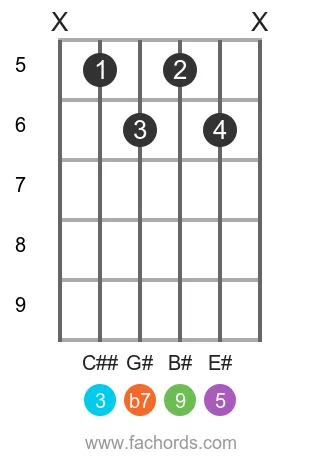
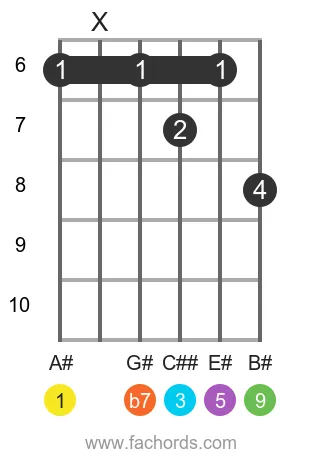
A# Dominant Ninth Guitar Chord Fingers Positions
Position 1
Open
Position 2
Movable
Position 3
Barre
Movable
 Find more shapes in our all guitar chords online library. If you
prefer a printable pdf, download
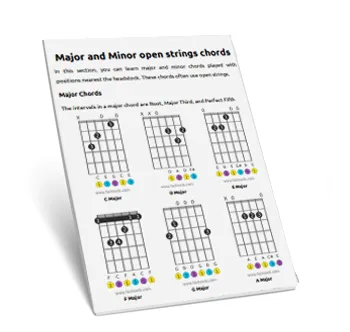
the Free Guitar Chords Chart Pdf
Find more shapes in our all guitar chords online library. If you
prefer a printable pdf, download
the Free Guitar Chords Chart Pdf
You can also use this accessible A#9 chord page, with written diagram instructions and screen-reader support for blind users.

Created by
Giancarlo is a musician (teaching guitar since 2000), software engineer, AI consultant and published researcher
FAQ
What defines the A#9 chord as a member of the Dominant Chords family?
The A#9 chord is identified as a dominant chord primarily by the inclusion of its minor seventh (b7) interval, which in this case is G#. This interval creates a characteristic tension that typically seeks to resolve, a hallmark of dominant harmony.
What are the specific notes and intervals that form an A#9 chord?
The A#9 chord is built from the notes A#, C##, E#, G#, and B#. These correspond to the intervals of the Root (1), Major Third (3), Perfect Fifth (5), Minor Seventh (b7), and Major Ninth (9) respectively.
Why are the notes C## and E# used in the A#9 chord instead of simpler enharmonic equivalents?
In music theory, intervals are named according to their scale degree. For an A# chord, the third interval must be some form of C, and the fifth some form of E. Using C## ensures it is recognized as a third, and E# as a fifth, preserving the theoretical structure of the chord's intervals (1, 3, 5, b7, 9) consistently within the A# scale.
What is the role of the '9' interval in an A#9 chord compared to the 'b7'?
The 'b7' (minor seventh) interval is fundamental to defining the chord as a dominant type, providing its characteristic tension. The '9' (major ninth) is an upper extension that adds richness, color, and a jazzy flavor to the dominant sound, creating a more complex and expansive harmony.