Abm11 Guitar Chord | Play, Hear and Practice Interactively
Want a structured chord roadmap instead of jumping between pages?
Go to the full guitar chords tutorial.
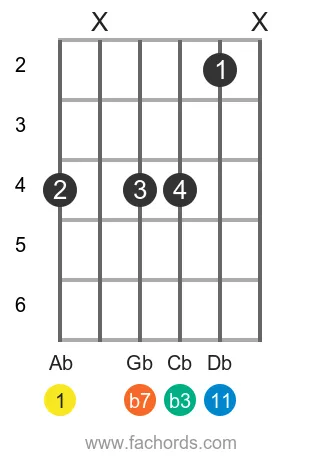
The Ab m11 chord is a beautiful and complex chord belonging to the Minor Chords family. It is composed of the notes Ab, Cb, Eb, Gb, Bb, and Db, built using specific musical intervals: Root (1), Minor Third (b3), Perfect Fifth (5), Minor Seventh (b7), Major Ninth (9), and Perfect Eleventh (11). Use the interactive fretboard tool at the top of this page to visualize every fingering, listen to the chord played as a strum or arpeggio, and check your own playing with the real-time microphone feedback.
Understanding these intervals and how they stack together is crucial for mastering the Ab m11 chord and other complex structures. As an 11th chord, it builds upon a 9th chord structure; you can explore this further in our guide to Ninth Chords. For a deeper dive into how chords are built from intervals, check out our Chord Construction tutorial. Many advanced chords, including the Abm11, often involve movable shapes, so our Guitar Bar Chords guide can be very helpful. Once you're comfortable with the shapes, focus on improving your chord changes to integrate it smoothly into your playing.
Below, you'll discover 20 chord diagrams ranked from the easiest open positions to more challenging movable shapes, alongside music theory explanations, songs that feature the Abm11, and the keys where it commonly appears. Before you delve into the diagrams, take a moment to use the interactive tool above. Set a comfortable tempo with the drum and BPM tool, strum the chord, and let the mic feedback confirm your finger placement. This hands-on, real-time practice loop is the most effective way to truly internalize this chord.
Notes of the Ab m11 chord:
Chord formula for the Minor Eleventh chord:
Guitar Patterns for the Ab Minor Eleventh chord
Position 1
Movable
 Find more shapes in our all guitar chords online library. If you
prefer a printable pdf, download
the Free Guitar Chords Chart Pdf
Find more shapes in our all guitar chords online library. If you
prefer a printable pdf, download
the Free Guitar Chords Chart Pdf
You can also use this accessible Abm11 chord page, with written diagram instructions and screen-reader support for blind users.

Created by
Giancarlo is a musician (teaching guitar since 2000), software engineer, AI consultant and published researcher
FAQ
What makes the Ab m11 chord an 'm11' specifically?
The 'm11' designation for the Ab m11 chord indicates that it's a minor chord with extensions up to the eleventh. The 'm' specifically refers to the presence of a minor third (b3) and a minor seventh (b7) interval, while the '11' signifies that the chord includes the ninth (9) and eleventh (11) intervals stacked upon the root, b3, 5, and b7.
Why are the notes Ab, Cb, Eb, Gb, Bb, Db used for Abm11, especially Cb and Db?
These specific notes are carefully chosen to represent the correct musical intervals when building an Ab m11 chord. Cb is used as the minor third (b3) above Ab, rather than B natural, to maintain theoretical consistency in interval spelling. Similarly, Db is the perfect eleventh (11) above Ab. This precise naming ensures the correct melodic and harmonic relationships are defined within the chord structure.
What does it mean for Ab m11 to be considered a 'minor chord'?
The Ab m11 chord is classified as a minor chord because its foundational interval, the third, is a minor third (Cb) relative to its root (Ab). This crucial minor third interval establishes the chord's characteristic minor quality, even with the addition of more complex extensions like the ninth and eleventh.
Given that the Ab m11 chord has six notes, is it always necessary to play all of them on the guitar?
While the Ab m11 chord theoretically comprises six distinct notes (Ab, Cb, Eb, Gb, Bb, Db), it's often not practical or even possible to play every single note simultaneously on a guitar due to string limitations and finger positioning. Guitarists commonly use various voicings for this chord, which may involve omitting certain notes (such as the 5th or even the root in some contexts) while still retaining the essential intervals like the root, minor third, minor seventh, and eleventh to preserve the chord's characteristic sound.
When and where is the Ab m11 chord typically used in music?
The Ab m11 is a rich and complex chord that adds sophistication and color to musical arrangements. It is particularly prevalent in jazz music, where advanced harmonies and intricate chord progressions are common, though it can also be found in other genres that utilize extended chords for a lush, nuanced sound.
How do the listed intervals (1, b3, 5, b7, 9, 11) translate to the specific notes (Ab, Cb, Eb, Gb, Bb, Db) in the Ab m11 chord?
Each interval describes the distance from the root note, Ab. Therefore: the 1 (Root) is Ab, the b3 (Minor Third) is Cb, the 5 (Perfect Fifth) is Eb, the b7 (Minor Seventh) is Gb, the 9 (Major Ninth) is Bb, and the 11 (Perfect Eleventh) is Db. These intervals are stacked to construct the complete Ab m11 chord.
