Ab9 Guitar Chord | Play, Hear and Practice Interactively
Want a structured chord roadmap instead of jumping between pages?
Go to the full guitar chords tutorial.
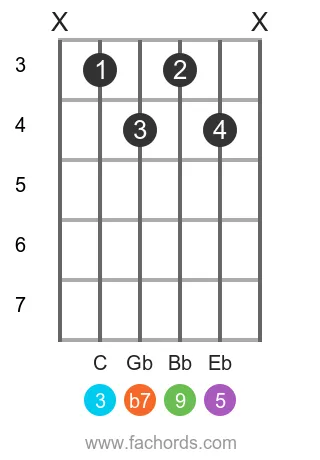
The Ab 9 chord, a rich member of the Dominant Chords family, is built from the notes Ab, C, Eb, Gb, and Bb. These correspond to the intervals Root (1), Major Third (3), Perfect Fifth (5), Minor Seventh (b7), and Major Ninth (9). Unlock the full potential of this chord with our interactive fretboard tool: visualize fingerings on the virtual fretboard, hear how it sounds with chord or arpeggio playback, and instantly verify your playing accuracy using real-time mic feedback.
Understanding how these intervals combine is key to mastering the Ab 9 chord's unique sound. As a dominant ninth, it adds depth and a jazzier feel to progressions. Dive deeper into its construction with our guide on Chord Construction. For a full understanding of its role in music, explore the larger family of Dominant Chords and specifically learn more about Ninth Chords. Once you're comfortable with the shapes, focus on improving your chord changes for seamless playing.
As you scroll down, you'll discover a collection of Ab 9 chord diagrams, presented from the easiest open positions to more advanced barre shapes. We also cover essential music theory, common songs that feature the Ab9, and the keys where you'll most often encounter it. Before you dive into the diagrams, take a moment to engage with the interactive tool above. Use the drum & BPM tool to set a practice tempo, play the chord, and let the mic feedback guide your hand. This hands-on practice is the fastest way to truly internalize the Ab9 chord and make it a natural part of your playing.
Notes that compose the Ab 9 chord:
Chord Structure:
Fingerings for the Ab Dominant Ninth guitar chord
Position 1
Movable
Position 2
Movable
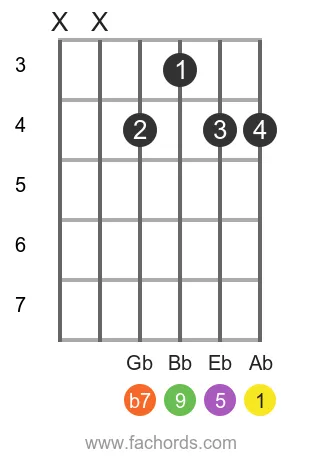
Position 3
Movable
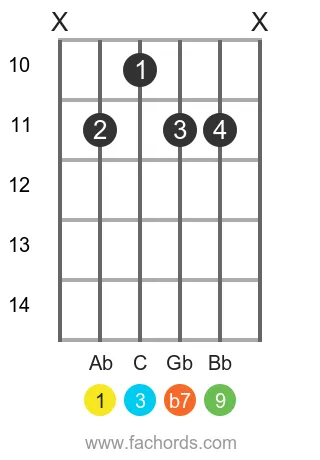
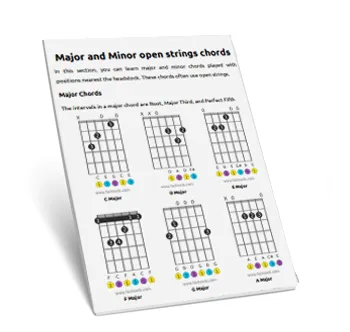
 Find more shapes in our all guitar chords online library. If you
prefer a printable pdf, download
the Free Guitar Chords Chart Pdf
Find more shapes in our all guitar chords online library. If you
prefer a printable pdf, download
the Free Guitar Chords Chart Pdf
You can also use this accessible Ab9 chord page, with written diagram instructions and screen-reader support for blind users.

Created by
Giancarlo is a musician (teaching guitar since 2000), software engineer, AI consultant and published researcher
FAQ
What notes are in an Ab 9 guitar chord?
The Ab 9 chord is composed of five distinct notes: Ab (the root), C (the major third), Eb (the perfect fifth), Gb (the minor seventh), and Bb (the major ninth). This combination creates its unique sound.
Which intervals are found in the Ab 9 chord?
The Ab 9 chord is constructed using five specific intervals relative to its root (Ab). These are the Root (1), Major Third (3), Perfect Fifth (5), Minor Seventh (b7), and Major Ninth (9).
What does it mean for the Ab 9 to be part of the "Dominant Chords" family?
Being part of the 'Dominant Chords' family means the Ab 9 chord plays a specific, crucial role in many musical compositions. Chords in this family often create a sense of movement or tension due to their characteristic interval structure, which includes a root, major third, and minor seventh, with the Ab 9 extending this further with a major ninth.
How does knowing the intervals help a guitarist master the Ab 9 chord?
Understanding the intervals (1, 3, 5, b7, 9) is key because it helps you grasp the underlying structure of the Ab 9 chord. Instead of just memorizing a shape, you'll know *why* specific notes (Ab, C, Eb, Gb, Bb) are played, allowing you to build the chord across the fretboard and apply this knowledge to other chords.
What does "chords are built by stacking intervals" mean for the Ab 9?
For the Ab 9 chord, 'stacking intervals' means starting with the root note (Ab) and then adding subsequent notes (C, Eb, Gb, Bb) by applying their specific interval distances above that root. This method systematically constructs the chord, adding the Major Third, Perfect Fifth, Minor Seventh, and Major Ninth in order.
What is the significance of the "9" in the Ab 9 chord name?
The "9" in "Ab 9" specifically indicates that the Major Ninth interval (Bb) is included in the chord, in addition to the root, major third, perfect fifth, and minor seventh. This extended interval adds a distinct, richer quality to the chord's sound compared to a simple Ab7.