How To Play Power Chords
The King Of Electric Guitar Chords
In this tutorial, we're going to learn everything we need to master Power Chords.
Power chords are fun and easy to play; they are the foundation of rock, punk and heavy music and sound great on an electric guitar with a bit of distortion. This kind of chord brings lots of energy to your sound, it's powerful indeed, so let's get rock!
Table Of Contents
What are Power Chords?
If you have studied some music theory, you should already know that chords can be major or minor (don't worry if this is not clear, we'll explain later).
Basic chords are composed of three notes; major chords are built with root, major third and perfect fifth, while minor chords are created by stacking root, minor third and perfect fifth.
So it's the third that gives the chord a major or minor feeling.
Power chords do not have the third, then they are neither major nor minor.
Power chords are composed of only two tones: the root, and the perfect fifth, which is 7 semitones (or half-steps, or frets) from the root.
Don't confuse Power chords with Suspended chords, which don't have the third as well, but have the fourth (sus4) or the second (sus2).
Power Chord are denoted with 5 (fifth). For example, C5 means a Power chord with root C.
Have a look at the diagrams below to better get what I mean:
Major, Minor and Power Chords Difference
Major Chord (1,3,5) e.g. C Maj
Minor Chord (1,b3,5) e.g. C Min
Suspended Chord (1,4,5) e.g. C Sus4
Power Chord (1,5) e.g. C5
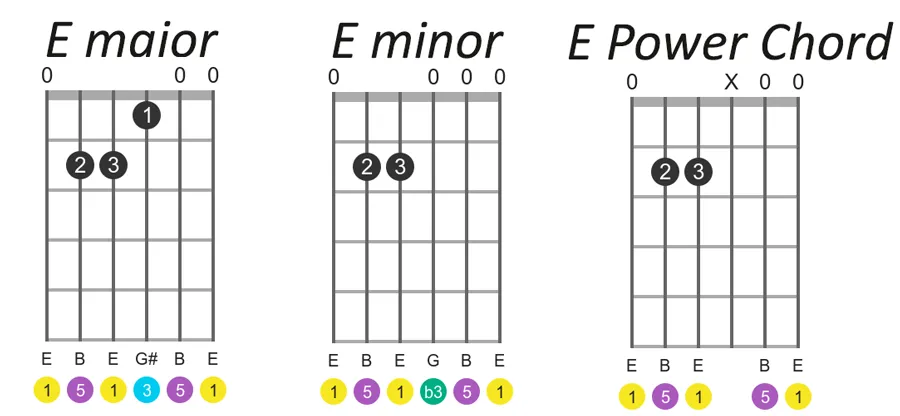
To turn a major or minor chord into a power chord, you simply mute the third:
A two-tones chord is immediate and easy to play (after proper training of course), so it's no mystery that power chords have been the cornerstone of rock, punk, and other types of energetic music for a long time.
Open And Movable Positions
Open positions use open strings, and they have the full and rich sound typical of open string. We can play power chords in open position on the lowest E string, A string and D string (you find instruction on how to read chord diagrams here):
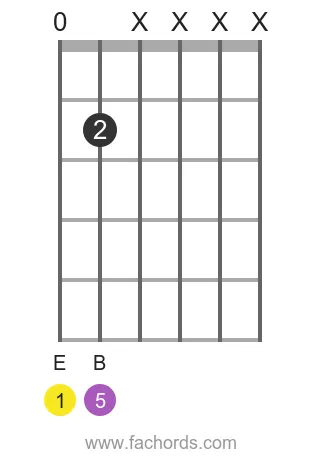
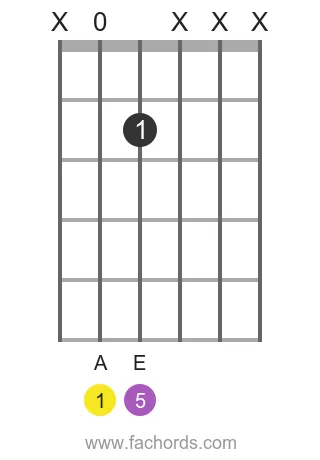
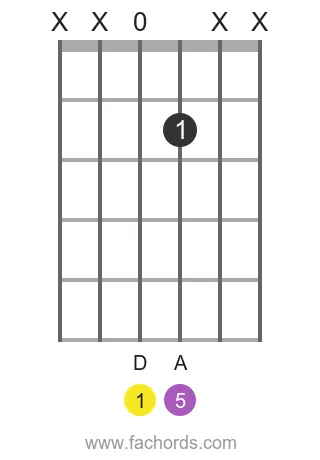
But Power chords give their best with movable shapes: you can basically play any chord on the E, A and D string, by shifting up and down the same exact shape, as shown in the next section.
How to Play Guitar Power Chords
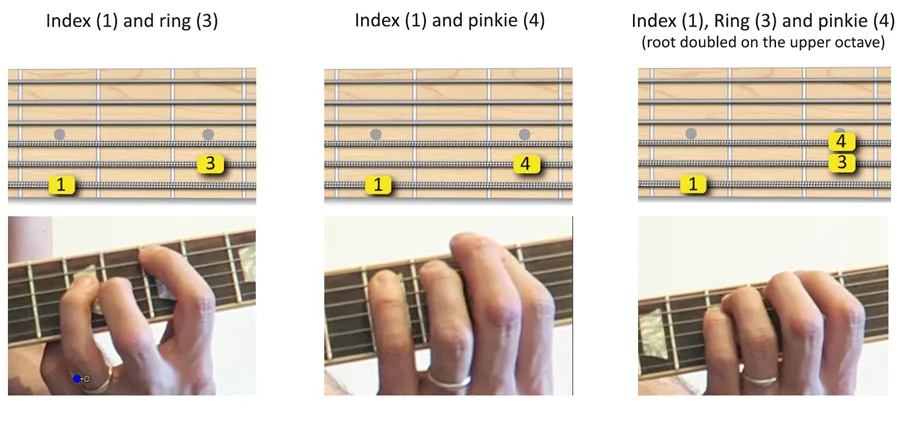
There are 3 ways to fret a power chord:
- Use the index finger to fret the root, and the ring finger to fret the fifth
- Use the index finger to fret the root, and the pinkie to fret the fifth
- Use the index finger to fret the root, and the ring finger to fret the fifth, and the pinkie to fret the root on the upper octave.
Some folks use a small barre with the ring finger to fret the fifth and the upper octave, but it's a clumsy position.
Please keep in mind that even if a shape is composed of 3 notes, it's still a two tones power chord (root and fifth); the root is simply played two times on different octaves:
Strings And Palm Muting
 This chord is often used in rock, punk and
heavy metal, that means electric guitars with distortion effects.
This chord is often used in rock, punk and
heavy metal, that means electric guitars with distortion effects.
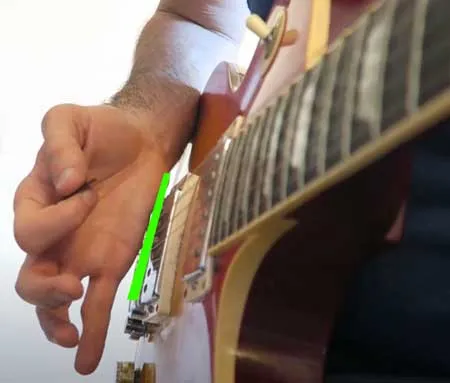
So it's crucial to mute the unused strings to prevent unwanted noise. You can use the free fingers of your left hand, and the palm of your right hand.
This last technique is called palm muting and creates the percussive effect typical of heavy metal rhythmic guitars. Have a look at the video for a practical demonstration of palm muting.
Power Chords on 6th and 5h Strings

The picture above shows you the notes on the E and A strings. These notes could be the root of any power chord you want to play, so you should memorize these locations.
Indeed, Power Chords give their best on these two lowest strings. Of course, it's possible to play the chords on higher strings, but the sound is less full and rich.
Also be careful that with shapes across the 4th and 5th strings it's necessary to adapt the fingerings, because of the way the guitar is tuned.
Power Chords and the 1-4-5 Progression
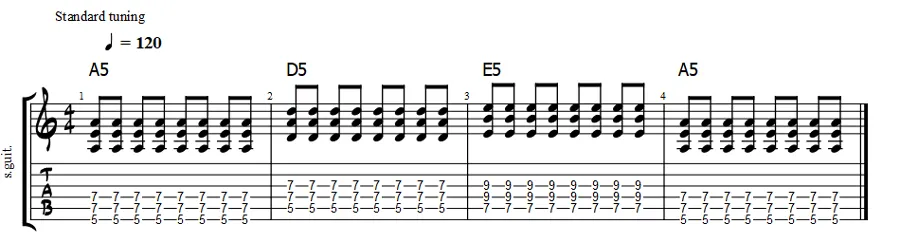
A great way to feel the real power of this kind of chord is to play the eternal rock progression 1-4-5.
Try to experiment with different rhythmic division, syncopation, and palm muting patterns.
How to Build Extensions on Power Chords

We can change the fingering a bit and add another note to add our Power chords a new tension: enter the second (or ninth) degree.
These are not easy shapes because they require a little bit of left-hand stretch, as you can see in the diagram above.
These chords are called Suspensed Second chords, because they are formed by 1,2 and 5.
Great examples of this chord in action can be found in many songs of John Petrucci, Dream Theater's guitarist.
Every Breath You Take by Police starts with a Sus2 power chord as well.
Power Chords In Classic And Baroque Music
Despite being a trademark of electric, powerful music, power chords have been used in old times by classical composers.
Of course they did not use the modern term "Power chord", but Fifth Chord.
The fact that they are neither major nor minor provides an ambiguity that can be useful in certain situations:
- Carl Orff's Carmina Burana
- Richard Strauss' Also Sprach Zarathustra
How To Play Power Chords: Conclusions
In this tutorial, we have seen what are Power chords, how they sound, how to play them across the entire fretboard, as well as some interesting variations and applications.
Now you should have a new weapon useful to create the next rock hit; to stay updated subscribe here
FAQ
What is the fundamental difference between a power chord and a major or minor chord?
The fundamental difference is that power chords do not contain a 'third' note. Major and minor chords are defined by whether they have a major or minor third, respectively. By omitting this third, power chords are neither major nor minor, consisting only of the root and the perfect fifth.
How many notes does a power chord actually contain, and how are they named?
A power chord fundamentally consists of only two tones: the root and the perfect fifth. Although some common guitar shapes involve playing the root an octave higher, making it a three-note shape, it's still considered a two-tone chord. Power chords are typically denoted with a '5' after the root note, such as C5 for a C power chord.
Why are power chords so prevalent in rock, punk, and heavy music genres?
Power chords are a cornerstone of these genres because they are easy to play, bring significant energy, and sound particularly powerful on an electric guitar with distortion. Their two-tone structure is immediate and effective, contributing to the aggressive and driving sound characteristic of these styles.
What are the common fingering options for playing power chords on the guitar?
There are three primary ways to fret a power chord: using the index finger for the root and the ring finger for the fifth; using the index finger for the root and the pinky for the fifth; or using the index for the root, the ring for the fifth, and the pinky for the root on the upper octave.
How can I prevent unwanted string noise when playing power chords, especially with distortion?
To prevent unwanted noise, it's crucial to mute unused strings. This can be done with the free fingers of your fretting hand gently touching adjacent strings. Additionally, a technique called 'palm muting' involves resting the edge of your picking hand's palm near the bridge to dampen the strings, creating a percussive effect often used in heavy metal.
Can I play power chords on any set of strings, or are there preferred positions?
While power chords can be played on various string sets, they generally sound fullest and richest when played on the lowest E and A strings. Playing them on higher strings might result in a less full sound. Also, be aware that fingerings for shapes crossing the 4th and 5th strings may require adaptation due to the guitar's tuning.
Is it possible to add extensions or variations to a basic power chord?
Yes, you can add extensions to power chords. One common variation is to add the second (or ninth) degree to the root and fifth, creating a 'Suspended Second' (sus2) chord. This involves a slightly different fingering that might require a small left-hand stretch, adding a new tension to the chord's sound.